Refine search
Actions for selected content:
26076 results in Abstract analysis
An Integral Involving a Product of Two Modified Bessel Functions of the Second Kind
-
- Journal:
- Proceedings of the Glasgow Mathematical Association / Volume 2 / Issue 2 / October 1954
- Published online by Cambridge University Press:
- 18 May 2009, pp. 85-88
-
- Article
-
- You have access
- Export citation
-
The formula to be proved is
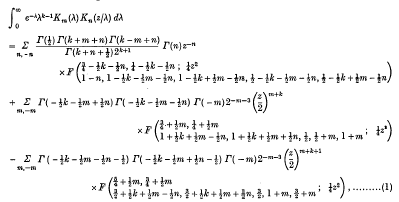
where R(z)>0.
Spectral operators and weakly compact homomorphisms in a class of Banach Spaces
-
- Journal:
- Glasgow Mathematical Journal / Volume 28 / Issue 2 / July 1986
- Published online by Cambridge University Press:
- 18 May 2009, pp. 215-222
-
- Article
-
- You have access
- Export citation
The Stress on the boundary of an elastic half-plane in which body forces are acting
-
- Journal:
- Proceedings of the Glasgow Mathematical Association / Volume 7 / Issue 1 / January 1965
- Published online by Cambridge University Press:
- 18 May 2009, pp. 48-54
-
- Article
-
- You have access
- Export citation
Macbeath's Curve and the Modular Group
-
- Journal:
- Glasgow Mathematical Journal / Volume 28 / Issue 2 / July 1986
- Published online by Cambridge University Press:
- 18 May 2009, p. 241
-
- Article
-
- You have access
- Export citation
Some inclusion theorems
-
- Journal:
- Proceedings of the Glasgow Mathematical Association / Volume 6 / Issue 4 / July 1964
- Published online by Cambridge University Press:
- 18 May 2009, pp. 161-168
-
- Article
-
- You have access
- Export citation
Lattice subgroups of free congruence groups
-
- Journal:
- Glasgow Mathematical Journal / Volume 10 / Issue 2 / July 1969
- Published online by Cambridge University Press:
- 18 May 2009, pp. 106-115
-
- Article
-
- You have access
- Export citation
-
Let Г(1) denote the homogeneous modular group of 2 × 2 matrices with integral entries and determinant 1. Let
 (1) be the inhomogeneous modular group of 2 × 2 integral matrices of determinant 1 in which a matrix is identified with its negative. (N), the principal congruence subgroup of level N, is the subgroup of (1) consisting of all T ∈ (1) for which T ≡ ± I (mod N), where N is a positive integer and I is the identity matrix. A subgroup
  of (1) is said to be a congruence group of level N if contains (N) and N is the least such integer. Similarly, we denote by Г(N) the principal congruence subgroup of level N of Г(1), consisting of those T∈(1) for which T ≡ I (mod N), and we say that a sub group of Г(1) is a congruence group of level N if contains Г (N) and N is minimal with respect to this property. In a recent paper [9] Rankin considered lattice subgroups of a free congruence subgroup
  of rank n of (1). By a lattice subgroup of we mean a subgroup of which contains the commutator group
  . In particular, he showed that, if is a congruence group of level N and if is a lattice congruence subgroup of of level qr, where r is the largest divisor of qr prime to N, then N divides q and r divides 12. He then posed the problem of finding an upper bound for the factor q. It is the purpose of this paper to find such an upper bound for q. We also consider bounds for the factor r.
 (1) be the inhomogeneous modular group of 2 × 2 integral matrices of determinant 1 in which a matrix is identified with its negative.
  of
of  of rank n of
  . In particular, he showed that, if
 A Note on the Classes of Non-Linear Semi-Special Permutations
-
- Journal:
- Proceedings of the Glasgow Mathematical Association / Volume 4 / Issue 1 / December 1958
- Published online by Cambridge University Press:
- 18 May 2009, pp. 3-6
-
- Article
-
- You have access
- Export citation
A test for commutators
-
- Journal:
- Glasgow Mathematical Journal / Volume 17 / Issue 1 / January 1976
- Published online by Cambridge University Press:
- 18 May 2009, pp. 31-36
-
- Article
-
- You have access
- Export citation
-
In the course of a study of commutator subgroups I. D. Macdonald [1] presented the free nilpotent group G4 of class 2 on 4 generators as an example of a nilpotent group whose commutator subgroup has elements that are not commutators. To demonstrate this he proceeded as follows: let G4 = 〈a1, a2, a3, a4〉 and put cij = [ai, aj] for 1 ≦ i < j ≦ 4. Then the relations in G4 are [cij, ak] = 1 for 1 ≦ i < j ≦ 4 and 1 ≦ k ≦ 4, and their consequences. Macdonald observed that an arbitrary commutator may be written as

which simplifies to

where δij = αiβj - αjβi The indices δij satisfy the relation

It follows that the element c13c24 in G′4 (for which δ12 = δ14 = δ23 = δ34 = 0 and δ13 = δ24 = 1) is not a commutator.

Semilocal semigroup rings
-
- Journal:
- Glasgow Mathematical Journal / Volume 25 / Issue 1 / January 1984
- Published online by Cambridge University Press:
- 18 May 2009, pp. 37-44
-
- Article
-
- You have access
- Export citation
The smallest proper congruence on S(X)
-
- Journal:
- Glasgow Mathematical Journal / Volume 30 / Issue 3 / September 1988
- Published online by Cambridge University Press:
- 18 May 2009, pp. 301-313
-
- Article
-
- You have access
- Export citation
Periodic radical products of two locally nilpotent subgroups†
-
- Journal:
- Glasgow Mathematical Journal / Volume 40 / Issue 2 / May 1998
- Published online by Cambridge University Press:
- 18 May 2009, pp. 241-255
-
- Article
-
- You have access
- Export citation
On the non-albelian tensor square of a nilpotent group of class two
-
- Journal:
- Glasgow Mathematical Journal / Volume 36 / Issue 3 / September 1994
- Published online by Cambridge University Press:
- 18 May 2009, pp. 291-296
-
- Article
-
- You have access
- Export citation
-
The nonabelian tensor square G⊗G of a group G is generated by the symbols g⊗h, g, h ∈ G, subject to the relations
 ,
,for all g, g′, h, h′ ∈ G, where
 The tensor square is a special case of the nonabelian tensor product which has its origins in homotopy theory. It was introduced by R. Brown and J. L. Loday in [4] and [5], extending ideas of Whitehead in [6].
 The tensor square is a special case of the nonabelian tensor product which has its origins in homotopy theory. It was introduced by R. Brown and J. L. Loday in [
On Certain Types of Solution of the Equation of Heat Conduction
-
- Journal:
- Proceedings of the Glasgow Mathematical Association / Volume 1 / Issue 1 / January 1952
- Published online by Cambridge University Press:
- 18 May 2009, pp. 48-52
-
- Article
-
- You have access
- Export citation
-
Let f(x, y, z, t) satisfy the equation

For certain purposes, particularly in connection with the propagation of a boundary of fusion etc., it is of interest to discover solutions of (1) which permit the equation:

to be solved explicitly in the form:

This suggests the examination of solutions of the type

where

and f, ϕ, ψ are functions to be determined. To save repetition, Roman capitals denote arbitrary constants throughout.
Conjugacy classes in sylow p-subgroups of GL(n, q), IV†
-
- Journal:
- Glasgow Mathematical Journal / Volume 36 / Issue 1 / January 1994
- Published online by Cambridge University Press:
- 18 May 2009, pp. 91-96
-
- Article
-
- You have access
- Export citation
-
In this paper we give new information about the conjugacy vector of the group
 , the Sylow p-subgroup of GL(n, q) consisting of the upper unitriangular matrices. The first two components of this vector are given in [4]. Here, we obtain the third component, that is, the number of conjugacy classes whose centralizer has qn+l elements. Besides, we give the whole set of numbers which compose this vector:
 , the Sylow p-subgroup of GL(n, q) consisting of the upper unitriangular matrices. The first two components of this vector are given in [4]. Here, we obtain the third component, that is, the number of conjugacy classes whose centralizer has q
On the adjoint group of some radical rings
-
- Journal:
- Glasgow Mathematical Journal / Volume 39 / Issue 1 / January 1997
- Published online by Cambridge University Press:
- 18 May 2009, pp. 35-41
-
- Article
-
- You have access
- Export citation
A Note on Integer Solutions of the Diophantine Equation x2-dy2=1
-
- Journal:
- Proceedings of the Glasgow Mathematical Association / Volume 3 / Issue 1 / December 1956
- Published online by Cambridge University Press:
- 18 May 2009, pp. 55-56
-
- Article
-
- You have access
- Export citation
-
In the equation

dis any positive integer which is not a perfect square. For convenience we shall consider only those solutions of (1) for which x and yare both positive. All the others can be obtained from these. In fact, it is well known that if (x0, y0) is the minimum positive integer solution of (1), then all integer solutions (x, y) are given by

and, in particular, all positive integer solutions are given by

GMJ volume 4 issue 1 Cover and Back matter
-
- Journal:
- Proceedings of the Glasgow Mathematical Association / Volume 4 / Issue 1 / December 1958
- Published online by Cambridge University Press:
- 18 May 2009, pp. b1-b2
-
- Article
-
- You have access
- Export citation
Integrals Involving a Modified Bessel Function of the Second Kind and an E-Function
-
- Journal:
- Proceedings of the Glasgow Mathematical Association / Volume 2 / Issue 2 / October 1954
- Published online by Cambridge University Press:
- 18 May 2009, pp. 93-96
-
- Article
-
- You have access
- Export citation
-
The first formula to be proved is
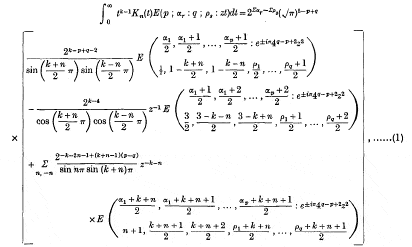
where p ≧ q + 1, | amp z | < л, R(k±n + αr)>0, r = l, 2, …, p. For other values of p and q the result is valid if the integral is convergent. A second formula is given in § 3.
The following formulae are required in the proof:
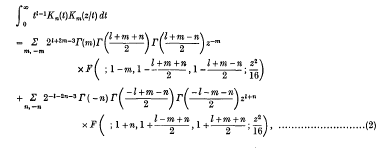
where R(z);>0, (1);

where R(α)>0, | amp z | < л, (2);

where the contour starts from -∞ on the ξ-axis, passes round the origin in the positive direction, and ends at -∞ on the ξ-axis, the initial value of amp ζ being - л, (3).
GMJ volume 8 issue 2 Cover and Back matter
-
- Journal:
- Glasgow Mathematical Journal / Volume 8 / Issue 2 / July 1967
- Published online by Cambridge University Press:
- 18 May 2009, pp. b1-b2
-
- Article
-
- You have access
- Export citation
GMJ volume 2 issue 4 Cover and Front matter
-
- Journal:
- Proceedings of the Glasgow Mathematical Association / Volume 2 / Issue 4 / February 1956
- Published online by Cambridge University Press:
- 18 May 2009, pp. f1-f2
-
- Article
-
- You have access
- Export citation
