Refine search
Actions for selected content:
26076 results in Abstract analysis
On a class of operators
-
- Journal:
- Glasgow Mathematical Journal / Volume 40 / Issue 2 / May 1998
- Published online by Cambridge University Press:
- 18 May 2009, pp. 237-240
-
- Article
-
- You have access
- Export citation
Character sums and small eigenvalues for Г0(p)
-
- Journal:
- Glasgow Mathematical Journal / Volume 27 / October 1985
- Published online by Cambridge University Press:
- 18 May 2009, pp. 99-116
-
- Article
-
- You have access
- Export citation
-
Let Δ denote the Laplace operator acting on the space L2(Г/H) of automorphic functions with respect to a congruence group Г, square integrable over the fundamental domain F=Г/H. It is known that Δ has a point spectrum

with (Weyl's law)
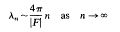
and it has a purely continuous spectrum on [¼,∞) of finite multiplicity equal to the number of inequivalent cusps. The eigenpacket of the continuous spectrum is formed by the Eisenstein series Ea(z, s) on s = ½+it where a ranges over inequivalent cusps. The eigenfunctions ui(z) with positive eigenvalues are Maass cusp forms.
On the radical of a group algebra over a commutative ring
-
- Journal:
- Glasgow Mathematical Journal / Volume 18 / Issue 1 / January 1977
- Published online by Cambridge University Press:
- 18 May 2009, pp. 101-104
-
- Article
-
- You have access
- Export citation
The number of irreducible tournaments
-
- Journal:
- Glasgow Mathematical Journal / Volume 11 / Issue 2 / July 1970
- Published online by Cambridge University Press:
- 18 May 2009, pp. 97-101
-
- Article
-
- You have access
- Export citation
-
An n-tournament is a set of n labelled points, each pair A, B of which is joined either by the oriented line AB or by the oriented line BA. There are N = n(n –1)/2 such pairs and so Fn different n-tournaments, where Fn = 2N. A tournament is reducible if the points can be separated into two non-empty subsets
 and ℬ, such that every line joining a point in to a point in ℬ is directed towards the point in ℬ. Rado [3] showed that an irreducible tournamentis strongly connected; i.e. for every ordered pair of points A, B, there is a sequence of correctly oriented lines AC1, C1C2, …, ChB in the tournament, and conversely that a strongly connected tournament is irreducible.
 and ℬ, such that every line joining a point in
 The kernel and trace operators for ideal extensions of regular semigroups
-
- Journal:
- Glasgow Mathematical Journal / Volume 36 / Issue 2 / May 1994
- Published online by Cambridge University Press:
- 18 May 2009, pp. 219-231
-
- Article
-
- You have access
- Export citation
Factorization and congruence in the arithmetics of Cayley's algebra
-
- Journal:
- Glasgow Mathematical Journal / Volume 33 / Issue 2 / May 1991
- Published online by Cambridge University Press:
- 18 May 2009, pp. 171-180
-
- Article
-
- You have access
- Export citation
Semiprime semigroup rings and a problem of J. Weissglass
-
- Journal:
- Glasgow Mathematical Journal / Volume 21 / Issue 1 / January 1980
- Published online by Cambridge University Press:
- 18 May 2009, pp. 131-134
-
- Article
-
- You have access
- Export citation
On the homotopy property of degree for multivalued noncompact maps
-
- Journal:
- Glasgow Mathematical Journal / Volume 21 / Issue 2 / July 1980
- Published online by Cambridge University Press:
- 18 May 2009, pp. 125-130
-
- Article
-
- You have access
- Export citation
On asymptotic values of certain sets of attached prime ideals
-
- Journal:
- Glasgow Mathematical Journal / Volume 30 / Issue 3 / September 1988
- Published online by Cambridge University Press:
- 18 May 2009, pp. 293-300
-
- Article
-
- You have access
- Export citation
Extension of partial endomorphisms of abelian groups
-
- Journal:
- Proceedings of the Glasgow Mathematical Association / Volume 6 / Issue 1 / January 1963
- Published online by Cambridge University Press:
- 18 May 2009, pp. 45-48
-
- Article
-
- You have access
- Export citation
-
It is known [1] that for a partial endomorphism μ of a group G that maps the subgroup A ⊆ G onto B ⊆ G. G to be extendable to a total endomorphism μ* of a supergroup G* ⊆ G such that μ an isomorphism on G*(μ*)m for some positive integer m, it is necessary and sufficient that there exist in G a sequence of normal subgroups

such that L1 ƞA is the kernel of μ and

for ι = 1, 2,…, m–1.
The question then arises whether these conditions could be simplified when the group G is abelian. In this paper it is shown not only that the conditions are simplified when Gis abelian but also that the extension group G*⊇G can be chosen as an abelian group.
Prime and semiprime semigroup rings of cancellative semigroups
-
- Journal:
- Glasgow Mathematical Journal / Volume 35 / Issue 1 / January 1993
- Published online by Cambridge University Press:
- 18 May 2009, pp. 1-12
-
- Article
-
- You have access
- Export citation
A note on comonotonic additivity
-
- Journal:
- Glasgow Mathematical Journal / Volume 38 / Issue 2 / May 1996
- Published online by Cambridge University Press:
- 18 May 2009, pp. 199-205
-
- Article
-
- You have access
- Export citation
A metrical result on the discrepancy of (nα)
-
- Journal:
- Glasgow Mathematical Journal / Volume 40 / Issue 3 / September 1998
- Published online by Cambridge University Press:
- 18 May 2009, pp. 393-425
-
- Article
-
- You have access
- Export citation
-
In the following let Ω be the set of irrational numbers in the interval [0,1] and let λ be Lebesgue measure restricted to Ω. For any real number x, let {x} = x - [x] be the fractional part of x. Let N be anatural number and let α e Ω. Then

is known as the discrepancy of the sequence (nα)n>1 modulo 1; here c[x, y) denotes the characteristic function of the interval [x, y).
A problem on the Riesz-Dunford operator calculus and convex univalent functions
-
- Journal:
- Glasgow Mathematical Journal / Volume 24 / Issue 2 / July 1983
- Published online by Cambridge University Press:
- 18 May 2009, pp. 129-130
-
- Article
-
- You have access
- Export citation
Characterizations of right Nakayama rings
-
- Journal:
- Glasgow Mathematical Journal / Volume 34 / Issue 1 / January 1992
- Published online by Cambridge University Press:
- 18 May 2009, pp. 91-102
-
- Article
-
- You have access
- Export citation
The group of isometries on Hardy spaces of the n-ball and the polydisc
-
- Journal:
- Glasgow Mathematical Journal / Volume 21 / Issue 2 / July 1980
- Published online by Cambridge University Press:
- 18 May 2009, pp. 199-204
-
- Article
-
- You have access
- Export citation
GMJ volume 6 issue 1 Cover and Back matter
-
- Journal:
- Proceedings of the Glasgow Mathematical Association / Volume 6 / Issue 1 / January 1963
- Published online by Cambridge University Press:
- 18 May 2009, pp. b1-b2
-
- Article
-
- You have access
- Export citation
Strong limits of normal operators
-
- Journal:
- Glasgow Mathematical Journal / Volume 24 / Issue 1 / January 1983
- Published online by Cambridge University Press:
- 18 May 2009, pp. 93-96
-
- Article
-
- You have access
- Export citation
Factoring absolutely summing operators through Hilbert-Schmidt operators
-
- Journal:
- Glasgow Mathematical Journal / Volume 31 / Issue 2 / May 1989
- Published online by Cambridge University Press:
- 18 May 2009, pp. 131-135
-
- Article
-
- You have access
- Export citation
A spectral mapping theorem for the Weyl spectrum
-
- Journal:
- Glasgow Mathematical Journal / Volume 38 / Issue 1 / January 1996
- Published online by Cambridge University Press:
- 18 May 2009, pp. 61-64
-
- Article
-
- You have access
- Export citation
-
Suppose H is a Hilbert space and write ℒ(H) for the set of all bounded linear operators on H. If T ∈ ℒ(H) we write σ(T) for the spectrum of T; π0(T) for the set of eigenvalues of T; and π00(T) for the isolated points of σ(T) that are eigenvalues of finite multiplicity. If K is a subset of C, we write iso K for the set of isolated points of K. An operator T ∈ ℒ(H) is said to be Fredholm if both T−1(0) and T(H)⊥ are finite dimensional. The index of a Fredholm operator T, denoted by index(T), is defined by

