Refine search
Actions for selected content:
26076 results in Abstract analysis
An estimate on the eigenvalues in bifurcation for gradient mappings
-
- Journal:
- Glasgow Mathematical Journal / Volume 39 / Issue 2 / May 1997
- Published online by Cambridge University Press:
- 18 May 2009, pp. 211-216
-
- Article
-
- You have access
- Export citation
-
Let H be a real Hilbert space and let A: H→H be a nonlinear operator such that A(0) = 0. We consider the eigenvalue problem

Recall that λ0 ε ℝ is said to be a bifurcation point for (1.1) if every neighbourhood of (λ0, 0) in ℝ × H contains solutions of (1.1).
On the nilpotent ranks of certain semigroups of transformations
-
- Journal:
- Glasgow Mathematical Journal / Volume 36 / Issue 1 / January 1994
- Published online by Cambridge University Press:
- 18 May 2009, pp. 1-9
-
- Article
-
- You have access
- Export citation
-
Let Pn be the semigroup of all partial transformations on the set Xn = {1,…, n}. As usual, we shall say that an element α in Pn is of type (k, r) or belongs to the set [k, r] if |dom α|=k and |lim α|. The completion α* of an element α ∈ [n − 1, n − 1] is an element in [n, n] defined by

where {i} = Xn∖dom α and {j} = Xn∖im α.
A note on liftings of hermitian elements and unitaries
-
- Journal:
- Glasgow Mathematical Journal / Volume 21 / Issue 1 / January 1980
- Published online by Cambridge University Press:
- 18 May 2009, pp. 183-185
-
- Article
-
- You have access
- Export citation
On a Theorem on Ordered Groups
-
- Journal:
- Proceedings of the Glasgow Mathematical Association / Volume 4 / Issue 1 / December 1958
- Published online by Cambridge University Press:
- 18 May 2009, pp. 16-21
-
- Article
-
- You have access
- Export citation
On commutativity of C*-algebras
-
- Journal:
- Glasgow Mathematical Journal / Volume 29 / Issue 1 / January 1987
- Published online by Cambridge University Press:
- 18 May 2009, pp. 93-97
-
- Article
-
- You have access
- Export citation
-
Two numerical characterizations of commutativity for C*-algebra
 (acting on the Hilbert space H) were given in [1]; one used the norms of self-adjoint operators in (Theorem 2), and the other the numerical index of (Theorem 3). In both cases the proofs were based on the result of Kaplansky which states that if the only nilpotent operator in is 0, then is commutative ([2] 2.12.21, p. 68). Of course the converse also holds.
 (acting on the Hilbert space H) were given in [1]; one used the norms of self-adjoint operators in
 Some dual integral equations involving inverse finite Mellin transforms
-
- Journal:
- Glasgow Mathematical Journal / Volume 14 / Issue 2 / September 1973
- Published online by Cambridge University Press:
- 18 May 2009, pp. 179-184
-
- Article
-
- You have access
- Export citation
Support projections on Banach spaces
-
- Journal:
- Glasgow Mathematical Journal / Volume 18 / Issue 1 / January 1977
- Published online by Cambridge University Press:
- 18 May 2009, pp. 13-15
-
- Article
-
- You have access
- Export citation
-
Each bounded linear operator a on a Hilbert space K has a hermitian left-support projection p such that
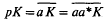 and (1 – p)K = ker α* = ker αα*. I demonstrate here that certain operators on Banach spaces also have left supports.
Throughout this paper X will be a complex Banach space with norm-dual X', and L(X) will be the Banach algebra of bounded linear operators on X. Two linear subspaces Y and Z of X are orthogonal (in the sense of G. Birkhoff) if ∥ y ∥ ≦ ∥ y + z ∥ (y ∈Y, z ∈ Z); this orthogonality relation is not, in general, symmetric. It is easy to see that pX is orthogonal to (1 – p)X if and only if the norm of p is 0 or 1, when p is a projection on X.
 and (1 – p)K = ker α* = ker αα*. I demonstrate here that certain operators on Banach spaces also have left supports.
Axiomatisations of the average and a further generalisation of monotonic sequences
-
- Journal:
- Glasgow Mathematical Journal / Volume 15 / Issue 1 / March 1974
- Published online by Cambridge University Press:
- 18 May 2009, pp. 63-65
-
- Article
-
- You have access
- Export citation
A characterization of artinian rings
-
- Journal:
- Glasgow Mathematical Journal / Volume 30 / Issue 1 / January 1988
- Published online by Cambridge University Press:
- 18 May 2009, pp. 67-73
-
- Article
-
- You have access
- Export citation
On some infinite series involving the zeros of Bessel functions of the first kind
-
- Journal:
- Proceedings of the Glasgow Mathematical Association / Volume 4 / Issue 3 / January 1960
- Published online by Cambridge University Press:
- 18 May 2009, pp. 144-156
-
- Article
-
- You have access
- Export citation
-
In this paper we shall be concerned with the derivation of simple expressions for the sums of some infinite series involving the zeros of Bessel functions of the first kind. For instance, if we denote by γv, n (n = l, 2, 3,…) the positive zeros of Jv(z), then, in certain physical applications, we are interested in finding the values of the sums

and

where m is a positive integer. In § 4 of this paper we shall derive a simple recurrence relation for S2m,v which enables the value of any sum to be calculated as a rational function of the order vof the Bessel function. Similar results are given in § 5 for the sum T2m,v.
On complemented and annihilator algebras
-
- Journal:
- Glasgow Mathematical Journal / Volume 10 / Issue 1 / January 1969
- Published online by Cambridge University Press:
- 18 May 2009, pp. 38-45
-
- Article
-
- You have access
- Export citation
On reductibility of trinomials
-
- Journal:
- Glasgow Mathematical Journal / Volume 22 / Issue 2 / July 1981
- Published online by Cambridge University Press:
- 18 May 2009, pp. 155-156
-
- Article
-
- You have access
- Export citation
GMJ volume 20 issue 1 Cover and Front matter
-
- Journal:
- Glasgow Mathematical Journal / Volume 20 / Issue 1 / January 1979
- Published online by Cambridge University Press:
- 18 May 2009, pp. f1-f7
-
- Article
-
- You have access
- Export citation
Generalisations of Some Hypergeometric Function Transformations
-
- Journal:
- Proceedings of the Glasgow Mathematical Association / Volume 1 / Issue 1 / January 1952
- Published online by Cambridge University Press:
- 18 May 2009, pp. 38-41
-
- Article
-
- You have access
- Export citation
-
The formulae

where γ = ½ (α + β + l), and

where γ = 1 + β, were given by Gauss (Ges. Werke, iii, pp. 225, 226). It is here proposed to find the corresponding expressions for the hypergeometric function when γ has general values (not zero or negative integral). These will be derived in section 2 by applying Lagrange's expansion

where

and that root of equation (4) in x is taken which is equal to λ when w = 0. Two generalisations of Whipple's Transformation will be obtained in section 3.
On commutative V*-algebras II
-
- Journal:
- Glasgow Mathematical Journal / Volume 13 / Issue 2 / September 1972
- Published online by Cambridge University Press:
- 18 May 2009, pp. 129-134
-
- Article
-
- You have access
- Export citation
On Square Roots and Logarithms of Self-Adjoint Operators
-
- Journal:
- Proceedings of the Glasgow Mathematical Association / Volume 4 / Issue 1 / December 1958
- Published online by Cambridge University Press:
- 18 May 2009, pp. 1-2
-
- Article
-
- You have access
- Export citation
-
All operators considered in this paper are bounded and linear (everywhere defined) on a Hilbert space. An operator A will be called a square root of an operator B if

A simple sufficient condition guaranteeing that any solution A of (1) be normal whenever B is normal was obtained in [1], namely: If B is normal and if there exists some real angle θ for which Re(Aeιθ)≥0, then (1) implies that A is normal. Here, Re (C) denotes the real part ½(C + C*) of an operator C.
Norm Attaining Bilinear Forms on Spaces of Continuous Functions
-
- Journal:
- Glasgow Mathematical Journal / Volume 40 / Issue 3 / September 1998
- Published online by Cambridge University Press:
- 18 May 2009, pp. 359-365
-
- Article
-
- You have access
- Export citation
On injectives in some varieties of Ockham algebras
-
- Journal:
- Glasgow Mathematical Journal / Volume 35 / Issue 3 / September 1993
- Published online by Cambridge University Press:
- 18 May 2009, pp. 345-351
-
- Article
-
- You have access
- Export citation
Completions of semilattices of cancellative semigroups
-
- Journal:
- Glasgow Mathematical Journal / Volume 26 / Issue 2 / July 1985
- Published online by Cambridge University Press:
- 18 May 2009, pp. 157-160
-
- Article
-
- You have access
- Export citation
GMJ volume 3 issue 1 Cover and Front matter
-
- Journal:
- Proceedings of the Glasgow Mathematical Association / Volume 3 / Issue 1 / December 1956
- Published online by Cambridge University Press:
- 18 May 2009, pp. f1-f7
-
- Article
-
- You have access
- Export citation
