Refine search
Actions for selected content:
26070 results in Abstract analysis
GMJ volume 14 issue 2 Cover and Front matter
-
- Journal:
- Glasgow Mathematical Journal / Volume 14 / Issue 2 / September 1973
- Published online by Cambridge University Press:
- 18 May 2009, pp. f1-f2
-
- Article
-
- You have access
- Export citation
A Structure Theorem for Topological Lattices
-
- Journal:
- Proceedings of the Glasgow Mathematical Association / Volume 5 / Issue 1 / January 1961
- Published online by Cambridge University Press:
- 18 May 2009, pp. 1-3
-
- Article
-
- You have access
- Export citation
On a theorem of Dvoretsky, Wald, and Wolfowitz concerning Liapounov Measures
-
- Journal:
- Glasgow Mathematical Journal / Volume 29 / Issue 2 / July 1987
- Published online by Cambridge University Press:
- 18 May 2009, pp. 205-220
-
- Article
-
- You have access
- Export citation
-
Let ω be a non-empty set, ℱ a Boolean σ-algebra of subsets of Ω, k a natural number, and let m:ℱ→ℝk be a non-atomic vector measure. Then, by the celebrated theorem of Liapounov [11], the range m[3F] = {m(A): A ε ℱ3F} of m is a compact convex subset of ℝk. This theorem has been generalized in a number of ways. For example Kingman and Robertson [8] and Knowles [9] have shown that, under appropriate conditions, results in the same spirit can be proved for measures taking their values in infinite-dimensional vector spaces. Another type of generalization was obtained by Dvoretsky, Wald and Wolfowitz [6,7]. What they do is to take m as above together with a natural number n≥ 1. They then consider the set Knof all vectors

where (A1 A2,…, An) is an ordered ℱ-measurable partition of Ω (i.e. a partition whose terms A, all belong to ℱ). They prove in [6] that Kn is a compact convex subset of ℝnk and moreover that Kn is equal to the set of all vectors of the form

where (ϕ1, ϕ2…, ϕn) is an ℱ-measurable partition of unity; i.e. it is an n-tuple of non-negative ϕr on Ω such that
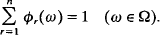
Liapounov's theorem can be obtained as a corollary of this result by taking n= 2.
Double MSn-algebras and double Kn.m-algebras
-
- Journal:
- Glasgow Mathematical Journal / Volume 35 / Issue 2 / May 1993
- Published online by Cambridge University Press:
- 18 May 2009, pp. 189-201
-
- Article
-
- You have access
- Export citation
Some finiteness conditions for automorphism groups
-
- Journal:
- Glasgow Mathematical Journal / Volume 29 / Issue 2 / July 1987
- Published online by Cambridge University Press:
- 18 May 2009, pp. 259-265
-
- Article
-
- You have access
- Export citation
On the growth of the cyclotomic polynomial in the interval (0, 1)
-
- Journal:
- Proceedings of the Glasgow Mathematical Association / Volume 3 / Issue 2 / June 1957
- Published online by Cambridge University Press:
- 18 May 2009, pp. 102-104
-
- Article
-
- You have access
- Export citation
-
Let
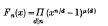
be the rath cyclotomic polynomial, and denote by An the absolute value of the largest coefficient of Fn(x).Schur proved that

and Emma Lehmer [5] showed that An>cn1/3 for infinitely many n; in fact she proved that n can be chosen as the product of three distinct primes. I proved [3] that there exists a positive constant q such that, for infinitely many n

and Bateman [1] proved very simply that, for every ∈>0 and all n>no(∈),


Proximate order (R) of entire functions represented by Dirichlet series (IV)
-
- Journal:
- Proceedings of the Glasgow Mathematical Association / Volume 7 / Issue 1 / January 1965
- Published online by Cambridge University Press:
- 18 May 2009, pp. 15-18
-
- Article
-
- You have access
- Export citation
-

where
 be an entire
function represented by a Dirichlet series whose order (R) and proximate order (R) are respectively ρ (0 < ρ < ∞) and ρ(σ). For proximate order (R) and its properties, see the paper of Balaguer [4, p. 28].
 be an entire
On the natural ordering of
 -classes and of idempotents in a regular semigroup
-
- Journal:
- Glasgow Mathematical Journal / Volume 11 / Issue 2 / July 1970
- Published online by Cambridge University Press:
- 18 May 2009, pp. 167-168
-
- Article
-
- You have access
- Export citation
 -classes and of idempotents in a regular semigroup
GMJ volume 24 issue 2 Cover and Back matter
-
- Journal:
- Glasgow Mathematical Journal / Volume 24 / Issue 2 / July 1983
- Published online by Cambridge University Press:
- 18 May 2009, p. b1
-
- Article
-
- You have access
- Export citation
GMJ volume 5 issue 2 Cover and Back matter
-
- Journal:
- Proceedings of the Glasgow Mathematical Association / Volume 5 / Issue 2 / July 1961
- Published online by Cambridge University Press:
- 18 May 2009, pp. b1-b6
-
- Article
-
- You have access
- Export citation
Principally ordered regular semigroups
-
- Journal:
- Glasgow Mathematical Journal / Volume 32 / Issue 3 / September 1990
- Published online by Cambridge University Press:
- 18 May 2009, pp. 349-364
-
- Article
-
- You have access
- Export citation
An approximative property of spaces of continuous functions
-
- Journal:
- Glasgow Mathematical Journal / Volume 15 / Issue 1 / March 1974
- Published online by Cambridge University Press:
- 18 May 2009, pp. 48-53
-
- Article
-
- You have access
- Export citation
Matrix invariants and complete intersections
-
- Journal:
- Glasgow Mathematical Journal / Volume 32 / Issue 2 / May 1990
- Published online by Cambridge University Press:
- 18 May 2009, pp. 227-229
-
- Article
-
- You have access
- Export citation
-
Consider the vector space of m-tuples of n by n matrices
 .
.The linear group GLn(C) acts on Xm, n by simultaneous conjugation. The corresponding ring of polynomial invariants

will be denoted by C(n, m) and is called the ring of matrix invariants of m-tuples of n by n matrices. C. Procesi has shown in [8] that C(n, m) is generated by traces of products of the corresponding generic matrices and, as such, coincides with the center of the trace ring of m generic n by n matrices R (n, m) which is also the ring of equivariant maps from Xm, n to Mn(ℂ).

Matched pairs of Lie algebroids
-
- Journal:
- Glasgow Mathematical Journal / Volume 39 / Issue 2 / May 1997
- Published online by Cambridge University Press:
- 18 May 2009, pp. 167-181
-
- Article
-
- You have access
- Export citation
Characterisations of partially continuous, strictly cosingular and φ- type operators
-
- Journal:
- Glasgow Mathematical Journal / Volume 33 / Issue 2 / May 1991
- Published online by Cambridge University Press:
- 18 May 2009, pp. 203-212
-
- Article
-
- You have access
- Export citation
-
We will denote the dimension of a subspace M of X by dim M and the codimension of M with respect to X by codxM or simply cod M if there is no danger of confusion. The classes of infinite dimensional and closed infinite codimensional subspaces of X will be denoted by
 and
and  respectively with ℱ(X) and ℱ(X) denoting the classes of finite dimensional and of finite codimensional subspaces of X respectively. For a subspace M of X we denote the injection of M into X by
  and the quotient map from X onto the quotient space X/M by
  . Where there is no danger of confusion we will write JM and QM. The injection of X into its completion
  will be denoted by Jx. Letting X′ denote the continuous dual of X we remark that since X′ is isometric to ()′, these two spaces will be considered identical where convenient. The orthogonal complements of subsets M ⊂ X in X′ and K ⊂ X′ in X will be denoted by M⊥ and ⊥K respectively; M⊥X and X⊥K will be used if there is danger of confusion.
 and
and  respectively with ℱ(X) and ℱ(X) denoting the classes of finite dimensional and of finite codimensional subspaces of X respectively. For a subspace M of X we denote the injection of M into X by
  and the quotient map from X onto the quotient space X/M by
  . Where there is no danger of confusion we will write J
 will be denoted by J
GMJ volume 39 issue 1 Cover and Front matter
-
- Journal:
- Glasgow Mathematical Journal / Volume 39 / Issue 1 / January 1997
- Published online by Cambridge University Press:
- 18 May 2009, pp. f1-f2
-
- Article
-
- You have access
- Export citation
A note on Mathieu functions
-
- Journal:
- Proceedings of the Glasgow Mathematical Association / Volume 3 / Issue 3 / December 1957
- Published online by Cambridge University Press:
- 18 May 2009, pp. 132-134
-
- Article
-
- You have access
- Export citation
-
The Mathieu functions of integral order [1] are the solutions with period π or 2π of the equation

The eigenvalues associated with the functions ceN and seN, where N is a positive integer, denoted by aN and bN respectively, reduce to
aN = bN = N2
when q is zero. The quantities aN and bN can be expanded in powers of q, but the explicit construction of high order coefficients is very tedious. In some applications the quantity of most interest is aN – bN, which may be called the “width of the unstable zone“. It is the object of this note to derive a general formula for the leading term in the expansion of this quantity, namely

Suppose first that N is an odd integer. Then there is an expansion

where

These functions π satisfy

and

On Substituting (3) in (1), one obtains the algebraic equation

where

Explicitly,
{11} = q

{lm} = 0 otherwise.
GMJ volume 28 issue 2 Cover and Back matter
-
- Journal:
- Glasgow Mathematical Journal / Volume 28 / Issue 2 / July 1986
- Published online by Cambridge University Press:
- 18 May 2009, p. b1
-
- Article
-
- You have access
- Export citation
The distribution of certain special values of the cubic Legendre symbol
-
- Journal:
- Glasgow Mathematical Journal / Volume 27 / October 1985
- Published online by Cambridge University Press:
- 18 May 2009, pp. 165-184
-
- Article
-
- You have access
- Export citation
-
Let ω be a primitive cube root of unity. We define the cubic residue symbol (Legendre symbol) on ℤ[ω] as follows. Let πεℤ[ω] be a prime, (3, π)=1. For α ε ℤ[ω] such that (α, π)=1 we let
 be that third root of unity so that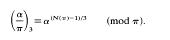
 be that third root of unity so that
Hörmander's Carleson theorem for the ball
-
- Journal:
- Glasgow Mathematical Journal / Volume 26 / Issue 1 / January 1985
- Published online by Cambridge University Press:
- 18 May 2009, pp. 13-17
-
- Article
-
- You have access
- Export citation
-
Let
 denote the unit ball in ℂ2 and let Sdenote its boundary, the unit sphere. For z ∈ B and δ>0, the following non isotropic balls are defined, where

A finite positive Borel measure μ, on B is called a Carleson measure if there exists a constant C for which

Here σ denotes normalized surface area measure on S. The following theorem was obtained by Hörmander [6] as a special case of more general variants for strictly pseudoconvex domains in ℂn. Recently Cima and Wogen [3] derived it from a Carleson measure theorem for Bergman spaces of the ball. A different direct approach to the Bergman context, and related settings, is given in Leucking [7].
 denote the unit ball in ℂ
