Refine search
Actions for selected content:
26070 results in Abstract analysis
GMJ volume 6 issue 4 Cover and Front matter
-
- Journal:
- Proceedings of the Glasgow Mathematical Association / Volume 6 / Issue 4 / July 1964
- Published online by Cambridge University Press:
- 18 May 2009, pp. f1-f2
-
- Article
-
- You have access
- Export citation
Transversally affine foliations
-
- Journal:
- Glasgow Mathematical Journal / Volume 17 / Issue 2 / July 1976
- Published online by Cambridge University Press:
- 18 May 2009, pp. 106-111
-
- Article
-
- You have access
- Export citation
-
Let ℱ be a smooth foliation of codimension p on a smooth manifold Mm. We can define ℱ by an atlas of coordinate charts (U, (x, y)), called leaf charts, where (x, y): U → Rm−p × Rp are coordinate functions for which the leaves of ℱ are given by y1 constant,…,yp constant, in U. Clearly, on the overlap of two such leaf charts (U, (x, y)) and (U′, (x′, y′)) we have a coordinate transformation of the form

If y′ is always affine in y, i.e.

where
 and Bi are constants, we shall say that ℱ is a transversally affine foliation. This notion is, in a sense, dual to that of affine foliation, see [2], in which x′ is affine in x and each leaf has an induced flat affine structure.
 and B
and BSpectral properties of holomorphic automorphism with fixed point
-
- Journal:
- Glasgow Mathematical Journal / Volume 28 / Issue 1 / January 1986
- Published online by Cambridge University Press:
- 18 May 2009, pp. 25-30
-
- Article
-
- You have access
- Export citation
-
The Hilbert space methods in the theory of biholomorphic mappings were applied and developed by S. Bergman [1, 2]. In this approach the central role is played by the Hilbert space L2H(D) consisting of all functions which are square integrable and holomorphic in a domain D ⊂ ℂN. A biholomorphic mapping φ:D ⃗ G induces the unitary mapping Uφ:L2H(G) ⃗ L2H(D) defined by the formula

Here ∂φ/∂z denotes the complex Jacobian of φ. The mapping Uϕ is useful, since it permits to replace a problem for D by a problem for its biholomorphic image G (see for example [11], [13]). When ϕ is an automorphism of D we obtain a unitary operator Uϕ on L2H(D).
On normal derivations of Hilbert–Schmidt type
-
- Journal:
- Glasgow Mathematical Journal / Volume 29 / Issue 2 / July 1987
- Published online by Cambridge University Press:
- 18 May 2009, pp. 245-248
-
- Article
-
- You have access
- Export citation
-
Let H denote a separable, infinite dimensional Hilbert space. Let B(H), C2 and C1 denote the algebra of all bounded linear operators acting on H, the Hilbert–Schmidt class and the trace class in B(H) respectively. It is well known that C2 and C1 each form a two-sided-ideal in B(H) and C2 is itself a Hilbert space with the inner product

where {ei} is any orthonormal basis of H and tr(.) is the natural trace on C1. The Hilbert–Schmidt norm of X ∈ C2 is given by ⅡXⅡ2=(X, X)½.
Non-abelian exterior products of groups and exact sequences in the homology of groups
-
- Journal:
- Glasgow Mathematical Journal / Volume 29 / Issue 1 / January 1987
- Published online by Cambridge University Press:
- 18 May 2009, pp. 13-19
-
- Article
-
- You have access
- Export citation
-
Various authors have obtained an eight term exact sequence in homology

from a short exact sequence of groups
 ,
,the term V varying from author to author (see [7] and [2]; see also [5] for the simpler case where N is central in G, and [6] for the case where N is central and N ⊂ [G, G]). The most satisfying version of the sequence is obtained by Brown and Loday [2] (full details of [2] are in [3]) as a corollary to their van Kampen type theorem for squares of spaces: they give the term V as the kernel of a map G ∧ N → N from a “non-abelian exterior product” of G and N to the group N (the definition of G ∧ N, first published in [2], is recalled below). The two short exact sequences

and

where F is free, together with the fact that H2(F) = 0 and H3(F) = 0, imply isomorphisms
 .
. .
.The isomorphism (2) is essentially the description of H2(G) proved algebraically in [11]. As noted in [2], the isomorphism (3) is the analogue for H3(G) of the Hopf formula for H2(G).


On the spectra of prespectral operators
-
- Journal:
- Glasgow Mathematical Journal / Volume 19 / Issue 1 / January 1978
- Published online by Cambridge University Press:
- 18 May 2009, pp. 57-61
-
- Article
-
- You have access
- Export citation
Some Series and Recurrence Relations for MacRobert's E-Function
-
- Journal:
- Proceedings of the Glasgow Mathematical Association / Volume 5 / Issue 3 / January 1962
- Published online by Cambridge University Press:
- 18 May 2009, pp. 116-117
-
- Article
-
- You have access
- Export citation
-
Since [3]

where
 , a result involving Wk, m, (z) can be transformed into a result involving MacRobert's E-function. Further this result can be generalised with the help of the known integrals for E-functions.
The object of this paper is to use this method to obtain some recurrence relations and series for MacRobert's E-functions.
 , a result involving W
Schottky uniformizations of closed Riemann surfaces with Abelian groups of conformal automorphisms
-
- Journal:
- Glasgow Mathematical Journal / Volume 36 / Issue 1 / January 1994
- Published online by Cambridge University Press:
- 18 May 2009, pp. 17-32
-
- Article
-
- You have access
- Export citation
The nonexistence of a factorization formula for Cayley numbers
-
- Journal:
- Glasgow Mathematical Journal / Volume 24 / Issue 2 / July 1983
- Published online by Cambridge University Press:
- 18 May 2009, pp. 131-132
-
- Article
-
- You have access
- Export citation
An analogue of a conjecture of Sato and Tate for a Hilbert modular form
-
- Journal:
- Glasgow Mathematical Journal / Volume 16 / Issue 2 / September 1975
- Published online by Cambridge University Press:
- 18 May 2009, pp. 69-87
-
- Article
-
- You have access
- Export citation
-
If k denotes a number field and εm is the product of an elliptic curve ε with itself m times over k, then for each prime π where ε has non-degenerate reduction, the zeta factor ζ(επ'S) can be expressed as

Where |π| denotes the norm of π. It is a consequence of a conjecture of Tate [16] that if ε does not have complex multiplications, then the numbers
 are distributed according to the density function
that is, the density of the set of primes π such that –
 is
is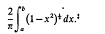
 are distributed according to the density function
 is
is
A coordinate-free approach to surface kinematics
-
- Journal:
- Glasgow Mathematical Journal / Volume 32 / Issue 3 / September 1990
- Published online by Cambridge University Press:
- 18 May 2009, pp. 299-307
-
- Article
-
- You have access
- Export citation
A Ramsey-type property in additive number theory
-
- Journal:
- Glasgow Mathematical Journal / Volume 27 / October 1985
- Published online by Cambridge University Press:
- 18 May 2009, pp. 5-10
-
- Article
-
- You have access
- Export citation
Orientable and non-orientable Klein surfaces with maximal symmetry
-
- Journal:
- Glasgow Mathematical Journal / Volume 26 / Issue 1 / January 1985
- Published online by Cambridge University Press:
- 18 May 2009, pp. 31-34
-
- Article
-
- You have access
- Export citation
-
Let X be a bordered Klein surface, by which we mean a Klein surface with non-empty boundary. X is characterized topologically by its orientability, the number k of its boundary components and the genus p of the closed surface obtained by filling in all the holes. The algebraic genus g of X is defined by
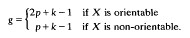 .
.If g≥2 it is known that if G is a group of automorphisms of X then |G|≤12(g-l) and that the upper bound is attained for infinitely many values of g ([4], [5]). A bordered Klein surface for which this upper bound is attained is said to have maximal symmetry. A group of 12(g-l) automorphisms of a bordered Klein surface of algebraic genus g is called an M*-group and it is known that a finite group G is an M*-group if and only if it is generated by 3 non-trivial elements T1, T2, T3 which obey the relations

([4]).
Discrete free products of two complex cyclic matrix groups
-
- Journal:
- Glasgow Mathematical Journal / Volume 20 / Issue 1 / January 1979
- Published online by Cambridge University Press:
- 18 May 2009, pp. 69-80
-
- Article
-
- You have access
- Export citation
-
All 2-by-2 matrices in this paper are to be viewed as linear fractional transformations on the extended complex plane ℂ*. Let L+ and L− be the open half-planes to the right and left, respectively, of the extended imaginary axis L. Let Λ be the set of complex 2-by-2 matrices A with real trace and determinant ±1 such that A(L+) ⊂L−. Let Ω = Ω1 ∪ Ω2 ∪ Ω3 ∪ Ω4, Where

and

An Integral involving an E-function and an Associated Legendre Function of the First Kind
-
- Journal:
- Proceedings of the Glasgow Mathematical Association / Volume 1 / Issue 3 / September 1953
- Published online by Cambridge University Press:
- 18 May 2009, pp. 111-114
-
- Article
-
- You have access
- Export citation
-
§ 1. Introductory. The formula to be proved is
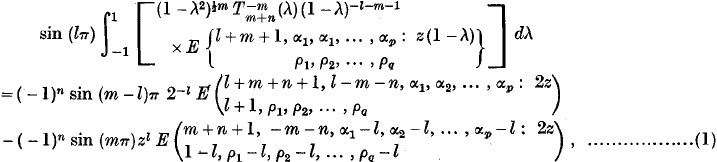
where n is zero or a positive integer, R(m)>0, R(αs-l)>0, s = 1, 2, …, p, p≧q.
A Note on Regular Coverings of Closed Orientable Surfaces
-
- Journal:
- Proceedings of the Glasgow Mathematical Association / Volume 5 / Issue 2 / July 1961
- Published online by Cambridge University Press:
- 18 May 2009, pp. 49-66
-
- Article
-
- You have access
- Export citation
-
The object of this note is to study the regular coverings of the closed orientable surface of genus 2.
Let the closed orientable surface Fh of genus h be a covering of F2 and let
 and f be the fundamental groups respectively. Then is a subgroup of f of index n = h − 1. A covering is called regular if is normal in f.
Conversely, let
be a normal subgroup of f of finite index. Then there is a uniquely determined regular covering Fh such that is the fundamental group of Fh. The covering Fh is an orientable surface. Since the index n of in f is supposed to be finite, Fh is closed, and its genus is given by n = h − 1.The fundamental group f can be defined by
 .
.
 and f be the fundamental groups respectively. Then
Simplex algebras and their representation
-
- Journal:
- Glasgow Mathematical Journal / Volume 14 / Issue 2 / September 1973
- Published online by Cambridge University Press:
- 18 May 2009, pp. 136-144
-
- Article
-
- You have access
- Export citation
Concerning intrinsic topologies on Boolean algebras and certain bicompactly generated lattices
-
- Journal:
- Glasgow Mathematical Journal / Volume 11 / Issue 2 / July 1970
- Published online by Cambridge University Press:
- 18 May 2009, pp. 156-161
-
- Article
-
- You have access
- Export citation
Rings characterized by their weakly-injective modules
-
- Journal:
- Glasgow Mathematical Journal / Volume 34 / Issue 3 / September 1992
- Published online by Cambridge University Press:
- 18 May 2009, pp. 349-353
-
- Article
-
- You have access
- Export citation
-
The notation in this paper will be standard and it may be found in [2] or [8]. Throughout the paper, the notation A ⊂' B will mean that A is an essential submodule of the module B. Given an arbitrary ring R and R-modules M and N, we say that M is weakly N-injective if and only if every map φ:N → E(M) from N into the injective hull E(M) of M may be written as a composition σ〫
 , where :N→M and σ:M→E(M) is a monomorphism. This is equivalent to saying that for every map φ:N→E(M), there exists a submodule X of E(M), isomorphic to M, such that φ(N) is contained in X. In particular, M is weakly R-injective if and only if, for every x ∈ E(M), there exists X ⊂ E(M) such that x ∈ X ≌ M. We say that M is weakly-injective if and only if it is weakly N-innjective for every finitely generated module N. Clearly, M is weakly-injective if and only if, for every finitely generated submodule N of E(M), there exists X ⊂ E(M) such that N ⊂ X ≌ M.
 , where
 The normalizer of Γ0(N) in PSL(2, ℝ)
-
- Journal:
- Glasgow Mathematical Journal / Volume 32 / Issue 3 / September 1990
- Published online by Cambridge University Press:
- 18 May 2009, pp. 317-327
-
- Article
-
- You have access
- Export citation
-
Let Γ denote the modular group, consisting of the Möbius transformations

As usual we denote the above transformation by the matrix
 remembering that V and – V represent the same transformation. If N is a positive integer we let Γ0(N) denote the transformations for which c ≡ 0 mod N. Then Γ0(N) is a subgroup of index
the product being taken over all prime divisors of N.
 remembering that V and – V represent the same transformation. If N is a positive integer we let Γ
