Refine search
Actions for selected content:
26076 results in Abstract analysis
A family of conformally asymmetric Riemann surfaces
-
- Journal:
- Glasgow Mathematical Journal / Volume 39 / Issue 2 / May 1997
- Published online by Cambridge University Press:
- 18 May 2009, pp. 221-225
-
- Article
-
- You have access
- Export citation
Components in vector lattices and extreme extensions of quasi-measures and measures
-
- Journal:
- Glasgow Mathematical Journal / Volume 35 / Issue 2 / May 1993
- Published online by Cambridge University Press:
- 18 May 2009, pp. 153-162
-
- Article
-
- You have access
- Export citation
-
We develop some ideas contained in the author's paper [8] which was, in turn, inspired by Bierlein and Stich [5]. The main body of the present paper is divided into three sections. Section 2 is concerned with some vector-lattice-theoretical results. They are then applied to extensions of quasi-measures and measures in Sections 3 and 4, respectively.
Let X be a vector lattice, let x ε X+ and let S be a non-empty set. Theorems 1 and 2 describe some properties of the convex set

(see Section 2 for the definition of the sum above). The extreme points of Dx,s are characterized in terms of the components of x. It is also shown that if X has the principal projection property and S is countable, then extr Dx,s is, in some sense, large in Dx,s. Furthermore, for finite S, each point in Dx,s is then a sσ-convex combination of extreme ones.
The Diophantine equation x2+3 = yn
-
- Journal:
- Glasgow Mathematical Journal / Volume 35 / Issue 2 / May 1993
- Published online by Cambridge University Press:
- 18 May 2009, pp. 203-206
-
- Article
-
- You have access
- Export citation
Quotient rings, chain conditions and injective ring endomorphisms
-
- Journal:
- Glasgow Mathematical Journal / Volume 31 / Issue 2 / May 1989
- Published online by Cambridge University Press:
- 18 May 2009, pp. 173-181
-
- Article
-
- You have access
- Export citation
The product of two ultraspherical polynomials
-
- Journal:
- Proceedings of the Glasgow Mathematical Association / Volume 5 / Issue 2 / July 1961
- Published online by Cambridge University Press:
- 18 May 2009, pp. 76-79
-
- Article
-
- You have access
- Export citation
-
Let
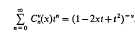
It is familiar that

(1) In the addition theorem [3, p. 363]

where

take θ = π and replace v by v−½. Since
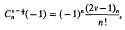
we get

On Schur's second partition theorem
-
- Journal:
- Glasgow Mathematical Journal / Volume 8 / Issue 2 / July 1967
- Published online by Cambridge University Press:
- 18 May 2009, pp. 127-132
-
- Article
-
- You have access
- Export citation
Group structure and properties of block ideals of the group algebra
-
- Journal:
- Glasgow Mathematical Journal / Volume 16 / Issue 1 / March 1975
- Published online by Cambridge University Press:
- 18 May 2009, pp. 22-28
-
- Article
-
- You have access
- Export citation
Grothendieck groups of twisted free associative algebras
-
- Journal:
- Glasgow Mathematical Journal / Volume 18 / Issue 2 / July 1977
- Published online by Cambridge University Press:
- 18 May 2009, pp. 193-196
-
- Article
-
- You have access
- Export citation
-
Let R be an associative ring with identity, X a set of noncommuting variables,
 = {αx} x ∈ X a set of automorphisms αx of R and R
 {X} the -twisted free associative algebra on X over R. Let Y be another set of noncommuting variables, ℬ = {βy}y∈Y a set of automorphisms βy of R {X} and S = (R{X})ℬ {Y} the ℬ-twisted free associative algebra on Y over R{X}. Next, let X1 be a set of noncommuting variables, for each l = 1,2,…. We form the free associative algebra S1 = S{X1}on Xl over S and inductively, we form the free associative algebra Sl+1 = Sl{Xl+1} on Xl+1 over Sl, l = 1,2,….
 = {α
= {α {X} the
 On a set of normal subgroups
-
- Journal:
- Proceedings of the Glasgow Mathematical Association / Volume 5 / Issue 3 / January 1962
- Published online by Cambridge University Press:
- 18 May 2009, pp. 137-146
-
- Article
-
- You have access
- Export citation
On the inclusion of a bounded convergence field in the space of almost convergent sequences
-
- Journal:
- Glasgow Mathematical Journal / Volume 13 / Issue 1 / March 1972
- Published online by Cambridge University Press:
- 18 May 2009, pp. 82-90
-
- Article
-
- You have access
- Export citation
Commutators in groups of order-preserving permutations
-
- Journal:
- Glasgow Mathematical Journal / Volume 33 / Issue 1 / January 1991
- Published online by Cambridge University Press:
- 18 May 2009, pp. 55-59
-
- Article
-
- You have access
- Export citation
Normal and quasinormal weighted composition operators
-
- Journal:
- Glasgow Mathematical Journal / Volume 33 / Issue 3 / September 1991
- Published online by Cambridge University Press:
- 18 May 2009, pp. 275-279
-
- Article
-
- You have access
- Export citation
Transform solutions of Dirichlet problems in quarter-spaces
-
- Journal:
- Glasgow Mathematical Journal / Volume 15 / Issue 2 / September 1974
- Published online by Cambridge University Press:
- 18 May 2009, pp. 156-158
-
- Article
-
- You have access
- Export citation
-
In a recent paper, Boudjelkha and Diaz [1] have considered the solutions of the Dirichlet problems for Laplace's equation

and for Helmholtz's equation

in¼–ℝn. The purpose of this brief note is to show that their formulae may be derived easily by the use of the theory of multiple Fourier transforms.

On a new class of polynomials
-
- Journal:
- Glasgow Mathematical Journal / Volume 18 / Issue 1 / January 1977
- Published online by Cambridge University Press:
- 18 May 2009, pp. 105-108
-
- Article
-
- You have access
- Export citation
Solution to a problem of A. D. Sands
-
- Journal:
- Glasgow Mathematical Journal / Volume 20 / Issue 2 / July 1979
- Published online by Cambridge University Press:
- 18 May 2009, pp. 115-117
-
- Article
-
- You have access
- Export citation
On ranges of Lyapunov transformations IV†
-
- Journal:
- Glasgow Mathematical Journal / Volume 17 / Issue 2 / July 1976
- Published online by Cambridge University Press:
- 18 May 2009, pp. 112-118
-
- Article
-
- You have access
- Export citation
-
Let ℂn,n denote the space of n × n matrices with complex entries and let ℋn denote the set of n × n hermitian matrices. Given any matrix A∊ℂn,n, the Lyapunov transformation corresponding to A is defined by ℐA(H) = AH+HA*, where H∊ℋn. Let PSD(n) be the set of all n × n hermitian positive semidefinite matrices. Taussky [8, 9] raised the problems of determining

and

Both of these problems seem to be difficult.
On the natural representation of the symmetric groups
-
- Journal:
- Proceedings of the Glasgow Mathematical Association / Volume 5 / Issue 3 / January 1962
- Published online by Cambridge University Press:
- 18 May 2009, pp. 121-136
-
- Article
-
- You have access
- Export citation
-
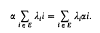
Let E be an arbitrary (non-empty) set and S the restricted symmetric group on E, that is the group of all permutations of E which keep all but a finite number of elements of E fixed. If Φ is any commutative ring with unit element, let Γ = Φ(S) be the group algebra of S over Φ,Γ ⊃ Φ and let M be the free Φ-module having E as Φ-base. The “natural” representation of S is obtained by turning M into a Γ-module in the obvious manner, namely by writing for α∈S, λ1∈Φ,
On an integral transform
-
- Journal:
- Glasgow Mathematical Journal / Volume 20 / Issue 1 / January 1979
- Published online by Cambridge University Press:
- 18 May 2009, pp. 1-14
-
- Article
-
- You have access
- Export citation
-
In this paper the author continues the search for a suitable integral transform that can be applied to certain boundary value problems involving the Helmholtz equation and the condition of radiation. The transform in question must be capable of eliminating the r-dependence appearing in the partial differential equation

On polytopes with small faces
-
- Journal:
- Glasgow Mathematical Journal / Volume 18 / Issue 1 / January 1977
- Published online by Cambridge University Press:
- 18 May 2009, pp. 39-49
-
- Article
-
- You have access
- Export citation
On the Cauchy problem for the differential equation f(t, x, x′, …, x(k)) = 0
-
- Journal:
- Glasgow Mathematical Journal / Volume 33 / Issue 3 / September 1991
- Published online by Cambridge University Press:
- 18 May 2009, pp. 343-348
-
- Article
-
- You have access
- Export citation
