Refine search
Actions for selected content:
26076 results in Abstract analysis
Bounded mean curvature isometric immersions of a compact Riemannian manifold with images contained in a tube
-
- Journal:
- Glasgow Mathematical Journal / Volume 40 / Issue 1 / March 1998
- Published online by Cambridge University Press:
- 18 May 2009, pp. 97-107
-
- Article
-
- You have access
- Export citation
Kernel functors for which the associated idempotent kernel functor is stable
-
- Journal:
- Glasgow Mathematical Journal / Volume 16 / Issue 2 / September 1975
- Published online by Cambridge University Press:
- 18 May 2009, pp. 103-106
-
- Article
-
- You have access
- Export citation
-
Let R be a ring with unity and let
 denote the category of unital right R-modules. A preradical γ of is a functor γ: → such that
(i) γ(M) ⊆ M for each R-module M,
(ii) for f:M → N, γ(f) is the restriction of f to γ(M).
 denote the category of unital right R-modules. A preradical γ of
 GMJ volume 38 issue 1 Cover and Back matter
-
- Journal:
- Glasgow Mathematical Journal / Volume 38 / Issue 1 / January 1996
- Published online by Cambridge University Press:
- 18 May 2009, pp. b1-b2
-
- Article
-
- You have access
- Export citation
Cleft extensions for a Hopf algebrakq[X,X−1, Y]
-
- Journal:
- Glasgow Mathematical Journal / Volume 40 / Issue 2 / May 1998
- Published online by Cambridge University Press:
- 18 May 2009, pp. 147-160
-
- Article
-
- You have access
- Export citation
Extending Edgar's ordering to locally convex spaces
-
- Journal:
- Glasgow Mathematical Journal / Volume 34 / Issue 2 / May 1992
- Published online by Cambridge University Press:
- 18 May 2009, pp. 175-188
-
- Article
-
- You have access
- Export citation
Congruences on an orthodox semigroup via the minimum inverse semigroup congruence
-
- Journal:
- Glasgow Mathematical Journal / Volume 18 / Issue 2 / July 1977
- Published online by Cambridge University Press:
- 18 May 2009, pp. 181-192
-
- Article
-
- You have access
- Export citation
Complete submanifolds with parallel mean curvature in a sphere
-
- Journal:
- Glasgow Mathematical Journal / Volume 38 / Issue 3 / September 1996
- Published online by Cambridge University Press:
- 18 May 2009, pp. 343-346
-
- Article
-
- You have access
- Export citation
-
Let Mn be an n-dimensional manifold immersed in an (n+p)-dimensional unit sphere Sn+p, with mean curvature H and second fundamental form B. We put φ(X, Y) = B(X, Y)–(X, Y)H where X and Y are tangent vector fields on Mn. Assume that the mean curvature is parallel in the normal bundle of Mn in Sn+p. Following Alencar and do Carmo [1] we denote by BH the square of the positive root of

Some characterizations of hereditarily artinian rings
-
- Journal:
- Glasgow Mathematical Journal / Volume 28 / Issue 1 / January 1986
- Published online by Cambridge University Press:
- 18 May 2009, pp. 21-23
-
- Article
-
- You have access
- Export citation
On Pontryagin duality
-
- Journal:
- Glasgow Mathematical Journal / Volume 20 / Issue 1 / January 1979
- Published online by Cambridge University Press:
- 18 May 2009, pp. 15-24
-
- Article
-
- You have access
- Export citation
Semigroups satisfying minimal conditions II
-
- Journal:
- Glasgow Mathematical Journal / Volume 20 / Issue 2 / July 1979
- Published online by Cambridge University Press:
- 18 May 2009, pp. 133-140
-
- Article
-
- You have access
- Export citation
The λ-property in schreier's space S and the Lorentz space d(a, 1)
-
- Journal:
- Glasgow Mathematical Journal / Volume 32 / Issue 3 / September 1990
- Published online by Cambridge University Press:
- 18 May 2009, pp. 277-284
-
- Article
-
- You have access
- Export citation
Gauss sums for U(2n, q2)
-
- Journal:
- Glasgow Mathematical Journal / Volume 40 / Issue 1 / March 1998
- Published online by Cambridge University Press:
- 18 May 2009, pp. 79-95
-
- Article
-
- You have access
- Export citation
Biquasitriangularity and spectral continuity
-
- Journal:
- Glasgow Mathematical Journal / Volume 26 / Issue 2 / July 1985
- Published online by Cambridge University Press:
- 18 May 2009, pp. 177-180
-
- Article
-
- You have access
- Export citation
On extensions of inequalities of Kolmogoroff and others and some applications to almost periodic functions
-
- Journal:
- Glasgow Mathematical Journal / Volume 13 / Issue 1 / March 1972
- Published online by Cambridge University Press:
- 18 May 2009, pp. 1-16
-
- Article
-
- You have access
- Export citation
-
Let f(x) be a complex function of a real variable, defined over the whole real line, which possesses n derivatives (the nth at least almost everywhere) and is such that
 . Then, if k is any integer for which 0< k < n, Kolmogoroff's inequality may be written as
 ,
,or, by putting
 ,
,
The constant K=K (k, n) known explicitly and is the best possible, i.e., there is a (real) function for which equality holds (see Bang [1]).
 . Then, if k is any integer for which 0< k < n, Kolmogoroff's inequality may be written as
 ,
,
On groups with decomposable commutator subgroups
-
- Journal:
- Glasgow Mathematical Journal / Volume 19 / Issue 2 / July 1978
- Published online by Cambridge University Press:
- 18 May 2009, pp. 159-162
-
- Article
-
- You have access
- Export citation
Examples of malformed subsets of a Riemann surface
-
- Journal:
- Glasgow Mathematical Journal / Volume 24 / Issue 2 / July 1983
- Published online by Cambridge University Press:
- 18 May 2009, pp. 101-106
-
- Article
-
- You have access
- Export citation
-
Let R be a hyperbolic Riemann surface and W an open subset of R with ∂W piecewise analytic. Denote by
 the space of Dirichlet finite Tonelli functions on R and by π the harmonic projection of . Consider the relative HD–class on W, HD(W;∂W) = {u∈ │ u │ W∈HD(W) and u │ R\W = 0}. The extremization operation μ
 is the linear mapping of HD(W;∂W) into HD(R) defined by μ
 . Since π preserves values of functions at the Royden harmonic boundary, the maximum principle implies that μis an order preserving injection and that Mμ
 is an isometry with respect to the supremum norms.
 the space of Dirichlet finite Tonelli functions on R and by π the harmonic projection of
  is the linear mapping of HD(W;∂W) into HD(R) defined by μ
 . Since π preserves values of functions at the Royden harmonic boundary, the maximum principle implies that μ
 is an isometry with respect to the supremum norms.
GMJ volume 32 issue 1 Cover and Front matter
-
- Journal:
- Glasgow Mathematical Journal / Volume 32 / Issue 1 / January 1990
- Published online by Cambridge University Press:
- 18 May 2009, pp. f1-f2
-
- Article
-
- You have access
- Export citation
GMJ volume 18 issue 2 Cover and Back matter
-
- Journal:
- Glasgow Mathematical Journal / Volume 18 / Issue 2 / July 1977
- Published online by Cambridge University Press:
- 18 May 2009, p. b1
-
- Article
-
- You have access
- Export citation
On the power of a prime dividing the order of the automorphism group of a finite group
-
- Journal:
- Proceedings of the Glasgow Mathematical Association / Volume 4 / Issue 4 / September 1960
- Published online by Cambridge University Press:
- 18 May 2009, pp. 163-170
-
- Article
-
- You have access
- Export citation
-
The existence of a function g of hhaving the property that pr divides the order of the automorphism group of a finite group G whenever pg divides the order of G was first established by Ledermann and Neumann [4], who showed that the least such function g(h) satisfies the inequality
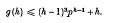
Later Green [2] improved this estimate to

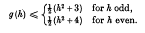
In the Present paper this will be revised, for sufficiently large h, to

Some isometric characterizations of ln∞
-
- Journal:
- Glasgow Mathematical Journal / Volume 34 / Issue 1 / January 1992
- Published online by Cambridge University Press:
- 18 May 2009, pp. 117-121
-
- Article
-
- You have access
- Export citation
-
The previous results on isometrically characterizing ln∞ in terms of operator ideal norms can be summarized as follows.
Let E be an n-dimensional Banach space.
(1) If λ(E) = 1, then
 (see [3], [5], [6]), where λ(E) is the projection constant of E (see [4]).
(2) If π(E) = n, then
(see [1],[2]).(3) If Δ2(E) = √n, then
(see [8]), where Δ2(E) is the 2-dominated constant of E(see [4]).(4) If for any linear operator T:
 → E, v1(T) =
  (T), then (see [7]), where v1 is the 1-nuclear norm (see [4]).
 (see [3], [5], [6]), where λ(E) is the projection constant of E (see [4]).
 → E, v
 (T), then