Refine search
Actions for selected content:
26070 results in Abstract analysis
A base norm space whose cone is not 1-generating
-
- Journal:
- Glasgow Mathematical Journal / Volume 25 / Issue 1 / January 1984
- Published online by Cambridge University Press:
- 18 May 2009, pp. 35-36
-
- Article
-
- You have access
- Export citation
A Definition for Strong Rieszian Summability and its Relationship to Strong Cesaro Summability
-
- Journal:
- Proceedings of the Glasgow Mathematical Association / Volume 1 / Issue 2 / July 1952
- Published online by Cambridge University Press:
- 18 May 2009, pp. 94-99
-
- Article
-
- You have access
- Export citation
-
1. Introduction. Given a series
 we define
  , by the relations
The series Σan is said to be summable (C, k) to the sum s, if

as n→∞, and strongly summable (C, k), k>0, with index p, to the sum s, or summable [C; k, p] to the sum s, if
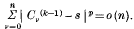
 we define
  , by the relations
Characterizing f-rings
-
- Journal:
- Glasgow Mathematical Journal / Volume 16 / Issue 2 / September 1975
- Published online by Cambridge University Press:
- 18 May 2009, pp. 88-90
-
- Article
-
- You have access
- Export citation
An extreme positive operator on a polyhedral cone
-
- Journal:
- Glasgow Mathematical Journal / Volume 30 / Issue 3 / September 1988
- Published online by Cambridge University Press:
- 18 May 2009, pp. 347-348
-
- Article
-
- You have access
- Export citation
A note on positive definite matrices
-
- Journal:
- Proceedings of the Glasgow Mathematical Association / Volume 3 / Issue 4 / July 1958
- Published online by Cambridge University Press:
- 18 May 2009, pp. 173-175
-
- Article
-
- You have access
- Export citation
An infinitesimal proof of the implicit function theorem
-
- Journal:
- Glasgow Mathematical Journal / Volume 35 / Issue 2 / May 1993
- Published online by Cambridge University Press:
- 18 May 2009, pp. 163-166
-
- Article
-
- You have access
- Export citation
-
We give a short and constructive proof of the general (multi-dimensional) Implicit Function Theorem (IFT), using infinitesimal (i.e. nonstandard) methods to implement our basic intuition about the result. Here is the statement of the IFT, quoted from [4];
Theorem. Let A ⊂ ℝn × ℝmbe an open set and let F:A → ℝ be a function of class Cp (p≥1). Suppose that (xO, yO) ε A with F(xO, yO) = 0 (xO ε ℝn, yO ε ℝm) and that the Jacobian determinant
 is not zero at (xO, yO). Then there is an open neighbourhood U of xO and a unique function f:U→ ℝmwith
F(x, f(x)) = 0
for all x ε U. Moreover, f is of class Cp.
 is not zero at (x
Algebras stably equivalent to selfinjective algebras whose Auslander-Reiten quivers consist only of generalized standard components
-
- Journal:
- Glasgow Mathematical Journal / Volume 40 / Issue 1 / March 1998
- Published online by Cambridge University Press:
- 18 May 2009, pp. 1-19
-
- Article
-
- You have access
- Export citation
Matching torsion and cotorsion theories
-
- Journal:
- Glasgow Mathematical Journal / Volume 15 / Issue 2 / September 1974
- Published online by Cambridge University Press:
- 18 May 2009, pp. 176-179
-
- Article
-
- You have access
- Export citation
-
Throughout the following note R will denote an associative ring with unit element 1. We shall denote by R-mod [resp. mod-R] the category of all unitary left [resp. right] R-modules. Morphisms in these categories will be written as acting on the side opposite scalar multiplication. All other functions will be written as acting on the left. If
 is a category, we shall abuse notation and write “A∈ when we mean “A is an object of ”.
 is a category, we shall abuse notation and write “A∈
On Tauberian theorems for Abel-Cesàro summability
-
- Journal:
- Proceedings of the Glasgow Mathematical Association / Volume 3 / Issue 4 / July 1958
- Published online by Cambridge University Press:
- 18 May 2009, pp. 176-181
-
- Article
-
- You have access
- Export citation
-
For a series Σan with partial sums An=a0 + a1 + … + an(n ≥ 0), supposed to be real in this note, we define, in a generally accepted notation ([2], pp. 7, 9, 94–98), the following transforms:
(C, α) sequence-transform,


(H, k)sequence-transform (k = 0, 1, 2, …):

(A: C, α)fnunction-transform,


GMJ volume 4 issue 3 Cover and Front matter
-
- Journal:
- Proceedings of the Glasgow Mathematical Association / Volume 4 / Issue 3 / January 1960
- Published online by Cambridge University Press:
- 18 May 2009, pp. f1-f2
-
- Article
-
- You have access
- Export citation
Supersoluble groups of automorphisms of compact Riemann surfaces
-
- Journal:
- Glasgow Mathematical Journal / Volume 31 / Issue 3 / September 1989
- Published online by Cambridge University Press:
- 18 May 2009, pp. 321-327
-
- Article
-
- You have access
- Export citation
-
Given an integer g ≥ 2 and a class
 of finite groups let N(g, ) denote the order of the largest group in that a compact Riemann surface of genus g admits as a group of automorphisms. For the classes of all finite groups, cyclic groups, abelian groups, nilpotent groups, p-groups (given p), soluble groups and finally for metabelian groups, an upper bound for N(g, ) as well as infinite sequences for g for which this bound is attained were found in [5, 6, 7, 8, 13], [4], [10], [15], [16], [1], [2] respectively. This paper deals with that problem for the class of finite supersoluble groups i.e. groups with an invariant series all of whose factors are cyclic. In addition, it goes further by describing exactly those values of g for which the bound is attained. More precisely we prove:
 of finite groups let N(g,
 The Schur Derivative of a Polynomial
-
- Journal:
- Proceedings of the Glasgow Mathematical Association / Volume 1 / Issue 4 / December 1953
- Published online by Cambridge University Press:
- 18 May 2009, pp. 159-163
-
- Article
-
- You have access
- Export citation
-
For a given sequence {am} and p≠0, Schur (2) defined

In particular if p is a prime, a an integer and
 , then by Fermat's theorem
is integral. Schur proved that if p † a, then all the derivatives

are integral. Zorn (3) using p-adic methods proved Schur's results and also found the residue of Xm (mod pm), where
 and x = 1 (mod p). The writer (1) proved Zorn's congruences by elementary methods as well as certain additional results of a similar sort.
 , then by Fermat's theorem
 and x = 1 (mod p). The writer (1) proved Zorn's congruences by elementary methods as well as certain additional results of a similar sort.
A note on integral equations
-
- Journal:
- Glasgow Mathematical Journal / Volume 13 / Issue 2 / September 1972
- Published online by Cambridge University Press:
- 18 May 2009, pp. 119-121
-
- Article
-
- You have access
- Export citation
-
In a recent paper Cooke [1] obtained a solution of the integral equation

by using the identity

and the technique, first used by Copson, of interchanging the orders of integration and hence reducing the problem to that of the successive solution of two Abel integral equations. It is also shown in [1] that the above identity can also be used to solve the dual series equations
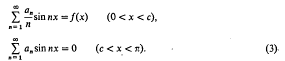
The kernel in equation (1) is a particular member of a general class of kernels which the author [6] has shown to be such that the resulting integral equation is directly soluble by using Copson's technique. The particular example of equation (1) is given in [6] and the identity of equation (2) was used by the author [7] to obtain the solution of equation (3).
On commutative Noetherian rings which satisfy the radical formula
-
- Journal:
- Glasgow Mathematical Journal / Volume 39 / Issue 3 / September 1997
- Published online by Cambridge University Press:
- 18 May 2009, pp. 285-293
-
- Article
-
- You have access
- Export citation
GMJ volume 39 issue 3 Cover and Front matter
-
- Journal:
- Glasgow Mathematical Journal / Volume 39 / Issue 3 / September 1997
- Published online by Cambridge University Press:
- 18 May 2009, pp. f1-f7
-
- Article
-
- You have access
- Export citation
The conjugate hull of an inverse semigroup
-
- Journal:
- Glasgow Mathematical Journal / Volume 21 / Issue 1 / January 1980
- Published online by Cambridge University Press:
- 18 May 2009, pp. 103-124
-
- Article
-
- You have access
- Export citation
On approximating Lebesgue integrals by Riemann sums
-
- Journal:
- Glasgow Mathematical Journal / Volume 33 / Issue 2 / May 1991
- Published online by Cambridge University Press:
- 18 May 2009, pp. 129-134
-
- Article
-
- You have access
- Export citation
-
If f is a real function, periodic with period 1, we define

In the whole paper we write ∫ for
 , mE for the Lebesgue measure of E ∩ [0,1], where E ⊂ ℝ is any measurable set of period 1, and we also use XE for the characteristic function of the set E. Consistent with this, the meaning of ℒp is ℒp [0, 1]. For all real xwe have
if f is Riemann-integrable on [0, 1]. However,∫ f exists for all f ∈ ℒ1 and one would wish to extend the validity of (2). As easy examples show, (cf. [3], [7]), (2) does not hold for f ∈ ℒp in general if p < 2. Moreover, Rudin [4] showed that (2) may fail for all x even for the characteristic function of an open set, and so, to get a reasonable extension, it is natural to weaken (2) to

where S ⊂ ℕ is some “good” increasing subsequence of ℕ. Naturally, for different function classes ℱ ⊂ ℒ1 we get different meanings of being good. That is, we introduce the class of ℱ-good sequences as

 , mE for the Lebesgue measure of E ∩ [0,1], where E ⊂ ℝ is any measurable set of period 1, and we also use X
On some small varieties of distributive Ockham algebras
-
- Journal:
- Glasgow Mathematical Journal / Volume 25 / Issue 2 / July 1984
- Published online by Cambridge University Press:
- 18 May 2009, pp. 175-181
-
- Article
-
- You have access
- Export citation
GMJ volume 37 issue 2 Cover and Front matter
-
- Journal:
- Glasgow Mathematical Journal / Volume 37 / Issue 2 / May 1995
- Published online by Cambridge University Press:
- 18 May 2009, pp. f1-f2
-
- Article
-
- You have access
- Export citation
GMJ volume 35 issue 1 Cover and Back matter
-
- Journal:
- Glasgow Mathematical Journal / Volume 35 / Issue 1 / January 1993
- Published online by Cambridge University Press:
- 18 May 2009, pp. b1-b2
-
- Article
-
- You have access
- Export citation
