Refine search
Actions for selected content:
26076 results in Abstract analysis
Indefinite quadratic polynomials
-
- Journal:
- Glasgow Mathematical Journal / Volume 24 / Issue 2 / July 1983
- Published online by Cambridge University Press:
- 18 May 2009, pp. 133-138
-
- Article
-
- You have access
- Export citation
-
Let

be an indefinite quadratic form with real coefficients. A well-known result, due to Birch, Davenport and Ridout [1], [5] and [6], states that if n ≥21 then for any ε > 0 there is an integer vector x ≠O such that

Recently [3] we have quantified this result, obtaining a function g(n) such that g(n)→ ½ as n n→ ∞ and such that for any η > 0 and all large enough X there is an integer vector x satisfying

where |x| = max |xi|and the implicit constant in Vinogradov's ≪-notation is independent of X.
On (v, k, λ)-configurations with v=4pe
-
- Journal:
- Glasgow Mathematical Journal / Volume 15 / Issue 2 / September 1974
- Published online by Cambridge University Press:
- 18 May 2009, pp. 180-183
-
- Article
-
- You have access
- Export citation
Translational hull and semigroups of binary relations
-
- Journal:
- Glasgow Mathematical Journal / Volume 9 / Issue 1 / January 1968
- Published online by Cambridge University Press:
- 18 May 2009, pp. 12-21
-
- Article
-
- You have access
- Export citation
Semiconvex spaces II
-
- Journal:
- Glasgow Mathematical Journal / Volume 10 / Issue 2 / July 1969
- Published online by Cambridge University Press:
- 18 May 2009, pp. 103-105
-
- Article
-
- You have access
- Export citation
Integrals allied to Airy's integrals
-
- Journal:
- Proceedings of the Glasgow Mathematical Association / Volume 3 / Issue 2 / June 1957
- Published online by Cambridge University Press:
- 18 May 2009, pp. 91-93
-
- Article
-
- You have access
- Export citation
-
Airy's integrals

can be expressed ([1], [2]) in terms of Bessel functions. In this paper integrals of the types
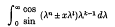
are discussed. Various subsidiary formulae are given in § 2, some integrals of the type
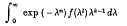
are evaluated in § 3, and from these the integrals of the Airy type are derived in § 4.

Numerical ranges of powers of hermitian elements
-
- Journal:
- Glasgow Mathematical Journal / Volume 28 / Issue 1 / January 1986
- Published online by Cambridge University Press:
- 18 May 2009, pp. 37-45
-
- Article
-
- You have access
- Export citation
-
An element k of a unital Banach algebra A is said to be Hermitian if its numerical range

is contained in ℝ; equivalently, ∥eitk∥ = 1(t ∈ ℝ)—see Bonsall and Duncan [3] and [4]. Here we find the largest possible extent of V(kn), n ∈ ℕ, given V(k) ⊆ [−1, 1], and so ∥k∥ ≤ 1: previous knowledge is in Bollobás [2] and Crabb, Duncan and McGregor [7]. The largest possible sets all occur in a single example. Surprisingly, they all have straight line segments in their boundaries. The example is in [2] and [7], but here we give A. Browder's construction from [5], partly published in [6]. We are grateful to him for a copy of [5], and for discussions which led to the present work. We are also grateful to J. Duncan for useful discussions.
Semigroup-graded rings with finite support
-
- Journal:
- Glasgow Mathematical Journal / Volume 38 / Issue 1 / January 1996
- Published online by Cambridge University Press:
- 18 May 2009, pp. 11-18
-
- Article
-
- You have access
- Export citation
-
Let S be a semigroup and let
 be an S-graded ring. Rs = 0 for all but finitely many elements s ∈ S1, then R is said to have finite support. In this paper we concern ourselves with the question of whether a graded ring R with finite support inherits a given ring theoretic property from the homogeneous subrings Re corresponding to idempotent semigroup elements e.
 be an S-graded ring. R
Generalisations of some Integrals Involving Bessel Functions and E-Functions
-
- Journal:
- Proceedings of the Glasgow Mathematical Association / Volume 1 / Issue 2 / July 1952
- Published online by Cambridge University Press:
- 18 May 2009, pp. 72-75
-
- Article
-
- You have access
- Export citation
-
§ 1. Introductory. In § 3 a generalisation of the formula [MacRobert, Phil. Mag., Ser. 7, XXXI, p. 258]

where αp+1 = ½m + ½n, αp+2 = ½m - ½n, R(m ± n) > 0, and x is real and positive, will be established. In the course of the proof Hardy's formula [Mess, of Maths., LVI, (1927), p. 190],

where R(b)>0, will be required. This was originally proved by an application of Mellin's Inversion Formula. An alternative proof is given in § 2, and some related formulae are deduced.
GMJ volume 20 issue 2 Cover and Front matter
-
- Journal:
- Glasgow Mathematical Journal / Volume 20 / Issue 2 / July 1979
- Published online by Cambridge University Press:
- 18 May 2009, pp. f1-f2
-
- Article
-
- You have access
- Export citation
Cone length of the exterior join
-
- Journal:
- Glasgow Mathematical Journal / Volume 40 / Issue 3 / September 1998
- Published online by Cambridge University Press:
- 18 May 2009, pp. 445-461
-
- Article
-
- You have access
- Export citation
Homomorphisms of (0, 1)-lattices with a given sublattice and quotient
-
- Journal:
- Glasgow Mathematical Journal / Volume 33 / Issue 2 / May 1991
- Published online by Cambridge University Press:
- 18 May 2009, pp. 159-170
-
- Article
-
- You have access
- Export citation
A ratio limit theorem for contraction projections and applications
-
- Journal:
- Glasgow Mathematical Journal / Volume 14 / Issue 1 / February 1973
- Published online by Cambridge University Press:
- 18 May 2009, pp. 80-85
-
- Article
-
- You have access
- Export citation
Injective hulls as completions
-
- Journal:
- Glasgow Mathematical Journal / Volume 13 / Issue 1 / March 1972
- Published online by Cambridge University Press:
- 18 May 2009, pp. 17-23
-
- Article
-
- You have access
- Export citation
Elliptic Integrals in Terms of Legendre Polynomials
-
- Journal:
- Proceedings of the Glasgow Mathematical Association / Volume 2 / Issue 2 / October 1954
- Published online by Cambridge University Press:
- 18 May 2009, pp. 97-99
-
- Article
-
- You have access
- Export citation
-
Consider the elliptic integral of the first kind

or, alternatively,

where x = sin ϕ. It is customary in the theory of elliptic integrals to let k = sin α, k' = cos α, sot that k'2 + k2 = 1. For convenience we shall also introduce the parameter


A Product of two E-Functions Expressed as a Sum of Two E-Functions
-
- Journal:
- Proceedings of the Glasgow Mathematical Association / Volume 2 / Issue 3 / July 1955
- Published online by Cambridge University Press:
- 18 May 2009, pp. 124-126
-
- Article
-
- You have access
- Export citation
-
The formula to be proved is

In proving (1) the following formulae are required:
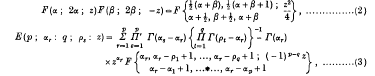
where p≥q + 1, (1).
Spaces of closed subgroups of a connected Lie group
-
- Journal:
- Glasgow Mathematical Journal / Volume 14 / Issue 1 / February 1973
- Published online by Cambridge University Press:
- 18 May 2009, pp. 77-79
-
- Article
-
- You have access
- Export citation
The range of a continuous linear functional over a class of functions defined by subordination
-
- Journal:
- Glasgow Mathematical Journal / Volume 32 / Issue 3 / September 1990
- Published online by Cambridge University Press:
- 18 May 2009, pp. 381-387
-
- Article
-
- You have access
- Export citation
-
Let Δ = {z ∈ ℂ ⃒ ⃓z⃓ <1) and H(Δ) the set of analytic functions on Δ. We recall the definition of subordination between two functions, say ƒ and g, analytic on Δ: this means that f(0)= g(0) and there is a function ρ ∈ H (Δ) such that ρ(0) = 0, ⃒ ρ(z)⃒<1 if z ∈ Δ, and f(z) ≡ g(ρ(z)). Subordination between f and g will be denoted by
f<g. The Hadamard product (or convolution) of two functions
 and
and  in H(Δ)is the function f * g ∈ H(Δ)definedas f * g (z)=
  .
.
 and
and  in H(Δ)is the function f * g ∈ H(Δ)definedas f * g (z)=
  .
.On a Theorem of Hurwitz
-
- Journal:
- Proceedings of the Glasgow Mathematical Association / Volume 5 / Issue 2 / July 1961
- Published online by Cambridge University Press:
- 18 May 2009, pp. 90-96
-
- Article
-
- You have access
- Export citation
-
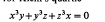
By a theorem of Hurwitz [3], an algebraic curve of genus g ≧ 2 cannot have more than 84(g − l) birational self-transformations, or, as we shall call them, automorphisms. The bound is attained for Klein's quartic
of genus 3 [4]. In studying the problem whether there are any other curves for which the bound is attained, I was led to consider the universal covering space of the Riemann surface, which, as Siegel observed, relates Hurwitz's theorem to Siegel's own result [7] on the measure of the fundamental region of Fuchsian groups. Any curve with 84(g − 1) automorphisms must be uniformized by a normal subgroup of the triangle group (2, 3, 7), and, by a closer analysis of possible finite factor groups of (2, 3, 7), purely algebraic methods yield an infinite family of curves with the maximum number of automorphisms. This will be shown in a later paper.
A note on Cauchy's root test
-
- Journal:
- Glasgow Mathematical Journal / Volume 17 / Issue 2 / July 1976
- Published online by Cambridge University Press:
- 18 May 2009, pp. 151-154
-
- Article
-
- You have access
- Export citation
-
Throughout this note we deal with a series Σan of positive terms. The following tests for the convergence of this series are well-known.
Test 1. (Ratio test). Let
 Then, if K < 1, Σanconverges, while if K > 1, Σandiverges.
Test 2. (Root test). Let
 Then, if K < 1, Σanconverges, while if K > 1, Σandiverges.
 Then, if K < 1, Σa
 Then, if K < 1, Σa
A generalisation of Divinsky's radical
-
- Journal:
- Proceedings of the Glasgow Mathematical Association / Volume 6 / Issue 2 / July 1963
- Published online by Cambridge University Press:
- 18 May 2009, pp. 75-87
-
- Article
-
- You have access
- Export citation
-
Let A be an associative ring. Given a ∊ A, an element b ∊ A is called a left identity for a if

Given a subset S of A, an element b ∊ A is, called a left identity for S if (1) is satisfied for all a ∊ S. An element of A need not have a left identity; for example, if A is nilpotent then no non-zero element of A has a left identity. If a does have a left identity, the latter need not be unique; if every element of a subset S of A has a left identity, then it is not necessarily true that S has a left identity.
