Refine search
Actions for selected content:
26077 results in Abstract analysis
A Geometrical Proof of certain Trigonometrical Formulæ
-
- Journal:
- Proceedings of the Edinburgh Mathematical Society / Volume 15 / February 1896
- Published online by Cambridge University Press:
- 20 January 2009, pp. 86-89
-
- Article
-
- You have access
- Export citation
PEM volume 9 issue 1 Cover and Back matter
-
- Journal:
- Proceedings of the Edinburgh Mathematical Society / Volume 9 / Issue 1 / October 1953
- Published online by Cambridge University Press:
- 20 January 2009, pp. b1-b2
-
- Article
-
- You have access
- Export citation
The Theory of Contours, and its Applications in Physical Science
-
- Journal:
- Proceedings of the Edinburgh Mathematical Society / Volume 4 / February 1885
- Published online by Cambridge University Press:
- 20 January 2009, pp. 25-28
-
- Article
-
- You have access
- Export citation
Some new operational representations
-
- Journal:
- Proceedings of the Edinburgh Mathematical Society / Volume 4 / Issue 4 / April 1936
- Published online by Cambridge University Press:
- 20 January 2009, pp. 232-237
-
- Article
-
- You have access
- Export citation
On the lifting of bounded sets in Fréchet spaces
-
- Journal:
- Proceedings of the Edinburgh Mathematical Society / Volume 36 / Issue 2 / June 1993
- Published online by Cambridge University Press:
- 20 January 2009, pp. 277-281
-
- Article
-
- You have access
- Export citation
Stability of Gelfand–Kirillov dimension for rings with the strong second layer condition
-
- Journal:
- Proceedings of the Edinburgh Mathematical Society / Volume 37 / Issue 2 / June 1994
- Published online by Cambridge University Press:
- 20 January 2009, pp. 347-354
-
- Article
-
- You have access
- Export citation
Permutations: Alternative Proofs of Elementary Formulas
-
- Journal:
- Proceedings of the Edinburgh Mathematical Society / Volume 16 / February 1897
- Published online by Cambridge University Press:
- 20 January 2009, pp. 68-69
-
- Article
-
- You have access
- Export citation
Sir Edmund Whittaker's Work on Automorphic Functions
-
- Journal:
- Proceedings of the Edinburgh Mathematical Society / Volume 11 / Issue 1 / June 1958
- Published online by Cambridge University Press:
- 20 January 2009, pp. 25-30
-
- Article
-
- You have access
- Export citation
Bruce C. Berndt Ramanujan's Notebooks, Part I (Springer-Verlag, 1985), x + 357 pp. DM 188.
-
- Journal:
- Proceedings of the Edinburgh Mathematical Society / Volume 29 / Issue 2 / June 1986
- Published online by Cambridge University Press:
- 20 January 2009, pp. 284-285
-
- Article
-
- You have access
- Export citation
PEM volume 5 issue 3 Cover and Back matter
-
- Journal:
- Proceedings of the Edinburgh Mathematical Society / Volume 5 / Issue 3 / February 1938
- Published online by Cambridge University Press:
- 20 January 2009, pp. b1-b2
-
- Article
-
- You have access
- Export citation
G. J. O. Jameson, Topology and Normed Spaces(Chapman and Hall, London, 1974), xv + 408 pp., £3·80 (soft cover), £5·80 (hardback).
-
- Journal:
- Proceedings of the Edinburgh Mathematical Society / Volume 19 / Issue 3 / March 1975
- Published online by Cambridge University Press:
- 20 January 2009, p. 317
-
- Article
-
- You have access
- Export citation
A Cauchy criterion for the summability of an infinite integral
-
- Journal:
- Proceedings of the Edinburgh Mathematical Society / Volume 23 / Issue 2 / June 1980
- Published online by Cambridge University Press:
- 20 January 2009, pp. 219-224
-
- Article
-
- You have access
- Export citation
-
If a ∈ L(1, T) for every finite T>1, then we say that the infinite integral
 a(u)du is convergent with sum s if
  a(u)du = s. It is well known that a necessary and sufficient condition for a(u)du to be convergent (with some finite sum s) is that Cauchy's criterion,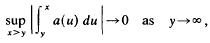
holds. The object of this note is to obtain a similar result for summability (C, α) of
a(u) du which reduces to Cauchy's criterion in the case of convergence. The corresti ponding problem for summable series has been treated by A. F. Andersen in (1).
 a(u)du is convergent with sum s if
  a(u)du = s. It is well known that a necessary and sufficient condition for
A. Hanyga Mathematical theory of non-linear elasticity (Ellis Horwood, 1985), 432 pp. £39.5
-
- Journal:
- Proceedings of the Edinburgh Mathematical Society / Volume 29 / Issue 2 / June 1986
- Published online by Cambridge University Press:
- 20 January 2009, p. 286
-
- Article
-
- You have access
- Export citation
Office-Bearers
-
- Journal:
- Proceedings of the Edinburgh Mathematical Society / Volume 43 / February 1924
- Published online by Cambridge University Press:
- 20 January 2009, p. 1
-
- Article
-
- You have access
- Export citation
Alan Baker, A concise introduction to the theory of numbers (Cambridge University Press, 1984), xii + 95 pp. £15 cloth, £4.95 paper.
-
- Journal:
- Proceedings of the Edinburgh Mathematical Society / Volume 28 / Issue 3 / October 1985
- Published online by Cambridge University Press:
- 20 January 2009, p. 421
-
- Article
-
- You have access
- Export citation
PEM volume 17 Cover and Front matter
-
- Journal:
- Proceedings of the Edinburgh Mathematical Society / Volume 17 / February 1898
- Published online by Cambridge University Press:
- 20 January 2009, pp. f1-f5
-
- Article
-
- You have access
- Export citation
PEM volume 34 issue 3 Cover and Back matter
-
- Journal:
- Proceedings of the Edinburgh Mathematical Society / Volume 34 / Issue 3 / October 1991
- Published online by Cambridge University Press:
- 20 January 2009, pp. b1-b6
-
- Article
-
- You have access
- Export citation
Duplication of linear algebras
-
- Journal:
- Proceedings of the Edinburgh Mathematical Society / Volume 6 / Issue 4 / October 1941
- Published online by Cambridge University Press:
- 20 January 2009, pp. 222-230
-
- Article
-
- You have access
- Export citation
PEM volume 31 issue 1 Cover and Front matter
-
- Journal:
- Proceedings of the Edinburgh Mathematical Society / Volume 31 / Issue 1 / February 1988
- Published online by Cambridge University Press:
- 20 January 2009, pp. f1-f2
-
- Article
-
- You have access
- Export citation
The Absolute Cesaro Summability of the Successively Derived Allied Series of a Fourier Series
-
- Journal:
- Proceedings of the Edinburgh Mathematical Society / Volume 8 / Issue 4 / October 1950
- Published online by Cambridge University Press:
- 20 January 2009, pp. 163-176
-
- Article
-
- You have access
- Export citation
-
We suppose that f(t) is integrable in the Lebesgue sense m (π, π) and is periodic with period 2π. We denote its Fourier series by

Then the allied series is

