Refine search
Actions for selected content:
26077 results in Abstract analysis
The Radon-Nikodym Theorem for Multimeasures
-
- Journal:
- Proceedings of the Edinburgh Mathematical Society / Volume 21 / Issue 2 / September 1978
- Published online by Cambridge University Press:
- 20 January 2009, pp. 167-173
-
- Article
-
- You have access
- Export citation
-
Let (S, ℳ) be a measurable space (that is, a set S in which is defined a σ-algebra ℳ of subsets) and X a locally convex space. A map M from ℳ to the family of all non-empty subsets of X is called a multimeasure iff for every sequence of disjoint sets An ɛ ℳ (n=1,2,… )with
 the series
  converges (in the sense of (6), p. 3) to M(A).
 the series
  converges (in the sense of (6), p. 3) to M(A).
On the absolute Cesaro summability factors of trigonometric series
-
- Journal:
- Proceedings of the Edinburgh Mathematical Society / Volume 16 / Issue 1 / June 1968
- Published online by Cambridge University Press:
- 20 January 2009, pp. 71-75
-
- Article
-
- You have access
- Export citation
-
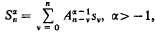
Let
 be any given infinite series with sn as its n-th partial sum.
We write
and

where

 be any given infinite series with s


Mixed Boundary-Value Problems in Potential Theory
-
- Journal:
- Proceedings of the Edinburgh Mathematical Society / Volume 22 / Issue 2 / June 1979
- Published online by Cambridge University Press:
- 20 January 2009, pp. 91-98
-
- Article
-
- You have access
- Export citation
The mean lattice point discrepancy
-
- Journal:
- Proceedings of the Edinburgh Mathematical Society / Volume 38 / Issue 3 / October 1995
- Published online by Cambridge University Press:
- 20 January 2009, pp. 523-531
-
- Article
-
- You have access
- Export citation
Sturm–Liouville problems with eigenparameter dependent boundary conditions
-
- Journal:
- Proceedings of the Edinburgh Mathematical Society / Volume 37 / Issue 1 / February 1994
- Published online by Cambridge University Press:
- 20 January 2009, pp. 57-72
-
- Article
-
- You have access
- Export citation
-
Sturm theory is extended to the equation

for 1/p, q, r∈L1 [0, 1] with p, r > 0, subject to boundary conditions

and

Oscillation and comparison results are given, and asymptotic estimates are developed. Interlacing of eigenvalues with those of a standard Sturm–Liouville problem where the boundary conditions are ajy(j) = cj(py′)(j), j=0, 1, forms a key tool.

Experimental Introduction to the Study of Magnetism
-
- Journal:
- Proceedings of the Edinburgh Mathematical Society / Volume 10 / February 1891
- Published online by Cambridge University Press:
- 20 January 2009, pp. 50-59
-
- Article
-
- You have access
- Export citation
J. G. Semple, and G. T. Kneebone, Algebraic Curves (Clarendon Press: Oxford University Press, 1959), 361 pp., 45s.
-
- Journal:
- Proceedings of the Edinburgh Mathematical Society / Volume 12 / Issue 3 / June 1961
- Published online by Cambridge University Press:
- 20 January 2009, pp. 165-166
-
- Article
-
- You have access
- Export citation
Perfect categories
-
- Journal:
- Proceedings of the Edinburgh Mathematical Society / Volume 20 / Issue 2 / September 1976
- Published online by Cambridge University Press:
- 20 January 2009, pp. 95-97
-
- Article
-
- You have access
- Export citation
Coverings and embeddings of inverse semigroups
-
- Journal:
- Proceedings of the Edinburgh Mathematical Society / Volume 36 / Issue 3 / October 1993
- Published online by Cambridge University Press:
- 20 January 2009, pp. 399-419
-
- Article
-
- You have access
- Export citation
PETER PINKERTON, M.A., D.SC, LL.D., F.R.S.E.
-
- Journal:
- Proceedings of the Edinburgh Mathematical Society / Volume 2 / Issue 4 / June 1931
- Published online by Cambridge University Press:
- 20 January 2009, pp. 268-271
-
- Article
-
- You have access
- Export citation
Trigonometrical Ratios of (A±B)
-
- Journal:
- Proceedings of the Edinburgh Mathematical Society / Volume 40 / February 1921
- Published online by Cambridge University Press:
- 20 January 2009, pp. 60-61
-
- Article
-
- You have access
- Export citation
On the Teaching of Geometry
-
- Journal:
- Proceedings of the Edinburgh Mathematical Society / Volume 24 / February 1905
- Published online by Cambridge University Press:
- 20 January 2009, p. 30
-
- Article
-
- You have access
- Export citation
Paulo Ribenboim, Functions, Limits, and Continuity(John Wiley and Sons, Inc., 1964), vii+140 pp., 45s.
-
- Journal:
- Proceedings of the Edinburgh Mathematical Society / Volume 15 / Issue 2 / December 1966
- Published online by Cambridge University Press:
- 20 January 2009, p. 160
-
- Article
-
- You have access
- Export citation
Supplementary Bibliography
-
- Journal:
- Proceedings of the Edinburgh Mathematical Society / Volume 28 / February 1909
- Published online by Cambridge University Press:
- 20 January 2009, p. 178
-
- Article
-
- You have access
- Export citation
Bipolar and Toroidal Harmonics
-
- Journal:
- Proceedings of the Edinburgh Mathematical Society / Volume 34 / February 1915
- Published online by Cambridge University Press:
- 20 January 2009, pp. 102-108
-
- Article
-
- You have access
- Export citation
-
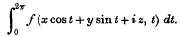
Most of the solutions of Laplace's equation in common use in mathematical physics have been expressed in the integral form given by Whittaker, viz
Dual integral equations with a trigonometric Kernel*
-
- Journal:
- Proceedings of the Edinburgh Mathematical Society / Volume 22 / Issue 3 / October 1979
- Published online by Cambridge University Press:
- 20 January 2009, pp. 213-215
-
- Article
-
- You have access
- Export citation
-
In this paper, we solve the following dual integral equations


where δ is a real positive constant and f(x) is a continuous and integrable function of x in [0, a]. The dual integral equations (1) and (2) arise in a crack problem of elasticity.
V. Bryant and H. Perfect, Independence Theory in Combinatorics (Chapman and Hall, 1980), £5.50 (soft cover).
-
- Journal:
- Proceedings of the Edinburgh Mathematical Society / Volume 25 / Issue 3 / October 1982
- Published online by Cambridge University Press:
- 20 January 2009, p. 282
-
- Article
-
- You have access
- Export citation
Total Graphs and Traversability
-
- Journal:
- Proceedings of the Edinburgh Mathematical Society / Volume 15 / Issue 2 / December 1966
- Published online by Cambridge University Press:
- 20 January 2009, pp. 117-120
-
- Article
-
- You have access
- Export citation
Lang Serge, Introduction to Modular Forms (Grundlehren der mathematischen Wissenschaften 222, Springer-Verlag, 1976), 261 pp., Cloth DM 5400, U.S. $22.20.
-
- Journal:
- Proceedings of the Edinburgh Mathematical Society / Volume 21 / Issue 1 / March 1978
- Published online by Cambridge University Press:
- 20 January 2009, pp. 91-92
-
- Article
-
- You have access
- Export citation
Rees matrix semigroups
-
- Journal:
- Proceedings of the Edinburgh Mathematical Society / Volume 33 / Issue 1 / February 1990
- Published online by Cambridge University Press:
- 20 January 2009, pp. 23-37
-
- Article
-
- You have access
- Export citation
