Refine search
Actions for selected content:
26077 results in Abstract analysis
On the division of a parallelepiped into tetrahedra without making new corners
-
- Journal:
- Proceedings of the Edinburgh Mathematical Society / Volume 12 / February 1893
- Published online by Cambridge University Press:
- 20 January 2009, pp. 106-107
-
- Article
-
- You have access
- Export citation
On Rankine's Formula for Earth Pressure
-
- Journal:
- Proceedings of the Edinburgh Mathematical Society / Volume 8 / February 1889
- Published online by Cambridge University Press:
- 20 January 2009, pp. 77-80
-
- Article
-
- You have access
- Export citation
K. K. Jensen and K. Thomsen Elements of KK-theory (Mathematics: Theory and Applications, Birkhauser, Basel-Boston-Berlin1991), viii + 202 pp. 3 7643 3496 7, sFr. 98.
-
- Journal:
- Proceedings of the Edinburgh Mathematical Society / Volume 35 / Issue 3 / October 1992
- Published online by Cambridge University Press:
- 20 January 2009, pp. 519-520
-
- Article
-
- You have access
- Export citation
J. H. Wilkinson, The Algebraic Eigenvalue Problem (Clarendon Press, Oxford, 1965), 662pp., 110s.
-
- Journal:
- Proceedings of the Edinburgh Mathematical Society / Volume 15 / Issue 4 / December 1967
- Published online by Cambridge University Press:
- 20 January 2009, p. 328
-
- Article
-
- You have access
- Export citation
Sterling K. Berberian, Notes on Spectral Theory (D. van Nostrand Co. Ltd., 1966), 118 pp., 20s.
-
- Journal:
- Proceedings of the Edinburgh Mathematical Society / Volume 16 / Issue 1 / June 1968
- Published online by Cambridge University Press:
- 20 January 2009, p. 82
-
- Article
-
- You have access
- Export citation
§5. Orthocentre
-
- Journal:
- Proceedings of the Edinburgh Mathematical Society / Volume 1 / February 1883
- Published online by Cambridge University Press:
- 20 January 2009, pp. 60-96
-
- Article
-
- You have access
- Export citation
Geometrical Interpretation of a few concomitants of the cubic in the Argand Plane
-
- Journal:
- Proceedings of the Edinburgh Mathematical Society / Volume 42 / February 1923
- Published online by Cambridge University Press:
- 20 January 2009, pp. 41-45
-
- Article
-
- You have access
- Export citation
-

be the binary cubic whose coefficients a1, are complex numbers represented on the Argand Plane. Then if its roots are z1, z2, z3, the three corresponding points form the vertices of a triangle A1 A2 A3. Let this triad of points be said to represent the cubic. Then its Hessian

is represented by a certain pair of other points; likewise every first polar

associates a definite pair of points (z) with any given point (y).
Prime essential rings
-
- Journal:
- Proceedings of the Edinburgh Mathematical Society / Volume 34 / Issue 2 / June 1991
- Published online by Cambridge University Press:
- 20 January 2009, pp. 241-250
-
- Article
-
- You have access
- Export citation
R. Kaluża Through a reporter's eyes: the life of Stefan Banach (Birkhäuser, Boston-Basel-Berlin, 1996), 167 pp., 3 7643 3772 9 (hardcover), £17.
-
- Journal:
- Proceedings of the Edinburgh Mathematical Society / Volume 40 / Issue 1 / February 1997
- Published online by Cambridge University Press:
- 20 January 2009, pp. 211-213
-
- Article
-
- You have access
- Export citation
Closed linear operators with domain containing their range
-
- Journal:
- Proceedings of the Edinburgh Mathematical Society / Volume 27 / Issue 2 / June 1984
- Published online by Cambridge University Press:
- 20 January 2009, pp. 229-233
-
- Article
-
- You have access
- Export citation
Some remarks on Levi complements and roots in Lie algebras with cone potential
-
- Journal:
- Proceedings of the Edinburgh Mathematical Society / Volume 35 / Issue 1 / February 1992
- Published online by Cambridge University Press:
- 20 January 2009, pp. 71-87
-
- Article
-
- You have access
- Export citation
SOME INTERESTING SPECIAL CASES OF A NON-LOCAL PROBLEM MODELLING OHMIC HEATING WITH VARIABLE THERMAL CONDUCTIVITY
-
- Journal:
- Proceedings of the Edinburgh Mathematical Society / Volume 44 / Issue 3 / October 2001
- Published online by Cambridge University Press:
- 20 January 2009, pp. 585-595
-
- Article
-
- You have access
- Export citation
M. Reid Undergraduate algebraic geometry (London Mathematical Society Student Texts 12, Cambridge University Press, Cambridge1988), viii + 129 pp, hard covers: 0 521 35559 1, £20; paper: 0 521 35662 8, £7.50.
-
- Journal:
- Proceedings of the Edinburgh Mathematical Society / Volume 32 / Issue 3 / October 1989
- Published online by Cambridge University Press:
- 20 January 2009, pp. 497-498
-
- Article
-
- You have access
- Export citation
PEM volume 20 issue 2 Cover and Back matter
-
- Journal:
- Proceedings of the Edinburgh Mathematical Society / Volume 20 / Issue 2 / September 1976
- Published online by Cambridge University Press:
- 20 January 2009, p. b1
-
- Article
-
- You have access
- Export citation
B. Kolman, Introductory Linear Algebra with Applications (Macmillan, 1976), xvi+426 pp.
-
- Journal:
- Proceedings of the Edinburgh Mathematical Society / Volume 22 / Issue 1 / February 1979
- Published online by Cambridge University Press:
- 20 January 2009, pp. 72-73
-
- Article
-
- You have access
- Export citation
PEM volume 38 issue 3 Cover and Back matter
-
- Journal:
- Proceedings of the Edinburgh Mathematical Society / Volume 38 / Issue 3 / October 1995
- Published online by Cambridge University Press:
- 20 January 2009, pp. b1-b7
-
- Article
-
- You have access
- Export citation
P. S. Novikov, Elements of Mathematical Logic (Oliver and Boyd, Edinburgh, 1964), 308 pp., 50s.
-
- Journal:
- Proceedings of the Edinburgh Mathematical Society / Volume 14 / Issue 3 / June 1965
- Published online by Cambridge University Press:
- 20 January 2009, pp. 245-246
-
- Article
-
- You have access
- Export citation
Decomposition of the n-Dimensional Lattice-Graph into Hamiltonian Lines
-
- Journal:
- Proceedings of the Edinburgh Mathematical Society / Volume 12 / Issue 3 / June 1961
- Published online by Cambridge University Press:
- 20 January 2009, pp. 123-131
-
- Article
-
- You have access
- Export citation
The Polar Properties of the Plane Trinodal Quartic Curve
-
- Journal:
- Proceedings of the Edinburgh Mathematical Society / Volume 3 / Issue 1 / March 1932
- Published online by Cambridge University Press:
- 20 January 2009, pp. 30-36
-
- Article
-
- You have access
- Export citation
A lower bound for the number of zeros of a meromorphic function and its second derivative
-
- Journal:
- Proceedings of the Edinburgh Mathematical Society / Volume 39 / Issue 1 / February 1996
- Published online by Cambridge University Press:
- 20 January 2009, pp. 171-185
-
- Article
-
- You have access
- Export citation
-
We prove that for a function f(z) transcendental and meromorphic in the plane and not of the form exp(az + b), we have either N(r, 1/ff″)≠0(T(r, f′/f)) or
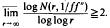 .
.
 .
.