Refine search
Actions for selected content:
26077 results in Abstract analysis
A Proof of the Binomial Theorem, with some Applications
-
- Journal:
- Proceedings of the Edinburgh Mathematical Society / Volume 38 / February 1919
- Published online by Cambridge University Press:
- 20 January 2009, pp. 6-9
-
- Article
-
- You have access
- Export citation
On semigroup algebras and semisimple semilattice sums of rings
-
- Journal:
- Proceedings of the Edinburgh Mathematical Society / Volume 24 / Issue 2 / June 1981
- Published online by Cambridge University Press:
- 20 January 2009, pp. 87-90
-
- Article
-
- You have access
- Export citation
-
Let P be a semilattice. In (5), a ring T is called a supplementary semilattice sum of subringsTα (α∈P) if the following conditions hold:
 TαTβ⊆Tαβ for all α,β∈P, and
 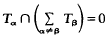 for each α∈P. Thus, as an abelian group, T is a direct sum of the additive subgroups Tα (α∈P), and the multiplicative structure of T is strongly influenced by the semilattice P. Properties of these rings have been studied extensively in (2), (3), (5), and (6).
 T
T for each α∈P. Thus, as an abelian group, T is a direct sum of the additive subgroups T
Theorems on Normals of an Ellipse
-
- Journal:
- Proceedings of the Edinburgh Mathematical Society / Volume 15 / February 1896
- Published online by Cambridge University Press:
- 20 January 2009, pp. 70-73
-
- Article
-
- You have access
- Export citation
-
The condition that the normals at the points whose eccentric angles are α, β, γ shall be concurrent is

The following method of establishing this result, as compared with those given in works on Concis, is direct, and also has the advantage of simplicity, by first proving the Trigonometrical identity

which may be simply done by multiplying both sides of the wellknown identity

when it will be easily found that the product in the first member reduces to that in (A) with opposite sign.
D. J. H. Garling, A course in Galois theory (Cambridge University Press, 1986), pp. 167, cloth £22.50, paper £8.95.
-
- Journal:
- Proceedings of the Edinburgh Mathematical Society / Volume 31 / Issue 1 / February 1988
- Published online by Cambridge University Press:
- 20 January 2009, pp. 166-167
-
- Article
-
- You have access
- Export citation
Differentiability of solutions of systems with impulse effect with respect to initial data and parameter
-
- Journal:
- Proceedings of the Edinburgh Mathematical Society / Volume 31 / Issue 3 / October 1988
- Published online by Cambridge University Press:
- 20 January 2009, pp. 353-368
-
- Article
-
- You have access
- Export citation
On normal subgroups of direct products
-
- Journal:
- Proceedings of the Edinburgh Mathematical Society / Volume 33 / Issue 2 / June 1990
- Published online by Cambridge University Press:
- 20 January 2009, pp. 309-319
-
- Article
-
- You have access
- Export citation
The Apolar Locus of Two Tetrads of Points
-
- Journal:
- Proceedings of the Edinburgh Mathematical Society / Volume 35 / February 1916
- Published online by Cambridge University Press:
- 20 January 2009, pp. 10-23
-
- Article
-
- You have access
- Export citation
Note on the hodograph of non-holonomic dynamical systems
-
- Journal:
- Proceedings of the Edinburgh Mathematical Society / Volume 6 / Issue 3 / August 1940
- Published online by Cambridge University Press:
- 20 January 2009, pp. 176-180
-
- Article
-
- You have access
- Export citation
-
Consider a non-holonomic dynamical system specified by the N coordinates qi, and kinetic energy defined by
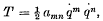
where amn are functions of qi and the dot denotes differentiation with respect to the time t.
PEM volume 8 issue 2 Cover and Front matter
-
- Journal:
- Proceedings of the Edinburgh Mathematical Society / Volume 8 / Issue 2 / October 1948
- Published online by Cambridge University Press:
- 20 January 2009, pp. f1-f2
-
- Article
-
- You have access
- Export citation
On an Asymptotic Expansion of the Hypergeometric Function
-
- Journal:
- Proceedings of the Edinburgh Mathematical Society / Volume 42 / February 1923
- Published online by Cambridge University Press:
- 20 January 2009, pp. 84-87
-
- Article
-
- You have access
- Export citation
-
In a previous paper the author has employed the expansion

where


and

to establish the theorem that, if −π/2<amp γ<π/2, the function Ps/Ts+1 remains finite as γ→∞. This theorem is valid provided that z is not real and ≧ 1.
Radially symmetric solutions of a class of singular elliptic equations
-
- Journal:
- Proceedings of the Edinburgh Mathematical Society / Volume 33 / Issue 2 / June 1990
- Published online by Cambridge University Press:
- 20 January 2009, pp. 169-180
-
- Article
-
- You have access
- Export citation
-
The boundary value problem
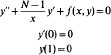
is studied with a view to obtaining the existence of positive solutions in C1([0, 1])∩C2((0, 1)). The function f is assumed to be singular in the second variable, with the singularity modeled after the special case f(x, y) = a(x)y−p, p>0.
This boundary value problem arises in the search of positive radially symmetric solutions to
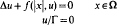
where Ω is the open unit ball in ℝN, centered at the origin, Γ is its boundary and |x| is the Euclidean norm of x.
On Spheroidal Harmonics and Allied Functions
-
- Journal:
- Proceedings of the Edinburgh Mathematical Society / Volume 33 / February 1914
- Published online by Cambridge University Press:
- 20 January 2009, pp. 118-121
-
- Article
-
- You have access
- Export citation
-
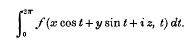
In a paper recently read before this Society, Mr E. Blades obtained a general formula for spheroidal harmonics in the form of the general solution of Laplace's equation given by Professor Whittaker,
If spheroidal coordinates r, θ, φ are defined by
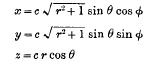
the result obtained is

On γ-transformations of series
-
- Journal:
- Proceedings of the Edinburgh Mathematical Society / Volume 6 / Issue 3 / August 1940
- Published online by Cambridge University Press:
- 20 January 2009, pp. 123-127
-
- Article
-
- You have access
- Export citation
-
The theorems given here deal with the efficiency, mutual consistency, and regularity of γ-transformations.
§1. Theorem 1. The necessary and sufficient conditions that γ-matrices are efficient for all divergent series whose partial sums are bounded, are
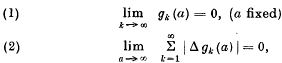
where Δgk(a)≡gk(a)−gk+1(a).
Professor W. L. Edge
-
- Journal:
- Proceedings of the Edinburgh Mathematical Society / Volume 41 / Issue 3 / October 1998
- Published online by Cambridge University Press:
- 20 January 2009, pp. 631-641
-
- Article
-
- You have access
- Export citation
Concurrency of lines joining vertices of a triangle to opposite vertices of triangles on its sides
-
- Journal:
- Proceedings of the Edinburgh Mathematical Society / Volume 32 / February 1913
- Published online by Cambridge University Press:
- 20 January 2009, pp. 58-64
-
- Article
-
- You have access
- Export citation
Sum of two inner functions and exposed points in H1
-
- Journal:
- Proceedings of the Edinburgh Mathematical Society / Volume 35 / Issue 3 / October 1992
- Published online by Cambridge University Press:
- 20 January 2009, pp. 349-357
-
- Article
-
- You have access
- Export citation
-
If h is an outer function in H1 then it is shown that h = (q1 + q2)g where both q1 and q2 are inner functions with Im
 almost everywhere, and g is a strong outer function (equivalently, g/∥g∥1 is an exposed point of the unit ball of H1). If q1 + q2 is nonconstant then such an h is not strongly outer. Moreover a sum of two inner functions is studied.
 almost everywhere, and g is a strong outer function (equivalently, g/∥g∥
Certain characterizations of varieties of bands
-
- Journal:
- Proceedings of the Edinburgh Mathematical Society / Volume 31 / Issue 2 / June 1988
- Published online by Cambridge University Press:
- 20 January 2009, pp. 301-319
-
- Article
-
- You have access
- Export citation
Groups with prescribed automorphism group: A clarification
-
- Journal:
- Proceedings of the Edinburgh Mathematical Society / Volume 27 / Issue 1 / February 1984
- Published online by Cambridge University Press:
- 20 January 2009, pp. 59-60
-
- Article
-
- You have access
- Export citation
Idempotent endomorphisms of an independence algebra of finite rank*
-
- Journal:
- Proceedings of the Edinburgh Mathematical Society / Volume 38 / Issue 1 / February 1995
- Published online by Cambridge University Press:
- 20 January 2009, pp. 107-116
-
- Article
-
- You have access
- Export citation
The Solutions of Mathieu's Differential Equation: Representation by Contour Integrals, and Asymptotic Expansions
-
- Journal:
- Proceedings of the Edinburgh Mathematical Society / Volume 44 / February 1925
- Published online by Cambridge University Press:
- 20 January 2009, pp. 57-71
-
- Article
-
- You have access
- Export citation
