Refine search
Actions for selected content:
26077 results in Abstract analysis
Poles and Polars of a Conic
-
- Journal:
- Proceedings of the Edinburgh Mathematical Society / Volume 26 / February 1907
- Published online by Cambridge University Press:
- 20 January 2009, pp. 93-94
-
- Article
-
- You have access
- Export citation
K. W. Morton and D. F. Mayers Numerical solution of partial differential equations (Cambridge University Press, Cambridge1994), 227 pp., hardcover: 0 521 41855 0, £35.00, paperback: 0 5214 2922 6, £13.95.
-
- Journal:
- Proceedings of the Edinburgh Mathematical Society / Volume 38 / Issue 3 / October 1995
- Published online by Cambridge University Press:
- 20 January 2009, pp. 544-545
-
- Article
-
- You have access
- Export citation
On the Envelope of the Directrices of a System of Similar Conics through three Points
-
- Journal:
- Proceedings of the Edinburgh Mathematical Society / Volume 29 / February 1910
- Published online by Cambridge University Press:
- 20 January 2009, pp. 35-38
-
- Article
-
- You have access
- Export citation
Varieties and d.g. near-rings
-
- Journal:
- Proceedings of the Edinburgh Mathematical Society / Volume 17 / Issue 3 / June 1971
- Published online by Cambridge University Press:
- 20 January 2009, pp. 271-274
-
- Article
-
- You have access
- Export citation
-
In this note we show that the variety of near-rings generated by d.g. near-rings is the class of all near-rings R satisfying

This extends a result of J. J. Malone (3) on the embedding of near-rings.
On the form in Polar co-ordinates of certain expressions occurring in Elastic Solids and in Hydrodynamics
-
- Journal:
- Proceedings of the Edinburgh Mathematical Society / Volume 3 / February 1884
- Published online by Cambridge University Press:
- 20 January 2009, pp. 109-114
-
- Article
-
- You have access
- Export citation
On the lower radical construction of Tangeman and Kreiling
-
- Journal:
- Proceedings of the Edinburgh Mathematical Society / Volume 33 / Issue 2 / June 1990
- Published online by Cambridge University Press:
- 20 January 2009, pp. 203-205
-
- Article
-
- You have access
- Export citation
Determination of the radii of the circles which touch three given circles
-
- Journal:
- Proceedings of the Edinburgh Mathematical Society / Volume 23 / February 1904
- Published online by Cambridge University Press:
- 20 January 2009, pp. 75-79
-
- Article
-
- You have access
- Export citation
Surfaces with isometric geodesics
-
- Journal:
- Proceedings of the Edinburgh Mathematical Society / Volume 34 / Issue 3 / October 1991
- Published online by Cambridge University Press:
- 20 January 2009, pp. 359-362
-
- Article
-
- You have access
- Export citation
Weighted spaces of harmonic and holomorphic functions: sequence space representations and protective descriptions
-
- Journal:
- Proceedings of the Edinburgh Mathematical Society / Volume 40 / Issue 1 / February 1997
- Published online by Cambridge University Press:
- 20 January 2009, pp. 41-62
-
- Article
-
- You have access
- Export citation
Finitely Embedded Modules Over Group Rings
-
- Journal:
- Proceedings of the Edinburgh Mathematical Society / Volume 21 / Issue 1 / March 1978
- Published online by Cambridge University Press:
- 20 January 2009, pp. 55-64
-
- Article
-
- You have access
- Export citation
Office-Bearers
-
- Journal:
- Proceedings of the Edinburgh Mathematical Society / Volume 10 / February 1891
- Published online by Cambridge University Press:
- 20 January 2009, p. 1
-
- Article
-
- You have access
- Export citation
Some theorems on absolute Cesàro summability
-
- Journal:
- Proceedings of the Edinburgh Mathematical Society / Volume 6 / Issue 2 / October 1939
- Published online by Cambridge University Press:
- 20 January 2009, pp. 114-122
-
- Article
-
- You have access
- Export citation
-
1. It is convenient to begin with a brief statement of the notation which will be used throughout this paper.
Let k be any positive number and let
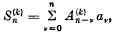
where
 is the coefficient of xn in the formal expansion of (1 – x )–k–1, and let
Then the series Σαn is said to be summable(C, k) if
 is convergent, that is, if
  tends to a limit, and absolutely summable (C, k), or summable |C, k|, if is absolutely convergent.
 is the coefficient of x
 is convergent, that is, if
  tends to a limit, and absolutely summable (C, k), or summable |C, k|, if
 T. Banchoff, T. Gaffney and C. McCrory Cusps of Gauss mappings (Research Notes in Mathematics 55, Pitman, 1981), 89 pp. £7.95
-
- Journal:
- Proceedings of the Edinburgh Mathematical Society / Volume 26 / Issue 2 / June 1983
- Published online by Cambridge University Press:
- 20 January 2009, p. 283
-
- Article
-
- You have access
- Export citation
Ergodic properties of Brownian Motion
-
- Journal:
- Proceedings of the Edinburgh Mathematical Society / Volume 23 / Issue 3 / October 1980
- Published online by Cambridge University Press:
- 20 January 2009, pp. 331-340
-
- Article
-
- You have access
- Export citation
P. A. Perry, Scattering theory by the Enss method (Mathematical Reports Vol. 1, Part 1, Harwood Academic Publishers, New York, 1983) xiv + 347 pp., $82.
-
- Journal:
- Proceedings of the Edinburgh Mathematical Society / Volume 27 / Issue 3 / October 1984
- Published online by Cambridge University Press:
- 20 January 2009, p. 350
-
- Article
-
- You have access
- Export citation
E. G. Phillips, A Course of Analysis (Cambridge Students' Editions, C.U.P., 1961), 361 pp., 15s.
-
- Journal:
- Proceedings of the Edinburgh Mathematical Society / Volume 13 / Issue 1 / June 1962
- Published online by Cambridge University Press:
- 20 January 2009, pp. 115-116
-
- Article
-
- You have access
- Export citation
On the Computation of a Lagrangian Interpolation
-
- Journal:
- Proceedings of the Edinburgh Mathematical Society / Volume 35 / February 1916
- Published online by Cambridge University Press:
- 20 January 2009, pp. 78-82
-
- Article
-
- You have access
- Export citation
The Absolute Summability (A) of Fourier Series
-
- Journal:
- Proceedings of the Edinburgh Mathematical Society / Volume 2 / Issue 3 / January 1931
- Published online by Cambridge University Press:
- 20 January 2009, pp. 129-134
-
- Article
-
- You have access
- Export citation
-
In a recent paper Dr J. M. Whittaker has shown that the Fourier series

of a function f(θ) which has a Lebesgue integral in (— π, π), is absolutely summable (A) to sum l, if
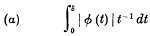
exists, where
 .
.
Edinburgh Mathematical Society
-
- Journal:
- Proceedings of the Edinburgh Mathematical Society / Volume 7 / Issue 4 / October 1946
- Published online by Cambridge University Press:
- 20 January 2009, pp. 207-214
-
- Article
-
- You have access
- Export citation
The ideal structure of idempotent-generated transformation semigroups
-
- Journal:
- Proceedings of the Edinburgh Mathematical Society / Volume 28 / Issue 3 / October 1985
- Published online by Cambridge University Press:
- 20 January 2009, pp. 319-331
-
- Article
-
- You have access
- Export citation
-
Let X be a set and
 the semigroup (under composition) of all total transformations from X into itself. In ([6], Theorem 3) Howie characterised those elements of that can be written as a product of idempotents in different from the identity. We gather from review articles that his work was later extended by Evseev and Podran [3, 4] (and independently for finite X by Sullivan [15]) to the semigroup
  of all partial transformations of X into itself. Howie's result was generalized in a different direction by Kim [8], and it has also been considered in both a topological and a totally ordered setting (see [11] and [14] for brief summaries of this latter work). In addition, Magill [10] investigated the corresponding idea for endomorphisms of a Boolean ring, while J. A. Erdos [2] resolved the analogous problem for linear transformations of a finite–dimensional vector space.
 the semigroup (under composition) of all total transformations from X into itself. In ([
 of all partial transformations of X into itself. Howie's result was generalized in a different direction by Kim [