Refine search
Actions for selected content:
26077 results in Abstract analysis
On a Method of Studying Displacement
-
- Journal:
- Proceedings of the Edinburgh Mathematical Society / Volume 15 / February 1896
- Published online by Cambridge University Press:
- 20 January 2009, pp. 119-128
-
- Article
-
- You have access
- Export citation
-
Let a rigid body
 suffer a displacement to a new position, where it will be denoted by
Then any point A belonging to
will take up a position A′ in . Let B be the point of F which coincides with A′. Then corresponding to B in there will be a point B′ in . Let this again coincide with C in , and so on. We have thus a sequence or chain of points whose relation may be thus indicated
 suffer a displacement to a new position, where it will be denoted by
The computation of the Hodgkin-Snaith operation in K*(Z × BU, Z/p)
-
- Journal:
- Proceedings of the Edinburgh Mathematical Society / Volume 29 / Issue 1 / February 1986
- Published online by Cambridge University Press:
- 20 January 2009, pp. 41-45
-
- Article
-
- You have access
- Export citation
-
This paper builds on the work of V. P. Snaith [5] (in particular Section 6) and gives a more explicit determination of the result.
Recently J. E. McLure has given a satisfactory account of Dyer-Lashof operations in X-theory. For any E∞-space Y and for any r≧2 there is a map

with specific properties (see [3], Theorem 1). Earlier, L. Hodgkin [2] and V. P. Snaith [5] constructed an operation

where Ind(Y) = {xp\x∈Kα(Y,Z/p)} is the indeterminancy of
 .
.
 .
.A Problem in the Theory of Numbers
-
- Journal:
- Proceedings of the Edinburgh Mathematical Society / Volume 26 / February 1907
- Published online by Cambridge University Press:
- 20 January 2009, pp. 95-96
-
- Article
-
- You have access
- Export citation
-
One of the well known properties of the number 7 is that when
 is reduced to a decimal, the periods of two digits are obtained to infinity by successive doubling. It is interesting to find for what other numbers this property is true.
Let n be any number, and r the base of notation, then
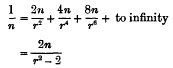
 is reduced to a decimal, the periods of two digits are obtained to infinity by successive doubling. It is interesting to find for what other numbers this property is true.
Office-Bearers
-
- Journal:
- Proceedings of the Edinburgh Mathematical Society / Volume 16 / February 1897
- Published online by Cambridge University Press:
- 20 January 2009, p. 1
-
- Article
-
- You have access
- Export citation
Semimodularity and bisimple ω-semigroups
-
- Journal:
- Proceedings of the Edinburgh Mathematical Society / Volume 17 / Issue 1 / June 1970
- Published online by Cambridge University Press:
- 20 January 2009, pp. 79-81
-
- Article
-
- You have access
- Export citation
-
Let S be a completely 0-simple semigroup and let Λ(S) be the lattice of congruences on S. G. Lallement (2) has described necessary and sufficient conditions on S for Λ(S) to be modular, and has shown that Λ(S) is always semimodular
 . This result may be stated: If S is 0-bisimple and contains a primitive idempotent, then Λ(S) is semimodular.
 . This result may be stated: If S is 0-bisimple and contains a primitive idempotent, then Λ(S) is semimodular.
On k-Conjugacy in a Group
-
- Journal:
- Proceedings of the Edinburgh Mathematical Society / Volume 14 / Issue 1 / June 1964
- Published online by Cambridge University Press:
- 20 January 2009, pp. 1-4
-
- Article
-
- You have access
- Export citation
Linear isometries on subalgebras of uniformly continuous functions
-
- Journal:
- Proceedings of the Edinburgh Mathematical Society / Volume 43 / Issue 1 / February 2000
- Published online by Cambridge University Press:
- 20 January 2009, pp. 139-147
-
- Article
-
- You have access
- Export citation
Inverse multiparameter eigenvalue problems for matrices III
-
- Journal:
- Proceedings of the Edinburgh Mathematical Society / Volume 31 / Issue 1 / February 1988
- Published online by Cambridge University Press:
- 20 January 2009, pp. 151-155
-
- Article
-
- You have access
- Export citation
-
This note will complement and, in a certain sense, complete our earlier studies [3, 4] of the theory of inverse multiparameter eigenvalue problems for matrices. In those papers, we considered the so called “additive inverse problem” which, briefly stated for the 2-parameter case, asks for conditions on given n × n matrices A, B, C and on given points (si, ti) ∈ ℝ2, 1 ≦ i ≦ n, under which a diagonal matrix D can be found so that the 2-parameter eigenvalue problem

can be solved when (λ,μ)=(si, ti), 1 = i = n. Put another way, we look for conditions ensuring that the points (si, ti), 1 ≦ i ≦ n, belong to the eigenvalues of (1.1).
Relative relation modules of finite groups
-
- Journal:
- Proceedings of the Edinburgh Mathematical Society / Volume 34 / Issue 3 / October 1991
- Published online by Cambridge University Press:
- 20 January 2009, pp. 433-442
-
- Article
-
- You have access
- Export citation
-
Let E be a free product of a finite number of cyclic groups, and S a normal subgroup of E such that E/S ≅ G is finite. For a prime p, Ŝ = S / S′Sp may be regarded as an
 -module. Whenever E is a free group, Ŝ is called a relation module (modulo p); in general we call Ŝ a relative relation module (modulo p). Gaschütz, Gruenberg and others have studied relation modules; the aim of this paper is to study relative relation modules.
 -module. Whenever E is a free group, Ŝ is called a relation module (modulo p); in general we call Ŝ a relative relation module (modulo p). Gaschütz, Gruenberg and others have studied relation modules; the aim of this paper is to study relative relation modules.
On the greatest prime Factor of a polynomial
-
- Journal:
- Proceedings of the Edinburgh Mathematical Society / Volume 16 / Issue 4 / December 1969
- Published online by Cambridge University Press:
- 20 January 2009, pp. 301-303
-
- Article
-
- You have access
- Export citation
Small fractional parts of quadratic forms
-
- Journal:
- Proceedings of the Edinburgh Mathematical Society / Volume 25 / Issue 3 / October 1982
- Published online by Cambridge University Press:
- 20 January 2009, pp. 269-277
-
- Article
-
- You have access
- Export citation
-
Let ‖x‖ denote the distance of x from the nearest integer. In 1948 H. Heilbronn proved [5] that for ε>0 and N>c1(ε) the inequality

holds for any real α. This result has since been generalised in many different directions, and we consider here extensions of the type: For ε>0, N>c2{ε, s) and a quadratic formQ(x1,…, xs) there exist integersn1,…,nsnot all zero with |n1|,…,|ns≦N and with

Semi-embeddings of Banach space
-
- Journal:
- Proceedings of the Edinburgh Mathematical Society / Volume 22 / Issue 3 / October 1979
- Published online by Cambridge University Press:
- 20 January 2009, pp. 233-240
-
- Article
-
- You have access
- Export citation
PEM volume 40 issue 1 Cover and Front matter
-
- Journal:
- Proceedings of the Edinburgh Mathematical Society / Volume 40 / Issue 1 / February 1997
- Published online by Cambridge University Press:
- 20 January 2009, pp. f1-f2
-
- Article
-
- You have access
- Export citation
Space sextic curves with six bitangents, and some geometry of the diagonal cubic surface
-
- Journal:
- Proceedings of the Edinburgh Mathematical Society / Volume 40 / Issue 1 / February 1997
- Published online by Cambridge University Press:
- 20 January 2009, pp. 85-97
-
- Article
-
- You have access
- Export citation
Strongly exposed points in bases for the positive cone of ordered Banach spaces and characterizations of l1(Г)
-
- Journal:
- Proceedings of the Edinburgh Mathematical Society / Volume 29 / Issue 2 / June 1986
- Published online by Cambridge University Press:
- 20 January 2009, pp. 271-282
-
- Article
-
- You have access
- Export citation
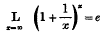
Note on the Inequality Theorems that lead up to the Exponential Limit
-
- Journal:
- Proceedings of the Edinburgh Mathematical Society / Volume 17 / February 1898
- Published online by Cambridge University Press:
- 20 January 2009, pp. 33-37
-
- Article
-
- You have access
- Export citation
Approximation and spectral properties of periodic spline operators
-
- Journal:
- Proceedings of the Edinburgh Mathematical Society / Volume 34 / Issue 3 / October 1991
- Published online by Cambridge University Press:
- 20 January 2009, pp. 363-382
-
- Article
-
- You have access
- Export citation
-
We consider discrete convolution operators
 whose range is the k-dimensional space
  spanned by the translates of a single function. Examples of include the space of trigonometric polynomials, periodic polynomial splines and trigonometric splines. The eigenfunctions of these operators corresponding to the nonzero eigenvalues are independent of α, and they form an orthogonal basis for . The limiting behaviour of as α, k→∞, is also considered. The corresponding limiting semigroups are computed explicitly.
 whose range is the k-dimensional space
  spanned by the translates of a single function. Examples of
 The Circles associated with the Triangle, viewed from their Centres of Similitude
-
- Journal:
- Proceedings of the Edinburgh Mathematical Society / Volume 2 / February 1883
- Published online by Cambridge University Press:
- 20 January 2009, pp. 2-4
-
- Article
-
- You have access
- Export citation
The Turning-Values of Cubic and Quartic Functions and the Nature of the Roots of Cubic and Quartic Equations
-
- Journal:
- Proceedings of the Edinburgh Mathematical Society / Volume 23 / February 1904
- Published online by Cambridge University Press:
- 20 January 2009, pp. 43-48
-
- Article
-
- You have access
- Export citation
-
Let a cubic function be denoted by

Put
 and the function takes the form
Consider the graph of this function, represented by


 and the function takes the form
A Mechanical Construction for the Quartic Trisectrix
-
- Journal:
- Proceedings of the Edinburgh Mathematical Society / Volume 21 / February 1902
- Published online by Cambridge University Press:
- 20 January 2009, pp. 138-139
-
- Article
-
- You have access
- Export citation
