Refine search
Actions for selected content:
26077 results in Abstract analysis
The Edinburgh Mathematical Society
-
- Journal:
- Proceedings of the Edinburgh Mathematical Society / Volume 1 / February 1883
- Published online by Cambridge University Press:
- 20 January 2009, pp. 1-2
-
- Article
-
- You have access
- Export citation
On a certain class of Linear Substitutions with Common Invariants, and an Associated Substitution of Order Four
-
- Journal:
- Proceedings of the Edinburgh Mathematical Society / Volume 31 / February 1912
- Published online by Cambridge University Press:
- 20 January 2009, pp. 54-70
-
- Article
-
- You have access
- Export citation
-
The determinant
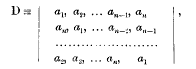
each row of wliich contains the same n elements in the same cyclic order, with ′a1 always in the leading diagonal, is the product of n linear factors, which we shall write as follows

where ρ is any primitive nth root of unity.
J. W. S. Cassels and a Committee appointed by the London Mathematical Society (eds.) The collected papers of J. E. Littlewood, 2 volumes (Oxford University Press, 1982), xxxviii + 1675 pp. £120 the set.
-
- Journal:
- Proceedings of the Edinburgh Mathematical Society / Volume 26 / Issue 3 / October 1983
- Published online by Cambridge University Press:
- 20 January 2009, pp. 395-396
-
- Article
-
- You have access
- Export citation
F. Chorlton, Textbook of Dynamics (D. van Nostrand Co. Ltd., London, 1963), 263 pp. Paper 25s., Cloth 45s.
-
- Journal:
- Proceedings of the Edinburgh Mathematical Society / Volume 14 / Issue 1 / June 1964
- Published online by Cambridge University Press:
- 20 January 2009, p. 83
-
- Article
-
- You have access
- Export citation
M. J. Tomkinson FC-groups (Research Notes in Mathematics 96, Pitman, 1984), 188 pp. £8.95.
-
- Journal:
- Proceedings of the Edinburgh Mathematical Society / Volume 29 / Issue 1 / February 1986
- Published online by Cambridge University Press:
- 20 January 2009, pp. 143-144
-
- Article
-
- You have access
- Export citation
S. Fiorini and R. J. Wilson, Edge Colourings of Graphs (Research Notes in Mathematics 16, Pitman, 1977), 154 pp., £6–50.
-
- Journal:
- Proceedings of the Edinburgh Mathematical Society / Volume 22 / Issue 1 / February 1979
- Published online by Cambridge University Press:
- 20 January 2009, p. 65
-
- Article
-
- You have access
- Export citation
PEM volume 11 issue 3 Cover and Back matter
-
- Journal:
- Proceedings of the Edinburgh Mathematical Society / Volume 11 / Issue 3 / May 1959
- Published online by Cambridge University Press:
- 20 January 2009, pp. b1-b2
-
- Article
-
- You have access
- Export citation
On Determinantal Symmetric Functions
-
- Journal:
- Proceedings of the Edinburgh Mathematical Society / Volume 4 / Issue 1 / March 1934
- Published online by Cambridge University Press:
- 20 January 2009, pp. 47-52
-
- Article
-
- You have access
- Export citation
-
§ 1. The theory of symmetric polynomials abounds in dual identities and symmetries of various kinds. It has been investigated from the determinantal standpoint largely by means of quotients of alternants, such as,

the denominator being the difference product of a, b, c, …, a simple alternant.
Centraliser near-ring representations
-
- Journal:
- Proceedings of the Edinburgh Mathematical Society / Volume 25 / Issue 2 / June 1982
- Published online by Cambridge University Press:
- 20 January 2009, pp. 145-153
-
- Article
-
- You have access
- Export citation
Robert Schlapp, M.A., Ph.D., F.R.S.E. 1899–1991
-
- Journal:
- Proceedings of the Edinburgh Mathematical Society / Volume 35 / Issue 2 / June 1992
- Published online by Cambridge University Press:
- 20 January 2009, pp. 329-334
-
- Article
-
- You have access
- Export citation
Deduction of the Thermodynamical Relations
-
- Journal:
- Proceedings of the Edinburgh Mathematical Society / Volume 10 / February 1891
- Published online by Cambridge University Press:
- 20 January 2009, pp. 41-43
-
- Article
-
- You have access
- Export citation
On the solitary wave
-
- Journal:
- Proceedings of the Edinburgh Mathematical Society / Volume 9 / February 1890
- Published online by Cambridge University Press:
- 20 January 2009, p. 49
-
- Article
-
- You have access
- Export citation
Longitudinal Elastic Waves in Cylinders and Tubes—Including Thermoelastic Effects
-
- Journal:
- Proceedings of the Edinburgh Mathematical Society / Volume 11 / Issue 3 / May 1959
- Published online by Cambridge University Press:
- 20 January 2009, pp. 153-159
-
- Article
-
- You have access
- Export citation
Theorems analogous to Newton's Theorems on Symmetric Functions, with Elementary Proofs
-
- Journal:
- Proceedings of the Edinburgh Mathematical Society / Volume 32 / February 1913
- Published online by Cambridge University Press:
- 20 January 2009, pp. 44-48
-
- Article
-
- You have access
- Export citation
A Hughes-like property for finite groups
-
- Journal:
- Proceedings of the Edinburgh Mathematical Society / Volume 38 / Issue 3 / October 1995
- Published online by Cambridge University Press:
- 20 January 2009, pp. 533-541
-
- Article
-
- You have access
- Export citation
A. Châtelet, L' Arithmétique des Corps Quadratiques (Monographies de L'Enseignement mathematique, No. 9, 1962), 257 pp., 26 fr. S.
-
- Journal:
- Proceedings of the Edinburgh Mathematical Society / Volume 13 / Issue 4 / December 1963
- Published online by Cambridge University Press:
- 20 January 2009, p. 344
-
- Article
-
- You have access
- Export citation
James B. Scarborough, The Gyroscope—Theory and Application, (Interscience Publishers, New York and London, 1958), pp. xii + 257, $6.50.
-
- Journal:
- Proceedings of the Edinburgh Mathematical Society / Volume 11 / Issue 3 / May 1959
- Published online by Cambridge University Press:
- 20 January 2009, p. 193
-
- Article
-
- You have access
- Export citation
Paruchuri K. Krishnaiah (Editor), Multivariate Analysis (Academic Press, 1966), xix + 592 pp., 156s.
-
- Journal:
- Proceedings of the Edinburgh Mathematical Society / Volume 16 / Issue 2 / December 1968
- Published online by Cambridge University Press:
- 20 January 2009, p. 182
-
- Article
-
- You have access
- Export citation
Note on a property of a quadrilateral
-
- Journal:
- Proceedings of the Edinburgh Mathematical Society / Volume 10 / February 1891
- Published online by Cambridge University Press:
- 20 January 2009, pp. 94-95
-
- Article
-
- You have access
- Export citation
Near-rings of quotients of endomorphism near-rings
-
- Journal:
- Proceedings of the Edinburgh Mathematical Society / Volume 19 / Issue 4 / September 1975
- Published online by Cambridge University Press:
- 20 January 2009, pp. 345-352
-
- Article
-
- You have access
- Export citation
-
Let
 be a category with finite products and a final object and let X be any group object in . The set of -morphisms,
  (X, X) is, in a natural way, a near-ring which we call the endomorphism near-ring of X in Such nearrings have previously been studied in the case where is the category of pointed sets and mappings, (6). Generally speaking, if Γ is an additive group and S is a semigroup of endomorphisms of Γ then a near-ring can be generated naturally by taking all zero preserving mappings of Γ into itself which commute with S (see 1). This type of near-ring is again an endomorphism near-ring, only the category is the category of S-acts and S-morphisms (see (4) for definition of S-act, etc.).
 be a category with finite products and a final object and let X be any group object in
  (X, X) is, in a natural way, a near-ring which we call the endomorphism near-ring of X in