Refine search
Actions for selected content:
26078 results in Abstract analysis
Oblique Incidence of a train of Plane Waves on a Semi-Infinite Plane
-
- Journal:
- Proceedings of the Edinburgh Mathematical Society / Volume 19 / February 1900
- Published online by Cambridge University Press:
- 20 January 2009, pp. 71-77
-
- Article
-
- You have access
- Export citation
S. Collings, Theoretical Statistics — Basic Ideas Volume II (Transworld Student Library), 148 pp., £0·85 (paperback).
-
- Journal:
- Proceedings of the Edinburgh Mathematical Society / Volume 20 / Issue 4 / September 1977
- Published online by Cambridge University Press:
- 20 January 2009, pp. 363-364
-
- Article
-
- You have access
- Export citation
Asymptotic tracts of harmonic functions II
-
- Journal:
- Proceedings of the Edinburgh Mathematical Society / Volume 38 / Issue 1 / February 1995
- Published online by Cambridge University Press:
- 20 January 2009, pp. 35-52
-
- Article
-
- You have access
- Export citation
-
An asymptotic tract of a real function u harmonic and non-constant in ℂ is a component of the set {z:u(z)≠c}, for some real number c; a quasi-tractT(≠ℂ) is an unbounded simply-connected domain in ℂ such that there exists a function u that is positive, unbounded and harmonic in T such that, for each point ζ∈∂T∩ℂ,

and a ℱ-tract is an unbounded simply-connected domain T in ℂ whose every prime end that contains ∞ in its impression is of the first kind.
The authors study the growth of a harmonic function in one of its asymptotic tracts, and the question of whether a quasi-tract is an asymptotic tract. The branching of either type of tract is also taken into consideration.

Some dual aspects of the Poisson kernel
-
- Journal:
- Proceedings of the Edinburgh Mathematical Society / Volume 33 / Issue 2 / June 1990
- Published online by Cambridge University Press:
- 20 January 2009, pp. 207-232
-
- Article
-
- You have access
- Export citation
-
The Poisson kernel
 is defined for z in the open unit disc D and ζ in the unit circle ∂D. As usually employed, it is integrated with respect to the second variable and a measure on ∂D to yield a harmonic function on D. Here, we fix a σ-finite positive Borel measure m on D and integrate the Poisson kernel with respect to the first variable against a function φ in L1(m) to obtain a function Tmφ on ∂D. We ask for what measures m the range of Tm is L1(∂D), for what m the kernel of Tm is non-zero, and for what m every positive continuous function on ∂D is of the form Tmφ with φ non-negative. When m is the counting measure of a countably infinite subset {ak:k∈ℕ} of D, the function (Tmφ)(ζ) is of the form
  with
with  . The main results generalize results previously obtained for sums of this form. A related mapping from Lp(m) into Lp(∂D) with 1 <p<∞ is briefly considered.
 is defined for z in the open unit disc D and ζ in the unit circle ∂D. As usually employed, it is integrated with respect to the second variable and a measure on ∂D to yield a harmonic function on D. Here, we fix a σ-finite positive Borel measure m on D and integrate the Poisson kernel with respect to the first variable against a function φ in L
 with
with  . The main results generalize results previously obtained for sums of this form. A related mapping from L
Cauchy problems for second order hyperbolic differential equations with constant coefficients
-
- Journal:
- Proceedings of the Edinburgh Mathematical Society / Volume 26 / Issue 3 / October 1983
- Published online by Cambridge University Press:
- 20 January 2009, pp. 307-311
-
- Article
-
- You have access
- Export citation
On the order of magnitude of Jacobsthal's function
-
- Journal:
- Proceedings of the Edinburgh Mathematical Society / Volume 20 / Issue 4 / September 1977
- Published online by Cambridge University Press:
- 20 January 2009, pp. 329-331
-
- Article
-
- You have access
- Export citation
-
Let n be an integer with n > 1. Jacobsthal (3) defines g(n) to be the least integer so that amongst any g(n) consecutive integers a + 1, a + 2, … a + g(n) there is at least one coprime with n. In other words, if

then

It is probably true that

where ω(n) denotes the number of different prime divisors of n, and Erdos (1) has pointed out that by the small sieve it is possible to show that there is a constant C such that

A General Basis Theorem
-
- Journal:
- Proceedings of the Edinburgh Mathematical Society / Volume 11 / Issue 3 / May 1959
- Published online by Cambridge University Press:
- 20 January 2009, pp. 139-141
-
- Article
-
- You have access
- Export citation
P. Rosenstiehl, and J. Mothes, Mathematics in Management, translated from the French by MrsA. Silvey (North Holland Publishing, Co., Amsterdam, 1968), xvi+392 pp.
-
- Journal:
- Proceedings of the Edinburgh Mathematical Society / Volume 17 / Issue 3 / June 1971
- Published online by Cambridge University Press:
- 20 January 2009, pp. 283-284
-
- Article
-
- You have access
- Export citation
PEM volume 1 issue 4 Cover and Front matter
-
- Journal:
- Proceedings of the Edinburgh Mathematical Society / Volume 1 / Issue 4 / July 1929
- Published online by Cambridge University Press:
- 20 January 2009, pp. f1-f2
-
- Article
-
- You have access
- Export citation
Commutation Problems Involving Rings of Infinite Matrices
-
- Journal:
- Proceedings of the Edinburgh Mathematical Society / Volume 14 / Issue 1 / June 1964
- Published online by Cambridge University Press:
- 20 January 2009, pp. 55-60
-
- Article
-
- You have access
- Export citation
-
Let R be a ring and let J be the set of all integers. In the set M(R) of all mappings A: J×J→R, let addition and multiplication be defined by


Here aij denotes the image of (i, j) under A and bij, cij, dij are similarly defined for the mappings B, C, D. In (2) we require A, B to be such that the sum
 is defined and is in R. Thus, in general, M(R) is not closed with respect to multiplication.
 is defined and is in R. Thus, in general, M(R) is not closed with respect to multiplication.
The length of the continued fraction expansion for a class of rational functions in

-
- Journal:
- Proceedings of the Edinburgh Mathematical Society / Volume 34 / Issue 1 / February 1991
- Published online by Cambridge University Press:
- 20 January 2009, pp. 7-17
-
- Article
-
- You have access
- Export citation
-
A study is made of the length L(h, k) of the continued fraction algorithm for h/k where h and k are co-prime polynomials in
 a finite field. In addition we investigate the sum of the degrees of the partial quotients in this expansion for h/k, h, k in
  . The above continued fraction is determined by means of the Euclidean algorithm for the polynomials h, k in .

 a finite field. In addition we investigate the sum of the degrees of the partial quotients in this expansion for h/k, h, k in
  . The above continued fraction is determined by means of the Euclidean algorithm for the polynomials h, k in
 On the Divisibility of certain Numbers
-
- Journal:
- Proceedings of the Edinburgh Mathematical Society / Volume 4 / February 1885
- Published online by Cambridge University Press:
- 20 January 2009, pp. 55-56
-
- Article
-
- You have access
- Export citation
The Diffraction of Transient Electro-Magnetic Waves by a Wedge
-
- Journal:
- Proceedings of the Edinburgh Mathematical Society / Volume 11 / Issue 2 / November 1958
- Published online by Cambridge University Press:
- 20 January 2009, pp. 95-103
-
- Article
-
- You have access
- Export citation
Note on the Integration of

-
- Journal:
- Proceedings of the Edinburgh Mathematical Society / Volume 3 / February 1884
- Published online by Cambridge University Press:
- 20 January 2009, pp. 100-104
-
- Article
-
- You have access
- Export citation
-
The integration of differentials of the form
seems to me to be susceptible of a more methodical mode of treatment than that commonly employed. In the ordinary way of presenting the matter there is little choice left to the student, when such an integration is required of him, between a haphazard, tentative process, and the consultation of a text-book, in which lists of ‘formulae of reduction’ are given.
Note on Tortuous Curves
-
- Journal:
- Proceedings of the Edinburgh Mathematical Society / Volume 24 / February 1905
- Published online by Cambridge University Press:
- 20 January 2009, pp. 51-55
-
- Article
-
- You have access
- Export citation
PEM volume 25 issue 2 Cover and Front matter
-
- Journal:
- Proceedings of the Edinburgh Mathematical Society / Volume 25 / Issue 2 / June 1982
- Published online by Cambridge University Press:
- 20 January 2009, pp. f1-f2
-
- Article
-
- You have access
- Export citation
Note on the Inequality Theorem that mxm–1(x – 1)>xm – 1>m(x – 1) unless when 0<m<1, when mxm–1(x – 1)<xm – 1<m(x – 1), where x is any positive quantity other than unity
-
- Journal:
- Proceedings of the Edinburgh Mathematical Society / Volume 20 / February 1901
- Published online by Cambridge University Press:
- 20 January 2009, pp. 29-30
-
- Article
-
- You have access
- Export citation
On Determinants of Symmetric Functions
-
- Journal:
- Proceedings of the Edinburgh Mathematical Society / Volume 1 / Issue 1 / May 1927
- Published online by Cambridge University Press:
- 20 January 2009, pp. 55-61
-
- Article
-
- You have access
- Export citation
-
The result of dividing the alternant |aαbβcγ…| by the simplest alternant |a0b1c2…| (the difference-product of a, b, c, …) is known to be a symmetric function expressible in two distinct ways, (1) as a determinant having for elements the elementary symmetric functions C, of a, b, c, …, (2) as a determinant having for elements the complete homogeneous symmetric functions Hr. For example
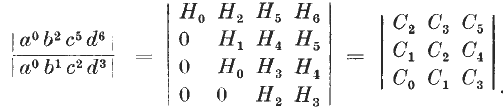
The formation of the (historically earlier) H-determinant is evident. The suffixes in the first row are the indices of the alternant; those of the other rows decrease by unit steps. This result is due to Jacobi.
Note on a curious operational theorem
-
- Journal:
- Proceedings of the Edinburgh Mathematical Society / Volume 8 / February 1889
- Published online by Cambridge University Press:
- 20 January 2009, pp. 21-22
-
- Article
-
- You have access
- Export citation
-
The idea in the following note is evidently capable of very wide development, but it can be made clear by a very simple example.
Whatever be the vectors α, β, γ, δ, we have always

But vector operators are to be treated in all respects like vectors, provided each be always kept before its subject.
On the stationary eccentricity of a system of four-tangent conics
-
- Journal:
- Proceedings of the Edinburgh Mathematical Society / Volume 28 / February 1909
- Published online by Cambridge University Press:
- 20 January 2009, pp. 2-5
-
- Article
-
- You have access
- Export citation
-
Let the convex quadrilateral formed by the four given tangents be ABA′B′, and O the intersection of the diagonals. Let OA and OB be taken as axes of x and y. Denote OA, OA′, OB and OB′ by a, a′, b and b′, a and b being positive, and a′ and b′ negative. The tangential equation of the system is then

where k is a variable parameter; for the equation is satisfied when the straight line lx + my + 1 = 0 passes through any two adjacent angular points of the quadrilateral.
