Refine search
Actions for selected content:
26078 results in Abstract analysis
A Note on Some Theorems for Ordinary Differential Equation
-
- Journal:
- Proceedings of the Edinburgh Mathematical Society / Volume 15 / Issue 2 / December 1966
- Published online by Cambridge University Press:
- 20 January 2009, pp. 165-167
-
- Article
-
- You have access
- Export citation
A series for ζ(s)
-
- Journal:
- Proceedings of the Edinburgh Mathematical Society / Volume 31 / Issue 2 / June 1988
- Published online by Cambridge University Press:
- 20 January 2009, pp. 205-210
-
- Article
-
- You have access
- Export citation
-
We obtain a series representation for ζ(s) valid in Res> – k(<0). This representation is obtained by a sequence of regrouping of the series 1–2−s + 3−s–4−s + …( = (1—21−s)ζ(s), Re s > 0). We can obtain asymptotic relations like

as an application of our series representation for ζ(s).
On Brown–McCoy radical classes in categories
-
- Journal:
- Proceedings of the Edinburgh Mathematical Society / Volume 26 / Issue 3 / October 1983
- Published online by Cambridge University Press:
- 20 January 2009, pp. 337-341
-
- Article
-
- You have access
- Export citation
On the Discriminant of the General Homogeneous Quadric
-
- Journal:
- Proceedings of the Edinburgh Mathematical Society / Volume 18 / February 1900
- Published online by Cambridge University Press:
- 20 January 2009, p. 83
-
- Article
-
- You have access
- Export citation
Note on the Problem of the Electrified Disc
-
- Journal:
- Proceedings of the Edinburgh Mathematical Society / Volume 10 / Issue 3 / January 1956
- Published online by Cambridge University Press:
- 20 January 2009, pp. 123-124
-
- Article
-
- You have access
- Export citation
On certain Quadric Hypersurfaces in Riemannian Space
-
- Journal:
- Proceedings of the Edinburgh Mathematical Society / Volume 4 / Issue 2 / January 1935
- Published online by Cambridge University Press:
- 20 January 2009, pp. 85-91
-
- Article
-
- You have access
- Export citation
On the Equation of the Parabolic Cylinder Functions
-
- Journal:
- Proceedings of the Edinburgh Mathematical Society / Volume 32 / February 1913
- Published online by Cambridge University Press:
- 20 January 2009, pp. 2-14
-
- Article
-
- You have access
- Export citation
-
Hermite, in 1864 (Comptes Rendus, vol. 58) introduced into analysis the polynomials defined by the relation
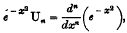
where n is a positive integer. He showed that they satisfied the differential equation
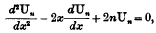
that they were orthogonal functions, and that an arbitrary function f(x) could be expanded in the form

The Wiener-Pitt Phenomenon on the Half-Line
-
- Journal:
- Proceedings of the Edinburgh Mathematical Society / Volume 13 / Issue 1 / June 1962
- Published online by Cambridge University Press:
- 20 January 2009, pp. 37-38
-
- Article
-
- You have access
- Export citation
PEM volume 38 issue 1 Cover and Back matter
-
- Journal:
- Proceedings of the Edinburgh Mathematical Society / Volume 38 / Issue 1 / February 1995
- Published online by Cambridge University Press:
- 20 January 2009, pp. b1-b2
-
- Article
-
- You have access
- Export citation
Note on the number of numbers less than a given number and prime to it
-
- Journal:
- Proceedings of the Edinburgh Mathematical Society / Volume 12 / February 1893
- Published online by Cambridge University Press:
- 20 January 2009, pp. 23-25
-
- Article
-
- You have access
- Export citation
-
The following proof of the well-known result, n being any number, a, b, c the different prime factors that singly, or multiply, compose it
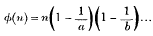
seems worthy of notice.
Geometrical aspects of the system
 and applications to the nonlinear wave equation
-
- Journal:
- Proceedings of the Edinburgh Mathematical Society / Volume 30 / Issue 2 / June 1987
- Published online by Cambridge University Press:
- 20 January 2009, pp. 247-256
-
- Article
-
- You have access
- Export citation
-
Let E be n-dimensional (n≧2) real vector space with a nondegenerate symmetric scalar product (.|.):E × E → R1 with an arbitrary signature (p, n–p). Let us consider a second order partial differential equation (P.D.E.) of the form:

where φ is a given function of two variables, v is an unknown function (defined on an open subset 0 ⊂E), |∇ν|2: =(∇ν|∇ν) is the square of the gradient ∇ν of the function ν and ∇2, denotes the Laplace-Beltrami operator.
 and applications to the nonlinear wave equation
W. K. Hayman and P. B. Kennedy, Subharmonic functions Vol. 1 (London Mathematical Society Monographs No 9, Academic Press, London, 1976), xvii+284 pp., £11·60.
-
- Journal:
- Proceedings of the Edinburgh Mathematical Society / Volume 21 / Issue 1 / March 1978
- Published online by Cambridge University Press:
- 20 January 2009, p. 91
-
- Article
-
- You have access
- Export citation
F. F. Bonsall and J. Duncan, Numerical Ranges II (Cambridge University Press, 1973), vii + 179 pp., £2·40.
-
- Journal:
- Proceedings of the Edinburgh Mathematical Society / Volume 19 / Issue 3 / March 1975
- Published online by Cambridge University Press:
- 20 January 2009, p. 315
-
- Article
-
- You have access
- Export citation
A note on the product of F-subgroups in a finite group
-
- Journal:
- Proceedings of the Edinburgh Mathematical Society / Volume 39 / Issue 1 / February 1996
- Published online by Cambridge University Press:
- 20 January 2009, pp. 37-42
-
- Article
-
- You have access
- Export citation
Multipliers of Bergman spaces into Lebesgue spaces
-
- Journal:
- Proceedings of the Edinburgh Mathematical Society / Volume 29 / Issue 1 / February 1986
- Published online by Cambridge University Press:
- 20 January 2009, pp. 125-131
-
- Article
-
- You have access
- Export citation
-
Let U be the open unit disk in the complex plane endowed with normalized Lebesgue measure m.
 will denote the usual Lebesgue space with respect to m, with 0<p<+∞. The Bergman space consisting of the analytic functions in will be denoted
  . Let μ be some positivefinite Borel measure on U. It has been known for some time (see [6] and [9]) what conditions on μ are equivalent to the estimate: There is a constant C such that
provided 0<p≦q.
 will denote the usual Lebesgue space with respect to m, with 0<p<+∞. The Bergman space consisting of the analytic functions in
  . Let μ be some positivefinite Borel measure on U. It has been known for some time (see [6] and [9]) what conditions on μ are equivalent to the estimate: There is a constant C such that
L. V. Ahlfors, and L. Sario, Riemann Surfaces (Princeton University Press, 1960), xi+382 pp., 80s.
-
- Journal:
- Proceedings of the Edinburgh Mathematical Society / Volume 13 / Issue 1 / June 1962
- Published online by Cambridge University Press:
- 20 January 2009, pp. 117-118
-
- Article
-
- You have access
- Export citation
On the Integration of the Canonic Equations and the Principle of Duality
-
- Journal:
- Proceedings of the Edinburgh Mathematical Society / Volume 28 / February 1909
- Published online by Cambridge University Press:
- 20 January 2009, pp. 6-13
-
- Article
-
- You have access
- Export citation
D. E. Cohen, Combinatorial group theory: a topological approach (London Mathematical Society Student Texts 14, Cambridge University Press, 1989), pp. x + 310, cloth 0 521 34133 7, £30; paper 0 521 34936 2, £11.95.
-
- Journal:
- Proceedings of the Edinburgh Mathematical Society / Volume 33 / Issue 3 / October 1990
- Published online by Cambridge University Press:
- 20 January 2009, p. 498
-
- Article
-
- You have access
- Export citation
A Direct Method of using the Hodograph Plane in Fluid Dynamics
-
- Journal:
- Proceedings of the Edinburgh Mathematical Society / Volume 11 / Issue 2 / November 1958
- Published online by Cambridge University Press:
- 20 January 2009, pp. 107-114
-
- Article
-
- You have access
- Export citation
C. Plumpton and W. A. Tomkys, Sixth Form Pure Mathematics, Vol. I (Pergamon Press, 1962), X+480 pp., 21s.
-
- Journal:
- Proceedings of the Edinburgh Mathematical Society / Volume 13 / Issue 2 / December 1962
- Published online by Cambridge University Press:
- 20 January 2009, p. 196
-
- Article
-
- You have access
- Export citation
