Refine search
Actions for selected content:
26078 results in Abstract analysis
On a Theorem of Gauss
-
- Journal:
- Proceedings of the Edinburgh Mathematical Society / Volume 4 / Issue 3 / August 1935
- Published online by Cambridge University Press:
- 20 January 2009, pp. 118-120
-
- Article
-
- You have access
- Export citation
The different and differentials of local fields with imperfect residue fields
-
- Journal:
- Proceedings of the Edinburgh Mathematical Society / Volume 40 / Issue 2 / June 1997
- Published online by Cambridge University Press:
- 20 January 2009, pp. 353-365
-
- Article
-
- You have access
- Export citation
On a certain expression for a spherical harmonic, with some extensions
-
- Journal:
- Proceedings of the Edinburgh Mathematical Society / Volume 8 / February 1889
- Published online by Cambridge University Press:
- 20 January 2009, pp. 81-89
-
- Article
-
- You have access
- Export citation
A Proof of the Theorem that the Arithmetic Mean of n positive quantities is not less than their Harmonic Mean
-
- Journal:
- Proceedings of the Edinburgh Mathematical Society / Volume 23 / February 1904
- Published online by Cambridge University Press:
- 20 January 2009, p. 54
-
- Article
-
- You have access
- Export citation
Determinants connected with the Periodic Solutions of Mathieu's Equations
-
- Journal:
- Proceedings of the Edinburgh Mathematical Society / Volume 33 / February 1914
- Published online by Cambridge University Press:
- 20 January 2009, pp. 122-138
-
- Article
-
- You have access
- Export citation
-
Various solutions of Mathieu's equation, or the equation of the elliptic cylinder functions

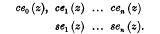
have recently been discussed in an elegant series of papers in these Proceedings. These papers have dealt with the periodic and quasi-periodic solutions, but the present paper merely considers determinants which give the infinite series of relations between a and q, so that the solutions are purely periodic, i.e. the solutions denoted by Professor Whittaker
Birationally Related Cubic
-
- Journal:
- Proceedings of the Edinburgh Mathematical Society / Volume 34 / February 1915
- Published online by Cambridge University Press:
- 20 January 2009, pp. 163-175
-
- Article
-
- You have access
- Export citation
The fundamental groupoid as a topological groupoid
-
- Journal:
- Proceedings of the Edinburgh Mathematical Society / Volume 19 / Issue 3 / March 1975
- Published online by Cambridge University Press:
- 20 January 2009, pp. 237-244
-
- Article
-
- You have access
- Export citation
-
Let X be a topological space. Then we may define the fundamental groupoid πX and also the quotient groupoid (πX)/N for N any wide, totally disconnected, normal subgroupoid N of πX (1). The purpose of this note is to show that if X is locally path-connected and semi-locally 1-connected, then the topology of X determines a “lifted topology” on (πX)/N so that it becomes a topological groupoid over X. With this topology the subspace
 which is the fibre of the initial point map ∂′: (πX)/N→X over x in X, is the usual covering space
  of X determined by the normal subgroup N{x} of the fundamental group π(X, x).
 which is the fibre of the initial point map ∂′: (πX)/N→X over x in X, is the usual covering space
  of X determined by the normal subgroup N{x} of the fundamental group π(X, x).
P. L. Walker, The theory of Fourier series and integrals (John Wiley & Sons, Chichester1968), pp. viii + 192, 0471 90112 1, £14.95.
-
- Journal:
- Proceedings of the Edinburgh Mathematical Society / Volume 31 / Issue 2 / June 1988
- Published online by Cambridge University Press:
- 20 January 2009, p. 331
-
- Article
-
- You have access
- Export citation
D. T. E. Marjoram, Exercises in Modern Mathematics (Pergamon Press, 1964), xiii+250 pp., 15s
-
- Journal:
- Proceedings of the Edinburgh Mathematical Society / Volume 15 / Issue 4 / December 1967
- Published online by Cambridge University Press:
- 20 January 2009, p. 323
-
- Article
-
- You have access
- Export citation
A Property of the Harmonic Triangle of the Complete Quadrangle formed by the four points of contact of the four tangents to the Cubic Curve from a point on it
-
- Journal:
- Proceedings of the Edinburgh Mathematical Society / Volume 29 / February 1910
- Published online by Cambridge University Press:
- 20 January 2009, pp. 2-5
-
- Article
-
- You have access
- Export citation
Adams's Hexagons and Circles
-
- Journal:
- Proceedings of the Edinburgh Mathematical Society / Volume 11 / February 1892
- Published online by Cambridge University Press:
- 20 January 2009, pp. 104-106
-
- Article
-
- You have access
- Export citation
ON THE ACCURACY OF SURFACE SPLINE APPROXIMATION AND INTERPOLATION TO BUMP FUNCTIONS
-
- Journal:
- Proceedings of the Edinburgh Mathematical Society / Volume 44 / Issue 2 / June 2001
- Published online by Cambridge University Press:
- 20 January 2009, pp. 225-239
-
- Article
-
- You have access
- Export citation
PEM volume 32 issue 3 Cover and Front matter
-
- Journal:
- Proceedings of the Edinburgh Mathematical Society / Volume 32 / Issue 3 / October 1989
- Published online by Cambridge University Press:
- 20 January 2009, pp. f1-f2
-
- Article
-
- You have access
- Export citation
On a Group of Transformations connected with the 27 Lines of the Non-Singular Cubic Surface
-
- Journal:
- Proceedings of the Edinburgh Mathematical Society / Volume 36 / February 1917
- Published online by Cambridge University Press:
- 20 January 2009, pp. 17-21
-
- Article
-
- You have access
- Export citation
On the Formula ρ=h2u2(u+u2)
-
- Journal:
- Proceedings of the Edinburgh Mathematical Society / Volume 38 / February 1919
- Published online by Cambridge University Press:
- 20 January 2009, pp. 51-52
-
- Article
-
- You have access
- Export citation
O. Endler, Valuation Theory (Springer-Verlag, Berlin–Heidelberg–New York, 1972), xii + 243 pp., soft cover DM 25, US $8.00.
-
- Journal:
- Proceedings of the Edinburgh Mathematical Society / Volume 19 / Issue 1 / March 1974
- Published online by Cambridge University Press:
- 20 January 2009, p. 103
-
- Article
-
- You have access
- Export citation
The normal vibrations of a rigid spherical punch on the surface of an elastic half-space
-
- Journal:
- Proceedings of the Edinburgh Mathematical Society / Volume 15 / Issue 4 / December 1967
- Published online by Cambridge University Press:
- 20 January 2009, pp. 297-307
-
- Article
-
- You have access
- Export citation
-
A rigid spherical punch vibrates normally on the surface of a semi-infinite isotropic elastic half-space. The essential novelty of this problem, which is treated within the context of classical elasticity, is that of a changing boundary; the radius of the circle of contact on the free surface varies with time. The geometrical co-ordinates are modified to yield a boundary value problem with fixed boundaries. However the governing differential equations become more complicated. These equations are solved by a perturbation procedure for the case where the contact radius a(t) is of the form
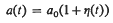
where a0 is constant and |ŋ(t)≪1. Finally the normal stress and the total load under the punch are evaluated in the form of series which are valid for sufficiently slowly varying ŋ(t).
Non-orthogonalisable vector fields on spheres
-
- Journal:
- Proceedings of the Edinburgh Mathematical Society / Volume 27 / Issue 3 / October 1984
- Published online by Cambridge University Press:
- 20 January 2009, pp. 275-281
-
- Article
-
- You have access
- Export citation
-
A (k – l)-field on Sn-1 may be given as a section ϕ of the fibre bundle

with fibre Vn-1, k-1 or, equivalently, as a semi-orthogonal map, i.e., a map

which is isometric in the second variable and such that for the basis vector e1∈Rk and every x∈Rn


PEM volume 2 issue 2 Cover and Back matter
-
- Journal:
- Proceedings of the Edinburgh Mathematical Society / Volume 2 / Issue 2 / June 1930
- Published online by Cambridge University Press:
- 20 January 2009, pp. b1-b2
-
- Article
-
- You have access
- Export citation
List of Members
-
- Journal:
- Proceedings of the Edinburgh Mathematical Society / Volume 37 / February 1918
- Published online by Cambridge University Press:
- 20 January 2009, pp. 97-104
-
- Article
-
- You have access
- Export citation
