Refine search
Actions for selected content:
26078 results in Abstract analysis
Sur une propriété projective des sections coniques
-
- Journal:
- Proceedings of the Edinburgh Mathematical Society / Volume 7 / February 1888
- Published online by Cambridge University Press:
- 20 January 2009, pp. 61-66
-
- Article
-
- You have access
- Export citation
PEM volume 36 Cover and Front matter
-
- Journal:
- Proceedings of the Edinburgh Mathematical Society / Volume 36 / February 1917
- Published online by Cambridge University Press:
- 20 January 2009, pp. f1-f5
-
- Article
-
- You have access
- Export citation
PEM volume 12 issue 4 Cover and Front matter
-
- Journal:
- Proceedings of the Edinburgh Mathematical Society / Volume 12 / Issue 4 / December 1961
- Published online by Cambridge University Press:
- 20 January 2009, pp. f1-f2
-
- Article
-
- You have access
- Export citation
Closed incompressible surfaces in 2-generator hyperbolic 3-manifolds with a single cusp
-
- Journal:
- Proceedings of the Edinburgh Mathematical Society / Volume 36 / Issue 3 / October 1993
- Published online by Cambridge University Press:
- 20 January 2009, pp. 501-513
-
- Article
-
- You have access
- Export citation
PEM volume 2 issue 2 Cover and Front matter
-
- Journal:
- Proceedings of the Edinburgh Mathematical Society / Volume 2 / Issue 2 / June 1930
- Published online by Cambridge University Press:
- 20 January 2009, pp. f1-f2
-
- Article
-
- You have access
- Export citation
On Hardy's Theory of m-Functions
-
- Journal:
- Proceedings of the Edinburgh Mathematical Society / Volume 1 / Issue 2 / March 1928
- Published online by Cambridge University Press:
- 20 January 2009, pp. 129-134
-
- Article
-
- You have access
- Export citation
-
§1. The Cardinal Function of Interpolation Theory is the function

which takes the values an at the points x = n. Ferrar has recently proved
Theorem1. If
 are convergent, C(x)is an m-function3for
This means that C(x) is a solution of the intergral equation

Ferrar's proof deals with functions of a real variable and involves some rather difficult double limit considerations.
 are convergent, C(x)is an m-function
B. Noble Numerical Methods, I: Iteration, Programming and Algebraic Equations (Oliver and Boyd, Edinburgh, 1964), 156 pp., 10s. 6d.
-
- Journal:
- Proceedings of the Edinburgh Mathematical Society / Volume 14 / Issue 2 / December 1964
- Published online by Cambridge University Press:
- 20 January 2009, p. 174
-
- Article
-
- You have access
- Export citation
Non-linear integral equations for Heun functions
-
- Journal:
- Proceedings of the Edinburgh Mathematical Society / Volume 16 / Issue 4 / December 1969
- Published online by Cambridge University Press:
- 20 January 2009, pp. 281-289
-
- Article
-
- You have access
- Export citation
-
Some years ago Lambe and Ward (1) and Erdélyi (2) obtained integral equations for Heun polynomials and Heun functions. The integral equations discussed by these authors were of the form

Further, as is well known, the Heun equation includes, among its special cases, Lamé's equation and Mathieu's equation and so (1.1) may be considered a generalisation of the integral equations satisfied by Lamé polynomials and Mathieu functions. However, integral equations of the type (1.1) are not the only ones satisfied by Lamé polynomials; Arscott (3) discussed a class of non- linear integral equations associated with these functions. This paper then is concerned with discussing the existence of non-linear integral equations satisfied by solutions of Heun's equation.
On the extensions of some classical distributions*
-
- Journal:
- Proceedings of the Edinburgh Mathematical Society / Volume 34 / Issue 1 / February 1991
- Published online by Cambridge University Press:
- 20 January 2009, pp. 19-29
-
- Article
-
- You have access
- Export citation
The Differentiation of an Indefinite Integral
-
- Journal:
- Proceedings of the Edinburgh Mathematical Society / Volume 43 / February 1924
- Published online by Cambridge University Press:
- 20 January 2009, pp. 106-110
-
- Article
-
- You have access
- Export citation
-
Theorem 1 needs very little explanation. It is the converse of the well known theorem that the indefinite integral F(x) of a function f(x) possesses a derivate on the right at every point at which f(x + 0) exists. If f(x + 0) does not exist, nothing can be said as to the existence or otherwise of F+(x); but in a general way we might expect that the integral of a function which oscillates comparatively slowly, say sin (log x) at x = 0, would be more likely to possess a derivate than that of a function which oscillates more rapidly, say
 . It appears from Theorem 1 that this is not by any means the case. In fact the integral of sin (log x) has not a definite derivate at x = 0 while that of has such a derivate.
 . It appears from Theorem 1 that this is not by any means the case. In fact the integral of sin (log x) has not a definite derivate at x = 0 while that of
 Free non-associative principal train algebras
-
- Journal:
- Proceedings of the Edinburgh Mathematical Society / Volume 27 / Issue 3 / October 1984
- Published online by Cambridge University Press:
- 20 January 2009, pp. 313-319
-
- Article
-
- You have access
- Export citation
-
The definitions of finite dimensional baric, train, and special train algebras, and of genetic algebras in the senses of Schafer and Gonshor (which coincide when the ground field is algebraically closed, and which I call special triangular) are given in Worz-Busekros's monograph [8]. In [6] I introduced applications requiring infinite dimensional generalisations. The elements of these algebras were infinite linear forms
 in basis elements a0, a1,… and complex coefficients such that
 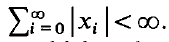 In this paper I consider only algebras whose elements are forms which only a finite number of the xi are non zero.
 in basis elements a
 In this paper I consider only algebras whose elements are forms
 MULTIPLE CONDENSATIONS FOR A NONLINEAR ELLIPTIC EQUATION WITH SUB-CRITICAL GROWTH AND CRITICAL BEHAVIOUR
-
- Journal:
- Proceedings of the Edinburgh Mathematical Society / Volume 44 / Issue 3 / October 2001
- Published online by Cambridge University Press:
- 20 January 2009, pp. 631-660
-
- Article
-
- You have access
- Export citation
On quasinormal subgroups of certain finitely generated groups
-
- Journal:
- Proceedings of the Edinburgh Mathematical Society / Volume 26 / Issue 1 / February 1983
- Published online by Cambridge University Press:
- 20 January 2009, pp. 25-28
-
- Article
-
- You have access
- Export citation
Some results on test elements
-
- Journal:
- Proceedings of the Edinburgh Mathematical Society / Volume 42 / Issue 3 / October 1999
- Published online by Cambridge University Press:
- 20 January 2009, pp. 541-549
-
- Article
-
- You have access
- Export citation
On the solution of the equation xp–1=0 (p being a prime number)
-
- Journal:
- Proceedings of the Edinburgh Mathematical Society / Volume 7 / February 1888
- Published online by Cambridge University Press:
- 20 January 2009, pp. 10-22
-
- Article
-
- You have access
- Export citation
Centralizers of abelian subgroups in locally finite simple groups
-
- Journal:
- Proceedings of the Edinburgh Mathematical Society / Volume 40 / Issue 2 / June 1997
- Published online by Cambridge University Press:
- 20 January 2009, pp. 217-225
-
- Article
-
- You have access
- Export citation
On Differentiating a Matrix
-
- Journal:
- Proceedings of the Edinburgh Mathematical Society / Volume 1 / Issue 2 / March 1928
- Published online by Cambridge University Press:
- 20 January 2009, pp. 111-128
-
- Article
-
- You have access
- Export citation
-
The theorem
 is well known. So also is the theorem that if
  concerning a determinant Λ and its reciprocal expressed by means of cofactors Aij of aij. Not quite so well known is the Cayley Hamilton theorem that a matrix X =[xij] satisfies its own characteristic equation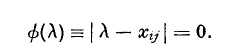
Unlike as these three results are, they nevertheless can be looked upon as particular phases of a general theorem concerning a matrix differential operator
 acting upon a function of a matrix X or its transposed.
 is well known. So also is the theorem that if
  concerning a determinant Λ and its reciprocal expressed by means of cofactors A
 acting upon a function of a matrix X or its transposed.
A Note on Dual Equations With Trigonometrical Kernels
-
- Journal:
- Proceedings of the Edinburgh Mathematical Society / Volume 13 / Issue 3 / June 1963
- Published online by Cambridge University Press:
- 20 January 2009, pp. 267-268
-
- Article
-
- You have access
- Export citation
On the Summability of Series by a Method of Valiron
-
- Journal:
- Proceedings of the Edinburgh Mathematical Society / Volume 4 / Issue 4 / April 1936
- Published online by Cambridge University Press:
- 20 January 2009, pp. 218-223
-
- Article
-
- You have access
- Export citation
-
The method of summability with which I shall be concerned here is denoted by (V, α ) and is defined as follows:—The series Σαn is said to be summable (V, α ) to the sum s if

This is a particular case of a method due to Valiron in which μ–2α is replaced by a function of μ.
On the essential spectrum of Banach-space operators
-
- Journal:
- Proceedings of the Edinburgh Mathematical Society / Volume 43 / Issue 3 / October 2000
- Published online by Cambridge University Press:
- 20 January 2009, pp. 511-528
-
- Article
-
- You have access
- Export citation
-
Let T and S be quasisimilar operators on a Banach space X. A well-known result of Herrero shows that each component of the essential spectrum of T meets the essential spectrum of S. Herrero used that, for an n-multicyclic operator, the components of the essential resolvent set with maximal negative index are simply connected. We give new and conceptually simpler proofs for both of Herrero's results based on the observation that on the essential resolvent set of T the section spaces of the sheaves

are complete nuclear spaces that are topologically dual to each other. Other concrete applications of this result are given.
