Refine search
Actions for selected content:
26078 results in Abstract analysis
PEM volume 26 issue 2 Cover and Fornt matter
-
- Journal:
- Proceedings of the Edinburgh Mathematical Society / Volume 26 / Issue 2 / June 1983
- Published online by Cambridge University Press:
- 20 January 2009, pp. f1-f2
-
- Article
-
- You have access
- Export citation
On the Geometry of the Conic and Triangle
-
- Journal:
- Proceedings of the Edinburgh Mathematical Society / Volume 26 / February 1907
- Published online by Cambridge University Press:
- 20 January 2009, pp. 46-57
-
- Article
-
- You have access
- Export citation
Note
-
- Journal:
- Proceedings of the Edinburgh Mathematical Society / Volume 6 / Issue 3 / August 1940
- Published online by Cambridge University Press:
- 20 January 2009, p. 192
-
- Article
-
- You have access
- Export citation
Generalised Solutions of Laplace's Equation
-
- Journal:
- Proceedings of the Edinburgh Mathematical Society / Volume 2 / Issue 4 / June 1931
- Published online by Cambridge University Press:
- 20 January 2009, pp. 181-188
-
- Article
-
- You have access
- Export citation
On Spheroidal Harmonics
-
- Journal:
- Proceedings of the Edinburgh Mathematical Society / Volume 33 / February 1914
- Published online by Cambridge University Press:
- 20 January 2009, pp. 65-68
-
- Article
-
- You have access
- Export citation
-
Ellipsoidal harmonics are defined to be those solutions of Laplace's equation
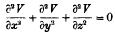
(where x, y, z are rectangular coordinates) which are useful in problems relating to ellipsoids. If the equation

represents a family of confocal quadrics, it is known that the ellipsoidal harmonics belonging to the family are products of the form

where l1, l2… are constants: one term is to be picked out of the square brackets as a multiplier of the other factors. Now if we consider the case in which two of the principal axes of the ellipsoids are equal, the latter become spheroids. If then we put b = 0 in (1) the family of confocal spheroids has the equation
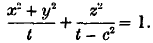
and belonging to this family there will be spheroidal harmonics of the form given by (2) with b zero.
Torsion-free pre-images of modules of finite length
-
- Journal:
- Proceedings of the Edinburgh Mathematical Society / Volume 31 / Issue 3 / October 1988
- Published online by Cambridge University Press:
- 20 January 2009, pp. 397-399
-
- Article
-
- You have access
- Export citation
J. H. Williamson, Lebesgue Integration (Holt, Rinehart and Winston, London, 1962), viii + 117 pp., 26s.
-
- Journal:
- Proceedings of the Edinburgh Mathematical Society / Volume 13 / Issue 3 / June 1963
- Published online by Cambridge University Press:
- 20 January 2009, pp. 262-263
-
- Article
-
- You have access
- Export citation
§6. Euler's line
-
- Journal:
- Proceedings of the Edinburgh Mathematical Society / Volume 1 / February 1883
- Published online by Cambridge University Press:
- 20 January 2009, pp. 97-103
-
- Article
-
- You have access
- Export citation
Bertram Martin Wilson, M.A., D.SC, F.R.S.E.
-
- Journal:
- Proceedings of the Edinburgh Mathematical Society / Volume 4 / Issue 4 / April 1936
- Published online by Cambridge University Press:
- 20 January 2009, pp. 268-269
-
- Article
-
- You have access
- Export citation
Martin Eisen, Elementary Combinatorial Analysis (Gordon and Breach, 1969), x+233 pp., 145s.
-
- Journal:
- Proceedings of the Edinburgh Mathematical Society / Volume 17 / Issue 3 / June 1971
- Published online by Cambridge University Press:
- 20 January 2009, p. 286
-
- Article
-
- You have access
- Export citation
Note on an Equation of Motion
-
- Journal:
- Proceedings of the Edinburgh Mathematical Society / Volume 9 / February 1890
- Published online by Cambridge University Press:
- 20 January 2009, pp. 91-92
-
- Article
-
- You have access
- Export citation
E. Hernández and G. Weiss A first course on wavelets (CRC Press, Boca Raton–New York–London–Tokyo, 1996), 512pp., 0 8493 8274 2, $64.95.
-
- Journal:
- Proceedings of the Edinburgh Mathematical Society / Volume 40 / Issue 3 / October 1997
- Published online by Cambridge University Press:
- 20 January 2009, pp. 614-615
-
- Article
-
- You have access
- Export citation
PEM volume 4 issue 3 Cover and Back matter
-
- Journal:
- Proceedings of the Edinburgh Mathematical Society / Volume 4 / Issue 3 / August 1935
- Published online by Cambridge University Press:
- 20 January 2009, pp. b1-b2
-
- Article
-
- You have access
- Export citation
On a result of S. Koshitani
-
- Journal:
- Proceedings of the Edinburgh Mathematical Society / Volume 27 / Issue 1 / February 1984
- Published online by Cambridge University Press:
- 20 January 2009, p. 57
-
- Article
-
- You have access
- Export citation
On a System of Equations
-
- Journal:
- Proceedings of the Edinburgh Mathematical Society / Volume 8 / Issue 3 / December 1949
- Published online by Cambridge University Press:
- 20 January 2009, pp. 101-105
-
- Article
-
- You have access
- Export citation
-
I propose to prove the following theorem.
With n > 2, the (n + 2) equations derived from the matrix

where

by equating to zero all (n + 1)-rowed determinants from the matrix ‖Δ‖ are equivalent to only two, one of which is linear in li (i = 1, 2, …, n) and the other is homogeneous and quadratic in a certain n – 1 of li (i = 1, 2, …, n); the elements of the matrix are real;
 (r, s = 1, 2, …, n) and d is arbitrary.

 (r, s = 1, 2, …, n) and d is arbitrary.
Direct finiteness of certain monoid algebras
-
- Journal:
- Proceedings of the Edinburgh Mathematical Society / Volume 39 / Issue 2 / June 1996
- Published online by Cambridge University Press:
- 20 January 2009, pp. 365-369
-
- Article
-
- You have access
- Export citation
On the “Flat” Regions of Integral Functions of Finite Order
-
- Journal:
- Proceedings of the Edinburgh Mathematical Society / Volume 2 / Issue 2 / June 1930
- Published online by Cambridge University Press:
- 20 January 2009, pp. 111-128
-
- Article
-
- You have access
- Export citation
Office-Bearers
-
- Journal:
- Proceedings of the Edinburgh Mathematical Society / Volume 32 / February 1913
- Published online by Cambridge University Press:
- 20 January 2009, p. 1
-
- Article
-
- You have access
- Export citation
Inequality Theorem, regarding the lines joining corresponding vertices of two equilateral, or directly similar, triangles
-
- Journal:
- Proceedings of the Edinburgh Mathematical Society / Volume 22 / February 1903
- Published online by Cambridge University Press:
- 20 January 2009, pp. 22-26
-
- Article
-
- You have access
- Export citation
PEM volume 37 issue 3 Cover and Front matter
-
- Journal:
- Proceedings of the Edinburgh Mathematical Society / Volume 37 / Issue 3 / October 1994
- Published online by Cambridge University Press:
- 20 January 2009, pp. f1-f2
-
- Article
-
- You have access
- Export citation
