Refine search
Actions for selected content:
26078 results in Abstract analysis
PEM volume 40 issue 2 Cover and Front matter
-
- Journal:
- Proceedings of the Edinburgh Mathematical Society / Volume 40 / Issue 2 / June 1997
- Published online by Cambridge University Press:
- 20 January 2009, pp. f1-f2
-
- Article
-
- You have access
- Export citation
Points at Infinity, etc., in a plane
-
- Journal:
- Proceedings of the Edinburgh Mathematical Society / Volume 25 / February 1906
- Published online by Cambridge University Press:
- 20 January 2009, pp. 26-35
-
- Article
-
- You have access
- Export citation
J. Heading, Mathematics Problem Book I: Algebra and Complex Numbers (Pergamon Press, 1964), 184 pp., 21s.
-
- Journal:
- Proceedings of the Edinburgh Mathematical Society / Volume 14 / Issue 2 / December 1964
- Published online by Cambridge University Press:
- 20 January 2009, p. 173
-
- Article
-
- You have access
- Export citation
A Theorem of Sonine in Bessel Functions, with two Extensions to Spherical Harmonics
-
- Journal:
- Proceedings of the Edinburgh Mathematical Society / Volume 37 / February 1918
- Published online by Cambridge University Press:
- 20 January 2009, pp. 33-47
-
- Article
-
- You have access
- Export citation
-
In his notable memoir on the Bessel Functions, Sonine proves the elegant result that
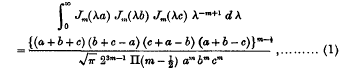
m > –½, provided a plane triangle can be drawn with sides a, b, c; otherwise the value of the integral is zero.
The Abstract Group G3,7,16: A Correction
-
- Journal:
- Proceedings of the Edinburgh Mathematical Society / Volume 13 / Issue 2 / December 1962
- Published online by Cambridge University Press:
- 20 January 2009, p. 188
-
- Article
-
- You have access
- Export citation
PEM volume 5 issue 4 Cover and Front matter
-
- Journal:
- Proceedings of the Edinburgh Mathematical Society / Volume 5 / Issue 4 / September 1938
- Published online by Cambridge University Press:
- 20 January 2009, pp. f1-f5
-
- Article
-
- You have access
- Export citation
A Formula for the Solution of Algebraic or Transcendental Equations
-
- Journal:
- Proceedings of the Edinburgh Mathematical Society / Volume 36 / February 1917
- Published online by Cambridge University Press:
- 20 January 2009, pp. 103-106
-
- Article
-
- You have access
- Export citation
-
Statement of the formula and numerical examples of it.
The object of the present note is to communicate the following formula for the solution of algebraic or transcendental equations:
The root of the equation

Wilhelm Magnus; Abraham Karrass; and Donald Solitar, Combinatorial Group Theory (Interscience Publishers, New York, 1966).
-
- Journal:
- Proceedings of the Edinburgh Mathematical Society / Volume 16 / Issue 1 / June 1968
- Published online by Cambridge University Press:
- 20 January 2009, p. 86
-
- Article
-
- You have access
- Export citation
A Type of Alternant
-
- Journal:
- Proceedings of the Edinburgh Mathematical Society / Volume 9 / Issue 1 / October 1953
- Published online by Cambridge University Press:
- 20 January 2009, pp. 20-27
-
- Article
-
- You have access
- Export citation
-
We define

where ap ≠ aq when p ≠ q. If N = Σλi, then the partition (λ1, λ2, …, λn) of N with λ1 ≥ λ2 ≥ … ≥ λn is denoted by (λ) and we set

All partitions will be in descending order and the usual notation for repeated parts will be used.

PEM volume 5 Cover and Front matter
-
- Journal:
- Proceedings of the Edinburgh Mathematical Society / Volume 5 / February 1886
- Published online by Cambridge University Press:
- 20 January 2009, pp. f1-f5
-
- Article
-
- You have access
- Export citation
On the “elementary” solution of Laplace's Equation
-
- Journal:
- Proceedings of the Edinburgh Mathematical Society / Volume 2 / Issue 3 / January 1931
- Published online by Cambridge University Press:
- 20 January 2009, pp. 135-139
-
- Article
-
- You have access
- Export citation
-
Hadamard defines the “elementary solution” of the general linear partial differential equation of the second order, namely

(Aik, BiC being functions of the n variables x1, x2, .., xn, which may be regarded as coordinates in a space of n dimensions), to be one of those solutions which are infinite to as low an order as possible at a given point and on every bicharacteristic through that point.
Congruence-free regular semigroups
-
- Journal:
- Proceedings of the Edinburgh Mathematical Society / Volume 28 / Issue 1 / February 1985
- Published online by Cambridge University Press:
- 20 January 2009, pp. 113-119
-
- Article
-
- You have access
- Export citation
PEM volume 40 issue 2 Cover and Back matter
-
- Journal:
- Proceedings of the Edinburgh Mathematical Society / Volume 40 / Issue 2 / June 1997
- Published online by Cambridge University Press:
- 20 January 2009, pp. b1-b2
-
- Article
-
- You have access
- Export citation
A. P. Domoryad, Mathematical Games and Pastimes (Pergamon Press; Macmillan, New York, 1964), xi + 298 pp.
-
- Journal:
- Proceedings of the Edinburgh Mathematical Society / Volume 14 / Issue 3 / June 1965
- Published online by Cambridge University Press:
- 20 January 2009, p. 248
-
- Article
-
- You have access
- Export citation
The power inequality on normed spaces
-
- Journal:
- Proceedings of the Edinburgh Mathematical Society / Volume 17 / Issue 3 / June 1971
- Published online by Cambridge University Press:
- 20 January 2009, pp. 237-240
-
- Article
-
- You have access
- Export citation
A Generalisation of a Result of Abel with an Application to Tree Enumerations
-
- Journal:
- Proceedings of the Edinburgh Mathematical Society / Volume 14 / Issue 3 / June 1965
- Published online by Cambridge University Press:
- 20 January 2009, pp. 239-241
-
- Article
-
- You have access
- Export citation
-
We prove the following theorem, which was established by Abel (1) for the case u = 1.
Theorem. If u, k are positive integers and x, 1, , u,are real numbers, then

where the sum
 is taken over all distinct ordered solutions (s1, , su) in non-negative integers of the equation
  .
.
 is taken over all distinct ordered solutions (s
 .
.J.-P. Serre, Trees (Translated from the French by J. Stillwell) (Springer-Verlag, 1980), 142 pp., DM 48.
-
- Journal:
- Proceedings of the Edinburgh Mathematical Society / Volume 25 / Issue 1 / February 1982
- Published online by Cambridge University Press:
- 20 January 2009, pp. 108-109
-
- Article
-
- You have access
- Export citation
On a Certain Type of Space-Tableau
-
- Journal:
- Proceedings of the Edinburgh Mathematical Society / Volume 9 / Issue 2 / November 1954
- Published online by Cambridge University Press:
- 20 January 2009, pp. 82-86
-
- Article
-
- You have access
- Export citation
-
An integer n may be partitioned into the set of integers (α1, α2, …, αl), where
 Whenever αi−1>αi the substitution of αi+1 for αi, where αi may be αi+1≡0, would give a partition of n+1 whilst the substitution of αi−1—1 for αi−1 would give a partition of n—1; partitions of n+1 and of n—1 so arising will be said to be associated with the given partition of n.
 Whenever α
An algorithm for solving generalized algebraic Lyapunov equations in Hilbert space, applications to boundary value problems
-
- Journal:
- Proceedings of the Edinburgh Mathematical Society / Volume 31 / Issue 1 / February 1988
- Published online by Cambridge University Press:
- 20 January 2009, pp. 99-105
-
- Article
-
- You have access
- Export citation
-
Let L(H) be the algebra of all bounded linear operators on a separable complex Hubert space H. In a recent paper [7], explicit expressions for solutions of a boundary value problem in the Hubert space H, of the type
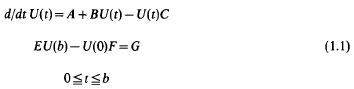
are given in terms of solutions of an algebraic operator equation

Index According to Subjects
-
- Journal:
- Proceedings of the Edinburgh Mathematical Society / Volume 7 / Issue 4 / October 1946
- Published online by Cambridge University Press:
- 20 January 2009, p. 206
-
- Article
-
- You have access
- Export citation
