Refine search
Actions for selected content:
26078 results in Abstract analysis
G. T. Kneebone, Mathematical Logic and the Foundations of Mathematics (Van Nostrand, 1963), xiv+435 pp., 65s.
-
- Journal:
- Proceedings of the Edinburgh Mathematical Society / Volume 13 / Issue 4 / December 1963
- Published online by Cambridge University Press:
- 20 January 2009, pp. 341-342
-
- Article
-
- You have access
- Export citation
On some generalisations of Laguerre polynomials
-
- Journal:
- Proceedings of the Edinburgh Mathematical Society / Volume 6 / Issue 4 / October 1941
- Published online by Cambridge University Press:
- 20 January 2009, pp. 193-221
-
- Article
-
- You have access
- Export citation
-
The sequence of orthogonal functions derived from Laguerre-polynomials is known to be complete, and hence closed, in L2 (0, ∞) if
 (a) > − 1. In a recent paper Dr Kober introduced a generalisation of this sequence, which enables him to extend the known results also for (a) < − 1. Kober's guiding principle seems to be the following one: The Laguerre orthogonal functions form, for (a) > − 1, a complete system of self and skew reciprocal functions of the Hankel transformation of order a. Now, if (a) < − 1, the ordinary Hankel transform has to be replaced by so-called cut Hankel transform. Hence the system of functions which has to replace-Laguerre orthogonal functions when (a) < − 1, should be a complete system of self and skew reciprocal functions of the cut Hankel transformation of order a, such that it reduces for (a) > − 1 (when the cut Hankel transform reduces to the ordinary one) to the sequence of Laguerre orthogonal functions. This, of course, is by no means a unique definition; nevertheless, together with what one would call the permanence of the Mellin transform, it enabled Kober to find a sequence of functions
  which (i) reduces to the sequence of Laguerre orthogonal functions when (a) > − 1, m = 0, (ii) is a complete set of self and skew reciprocal functions of the cut Hankel transformation with kernel Ja, m and (iii) has the required qualities of completeness and closedness.
 (a) > − 1. In a recent paper Dr Kober introduced a generalisation of this sequence, which enables him to extend the known results also for
  which (i) reduces to the sequence of Laguerre orthogonal functions when
 A direct method of obtaining the Foci and Directrices from the general equation

-
- Journal:
- Proceedings of the Edinburgh Mathematical Society / Volume 23 / February 1904
- Published online by Cambridge University Press:
- 20 January 2009, pp. 96-99
-
- Article
-
- You have access
- Export citation
-
The general equation of the second degree in two variables

can be brought by a direct process into the form

the determination of the constants ξ η l, m, n depending only on the solution of quadratic equations; so that the method is suitable for determining the foci, directrices, and eccentricities of conies with given numerical equations.
Distributive p-algebras and double p-algebras having n-permutable congruences
-
- Journal:
- Proceedings of the Edinburgh Mathematical Society / Volume 35 / Issue 2 / June 1992
- Published online by Cambridge University Press:
- 20 January 2009, pp. 301-307
-
- Article
-
- You have access
- Export citation
-
Recent research on aspects of distributive lattices, p-algebras, double p-algebras and de-Morgan algebras (see [2] and the references therein) has led to the consideration of the classes
 (n≧1) of distributive lattices having no n + 1-element chain in their poset of prime ideals. In [1] we were obliged to characterize the members of by a sentence in the first-order theory of distributive lattices. Subsequently (see [2]), it was realised that coincides with the class of distributive lattices having n+1-permutable congruences. This result is hereby employed to describe those distributive p-algebras and double p-algebras having n-permutable congruences. As an application, new characterizations of those distributive p-algebras and double p-algebras having the property that their compact congruences are principal are obtained. In addition, those varieties of distributive p-algebras and double p-algebras having n-permutable congruences are announced.
 (n≧1) of distributive lattices having no n + 1-element chain in their poset of prime ideals. In [1] we were obliged to characterize the members of
 Fatou-Riesz-theorems in general sequence spaces
-
- Journal:
- Proceedings of the Edinburgh Mathematical Society / Volume 23 / Issue 2 / June 1980
- Published online by Cambridge University Press:
- 20 January 2009, pp. 199-205
-
- Article
-
- You have access
- Export citation
-
Consider a formal series
 with partial sums
  and the corresponding power series
  . Throughout we will assume that f is analytic for |z| <1, i.e. that
 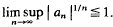 A classical theorem of Fatou-Riesz (see (1, 4)) states that if
  and
and
then
 is convergent to 0.
 with partial sums
  and the corresponding power series
  . Throughout we will assume that f is analytic for |z| <1, i.e. that
  A classical theorem of Fatou-Riesz (see (
 and
and
 is convergent to 0.
On extension of characters from normal subgroups
-
- Journal:
- Proceedings of the Edinburgh Mathematical Society / Volume 27 / Issue 1 / February 1984
- Published online by Cambridge University Press:
- 20 January 2009, pp. 7-9
-
- Article
-
- You have access
- Export citation
“Vortex Rings in a Compressible Fluid”
-
- Journal:
- Proceedings of the Edinburgh Mathematical Society / Volume 6 / February 1887
- Published online by Cambridge University Press:
- 20 January 2009, pp. 59-68
-
- Article
-
- You have access
- Export citation
An extension of de Longchamps' chain of theorems
-
- Journal:
- Proceedings of the Edinburgh Mathematical Society / Volume 6 / Issue 2 / October 1939
- Published online by Cambridge University Press:
- 20 January 2009, pp. 78-84
-
- Article
-
- You have access
- Export citation
Note on a Theorem in Double Series
-
- Journal:
- Proceedings of the Edinburgh Mathematical Society / Volume 22 / February 1903
- Published online by Cambridge University Press:
- 20 January 2009, p. 12
-
- Article
-
- You have access
- Export citation
A nonembedding result for complex Grassmann manifolds
-
- Journal:
- Proceedings of the Edinburgh Mathematical Society / Volume 17 / Issue 2 / December 1970
- Published online by Cambridge University Press:
- 20 January 2009, pp. 149-153
-
- Article
-
- You have access
- Export citation
-
A smooth map
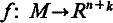 of a differentiable n-manifold into Euclidean (n+k)-space is called an immersion if its Jacobian has rank n at each point of M. If f is also 1-1, it is called an embedding.
 of a differentiable n-manifold into Euclidean (n+k)-space is called an immersion if its Jacobian has rank n at each point of M. If f is also 1-1, it is called an embedding.
The Locus of the Straight Lines which intersect Three Given Lines
-
- Journal:
- Proceedings of the Edinburgh Mathematical Society / Volume 28 / February 1909
- Published online by Cambridge University Press:
- 20 January 2009, pp. 60-61
-
- Article
-
- You have access
- Export citation
-
The following note indicates how the equation to the locus of the straight lines which intersect three given lines may be obtained by the use of the conditions that three planes should have a line of intersection.
Three given planes

have a line of intersection if any two of the determinants in the scheme

are equal to zero.

On Equivalent Truth-Tables of Many-Valued Logics
-
- Journal:
- Proceedings of the Edinburgh Mathematical Society / Volume 10 / Issue 2 / December 1954
- Published online by Cambridge University Press:
- 20 January 2009, pp. 56-61
-
- Article
-
- You have access
- Export citation
-
Many-valued or non-Aristotelian calculi of propositions (logics) were originally introduced by generalisation of the truth-table method. It was known by the end of the nineteenth century that ordinary “binary” formulae of the calculus of propositions, such as


could be verified directly by means of the truth-table:
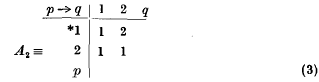
although the terminology and symbolism used were different.
The nonabelian tensor square of a finite split metacyclic group
-
- Journal:
- Proceedings of the Edinburgh Mathematical Society / Volume 30 / Issue 1 / February 1987
- Published online by Cambridge University Press:
- 20 January 2009, pp. 91-95
-
- Article
-
- You have access
- Export citation
-
Given any group G, its tensor square G ⊗ G is defined by the followingpresentation(see [[3]):
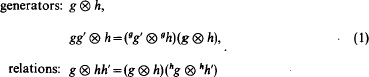
where g,g′,h,h′ range independently over G, and gh=ghg−1. In what follows, gg′ ⊗ gh is often written in the abbreviated form g(g′ ⊗ h).
List of Members—January 1936
-
- Journal:
- Proceedings of the Edinburgh Mathematical Society / Volume 4 / Issue 4 / April 1936
- Published online by Cambridge University Press:
- 20 January 2009, pp. 279-286
-
- Article
-
- You have access
- Export citation
When is the spectrum of a convolution operator on Lp independent of p?
-
- Journal:
- Proceedings of the Edinburgh Mathematical Society / Volume 33 / Issue 2 / June 1990
- Published online by Cambridge University Press:
- 20 January 2009, pp. 327-332
-
- Article
-
- You have access
- Export citation
On Curve Tracings
-
- Journal:
- Proceedings of the Edinburgh Mathematical Society / Volume 14 / February 1895
- Published online by Cambridge University Press:
- 20 January 2009, p. 121
-
- Article
-
- You have access
- Export citation
PEM volume 37 issue 1 Cover and Front matter
-
- Journal:
- Proceedings of the Edinburgh Mathematical Society / Volume 37 / Issue 1 / February 1994
- Published online by Cambridge University Press:
- 20 January 2009, pp. f1-f2
-
- Article
-
- You have access
- Export citation
A Pair of Dual Integral Equations Involving Bessel Functions of the First and the Second Kind
-
- Journal:
- Proceedings of the Edinburgh Mathematical Society / Volume 14 / Issue 2 / December 1964
- Published online by Cambridge University Press:
- 20 January 2009, pp. 149-158
-
- Article
-
- You have access
- Export citation
-
In this paper we give a method for the solution of the dual integral equations


where Jv and Yv are Bessel functions of the first and second kind, −½≦α≦½, f1(ρ) and f2(ρ) are known functions and ψ(ξ) is to be determined. Such equations arise in the discussion of boundary value problems for half-spaces containing a cylindrical cavity. For example, let us take the problem of finding a potential function φ(ρ, θ, z) which satisfies Laplace's equation for

subject to the usual regularity conditions and the following boundary conditions:

A. Ogg, Modular Forms and Dirichlet Series (W. A. Benjamin, Inc., New York, 1969), xviii+173 pp., cloth $15, paper $6.95.
-
- Journal:
- Proceedings of the Edinburgh Mathematical Society / Volume 17 / Issue 3 / June 1971
- Published online by Cambridge University Press:
- 20 January 2009, pp. 285-286
-
- Article
-
- You have access
- Export citation
Note on a Theorem in Continued Fractions
-
- Journal:
- Proceedings of the Edinburgh Mathematical Society / Volume 18 / February 1900
- Published online by Cambridge University Press:
- 20 January 2009, p. 84
-
- Article
-
- You have access
- Export citation
