Refine search
Actions for selected content:
26078 results in Abstract analysis
On a result in Young's quantitative substitutional analysis
-
- Journal:
- Proceedings of the Edinburgh Mathematical Society / Volume 15 / Issue 4 / December 1967
- Published online by Cambridge University Press:
- 20 January 2009, pp. 257-262
-
- Article
-
- You have access
- Export citation
-
In (4) Young investigates the representation in terms of his exact seminormal units
 of substitutional expressions which are unchanged on premultiplication by any permutation of a given set of consecutive letters, or which are changed in sign on premultiplication by an odd permutation of those letters. He illustrates his results by deducing the forms of the matrices representing the positive and negative symmetric groups on a set of consecutive letters.
 of substitutional expressions which are unchanged on premultiplication by any permutation of a given set of consecutive letters, or which are changed in sign on premultiplication by an odd permutation of those letters. He illustrates his results by deducing the forms of the matrices representing the positive and negative symmetric groups on a set of consecutive letters.
A Theorem on Algebras of Measures on Topological Groups
-
- Journal:
- Proceedings of the Edinburgh Mathematical Society / Volume 11 / Issue 4 / November 1959
- Published online by Cambridge University Press:
- 20 January 2009, pp. 195-206
-
- Article
-
- You have access
- Export citation
-
Let G be a locally compact Abelian group, and
 the set of bounded complex (regular countably-additive Borel) measures on G. It is well known that becomes a Banach space if the norm
  is defined by
the supremum being over all finite sets of disjoint Borel subsets of G.
 the set of bounded complex (regular countably-additive Borel) measures on G. It is well known that
  is defined by
K. Kuratowski, Introduction to Set Theory and Topology (Pergamon Press, 1961), 283 pp., 45s.
-
- Journal:
- Proceedings of the Edinburgh Mathematical Society / Volume 13 / Issue 2 / December 1962
- Published online by Cambridge University Press:
- 20 January 2009, p. 195
-
- Article
-
- You have access
- Export citation
Families of SU(2) representations for mapping cylinders of periodic monodromy
-
- Journal:
- Proceedings of the Edinburgh Mathematical Society / Volume 40 / Issue 2 / June 1997
- Published online by Cambridge University Press:
- 20 January 2009, pp. 383-392
-
- Article
-
- You have access
- Export citation
The Dygogram of Axle Reaction of a Pendulum
-
- Journal:
- Proceedings of the Edinburgh Mathematical Society / Volume 26 / February 1907
- Published online by Cambridge University Press:
- 20 January 2009, pp. 21-29
-
- Article
-
- You have access
- Export citation
G. H. Hardy, and E. M. Wright, An Introduction to the Theory of Numbers (Fourth Edition) (Clarendon Press: Oxford University Press, 1960), 421 pp., 42s.
-
- Journal:
- Proceedings of the Edinburgh Mathematical Society / Volume 12 / Issue 3 / June 1961
- Published online by Cambridge University Press:
- 20 January 2009, p. 161
-
- Article
-
- You have access
- Export citation
Theorems in the Products of Related Quantities
-
- Journal:
- Proceedings of the Edinburgh Mathematical Society / Volume 13 / February 1894
- Published online by Cambridge University Press:
- 20 January 2009, pp. 160-165
-
- Article
-
- You have access
- Export citation
-
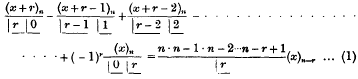
§1. Let (x)u denote the function

then
Automorphism groups of laminated near-rings determined by complex polynomials
-
- Journal:
- Proceedings of the Edinburgh Mathematical Society / Volume 26 / Issue 1 / February 1983
- Published online by Cambridge University Press:
- 20 January 2009, pp. 73-84
-
- Article
-
- You have access
- Export citation
Nilpotents in semigroups of partial order-preserving transformations
-
- Journal:
- Proceedings of the Edinburgh Mathematical Society / Volume 37 / Issue 3 / October 1994
- Published online by Cambridge University Press:
- 20 January 2009, pp. 361-377
-
- Article
-
- You have access
- Export citation
On non-negative spectrum in Banach algebras
-
- Journal:
- Proceedings of the Edinburgh Mathematical Society / Volume 18 / Issue 4 / December 1973
- Published online by Cambridge University Press:
- 20 January 2009, pp. 295-298
-
- Article
-
- You have access
- Export citation
Composition de Mathématiques Élémentaires proposée au Concours d' Agrégation de 1886
-
- Journal:
- Proceedings of the Edinburgh Mathematical Society / Volume 5 / February 1886
- Published online by Cambridge University Press:
- 20 January 2009, pp. 23-28
-
- Article
-
- You have access
- Export citation
-
On donne un cercle et deux points P et Q situés sur un diamètre, on joint les points P et Q aux extrémités A et B d'ux diamètre du cercle par les droites I'A et QB qui se coupent au point M. On fait tourner le diamètre AB et on demande
I. D' étudier les variations du rappo
 et de construire la figure quand le rapport a une
 donnée.
II. D' étudier les variations de l' angle AMB, et de construire la figure quand cet angle a une valeur donnée.
III. A′ et B′ étant les seconds points d' intersection des droites MA, MB avec la circonférence donnée, trouver le, lieu du centre du cercle circonscrit au triangle MA′B′.
 et de construire la figure quand le rapport a une
 donnée.
The natural partial order on an abundant semigroup
-
- Journal:
- Proceedings of the Edinburgh Mathematical Society / Volume 30 / Issue 2 / June 1987
- Published online by Cambridge University Press:
- 20 January 2009, pp. 169-186
-
- Article
-
- You have access
- Export citation
A. M. Stuart and A. R. Humphries Dynamical systems and numerical analysis (Cambridge Monographs on Applied and Computational Mathematics No. 2, Cambridge University Press, 1996), xxii + 685 pp., 0 521 49672 1, (hardback) £40 (US$59.95).
-
- Journal:
- Proceedings of the Edinburgh Mathematical Society / Volume 41 / Issue 1 / February 1998
- Published online by Cambridge University Press:
- 20 January 2009, pp. 213-216
-
- Article
-
- You have access
- Export citation
The Geometrical Interpretation of the Complete System of two Double Binary (2, 1) Forms
-
- Journal:
- Proceedings of the Edinburgh Mathematical Society / Volume 43 / February 1924
- Published online by Cambridge University Press:
- 20 January 2009, pp. 17-25
-
- Article
-
- You have access
- Export citation
-

and

denote two double binary (2–1) forms in (x, ξ). It is proposed to discuss the geometrical significance of their simultaneous covariant complete system, which is here quoted without proof.
Rings with Central Idempotent or Nilpotent Elements
-
- Journal:
- Proceedings of the Edinburgh Mathematical Society / Volume 9 / Issue 4 / May 1958
- Published online by Cambridge University Press:
- 20 January 2009, pp. 157-165
-
- Article
-
- You have access
- Export citation
Dickson–Stirling numbers
-
- Journal:
- Proceedings of the Edinburgh Mathematical Society / Volume 40 / Issue 3 / October 1997
- Published online by Cambridge University Press:
- 20 January 2009, pp. 409-423
-
- Article
-
- You have access
- Export citation
-
The Dickson polynomial Dn, (x, a) of degree n is defined by
 denotes the greatest integer function. In particular, we define D0 (x, a) = 2 for all real x and a. By using Dickson polynomials we present new types of generalized Stirling numbers of the first and second kinds. Some basic properties of these numbers and a combinatorial application to the enumeration of functions on finite sets in terms of their range values is also given.
 denotes the greatest integer function. In particular, we define D
On an Asymptotic Integral
-
- Journal:
- Proceedings of the Edinburgh Mathematical Society / Volume 10 / Issue 3 / January 1956
- Published online by Cambridge University Press:
- 20 January 2009, pp. 141-144
-
- Article
-
- You have access
- Export citation
-
1. This note gives an asymptotic evaluation of an integral of the form

as n tends to infinity, where
 is a sequence of real-valued functions. The theorem to be established is a natural extension of B. Levi's generalised Laplace-Darboux theorem (1, 341-51); it gives a rule for evaluating a wider class of asymptotic integrals.
 is a sequence of real-valued functions. The theorem to be established is a natural extension of B. Levi's generalised Laplace-Darboux theorem (1, 341-51); it gives a rule for evaluating a wider class of asymptotic integrals.
De la Vallée Poussin's Extension of Poisson's Integral
-
- Journal:
- Proceedings of the Edinburgh Mathematical Society / Volume 25 / February 1906
- Published online by Cambridge University Press:
- 20 January 2009, pp. 18-25
-
- Article
-
- You have access
- Export citation
A question concerning Aronhold's Theorems on Bitangents
-
- Journal:
- Proceedings of the Edinburgh Mathematical Society / Volume 8 / Issue 1 / October 1947
- Published online by Cambridge University Press:
- 20 January 2009, pp. 37-38
-
- Article
-
- You have access
- Export citation
A Geometrical Proof of a Theorem connected with the Tetrahedron
-
- Journal:
- Proceedings of the Edinburgh Mathematical Society / Volume 27 / February 1909
- Published online by Cambridge University Press:
- 20 January 2009, pp. 51-53
-
- Article
-
- You have access
- Export citation
