Refine search
Actions for selected content:
26080 results in Abstract analysis
The Absolute Summability of Fourier Series
-
- Journal:
- Proceedings of the Edinburgh Mathematical Society / Volume 2 / Issue 1 / January 1930
- Published online by Cambridge University Press:
- 20 January 2009, pp. 1-5
-
- Article
-
- You have access
- Export citation
-
An elementary proposition states that an absolutely convergent series is convergent, i.e. that if

then

On pseudo-Anosov maps which extend over two handlebodies
-
- Journal:
- Proceedings of the Edinburgh Mathematical Society / Volume 33 / Issue 2 / June 1990
- Published online by Cambridge University Press:
- 20 January 2009, pp. 181-190
-
- Article
-
- You have access
- Export citation
On the relations of certain conics to a triangle
-
- Journal:
- Proceedings of the Edinburgh Mathematical Society / Volume 24 / February 1905
- Published online by Cambridge University Press:
- 20 January 2009, pp. 38-41
-
- Article
-
- You have access
- Export citation
Two infinite integrals
-
- Journal:
- Proceedings of the Edinburgh Mathematical Society / Volume 5 / Issue 4 / September 1938
- Published online by Cambridge University Press:
- 20 January 2009, pp. 174-181
-
- Article
-
- You have access
- Export citation
-
The infinite integrals
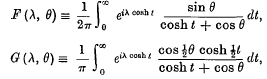
in which λ is positive and – π < θ < π were encountered by Kottler in a problem in the theory of diffraction. They have more recently been studied by Copson and Ferrar, who obtained the remarkably simple Fourier series

in which
 denotes a “cut Bessel function” of the third kind; this expansion is valid when
  the term
  has to be added to the expansion on the right.
 denotes a “cut Bessel function” of the third kind; this expansion is valid when
  the term
  has to be added to the expansion on the right.
The Brocard and Tucker Circles of a Cyclic Quadrilateral
-
- Journal:
- Proceedings of the Edinburgh Mathematical Society / Volume 36 / February 1917
- Published online by Cambridge University Press:
- 20 January 2009, pp. 61-83
-
- Article
-
- You have access
- Export citation
V. I. Arnold Topological invariants of plane curves and caustics (University Lecture Series, Vol. 5, American Mathematical Society, Providence, RI, 1995), 60pp., paperback, 0 8218 0308 5, £17.50.
-
- Journal:
- Proceedings of the Edinburgh Mathematical Society / Volume 39 / Issue 3 / October 1996
- Published online by Cambridge University Press:
- 20 January 2009, pp. 590-591
-
- Article
-
- You have access
- Export citation
The Revolving Chain
-
- Journal:
- Proceedings of the Edinburgh Mathematical Society / Volume 27 / February 1909
- Published online by Cambridge University Press:
- 20 January 2009, pp. 10-31
-
- Article
-
- You have access
- Export citation
On an Algebraical Equation of Professor Cayley's.
-
- Journal:
- Proceedings of the Edinburgh Mathematical Society / Volume 11 / February 1892
- Published online by Cambridge University Press:
- 20 January 2009, p. 85
-
- Article
-
- You have access
- Export citation
Amalgamated sums of groups
-
- Journal:
- Proceedings of the Edinburgh Mathematical Society / Volume 39 / Issue 3 / October 1996
- Published online by Cambridge University Press:
- 20 January 2009, pp. 561-570
-
- Article
-
- You have access
- Export citation
A simple method of establishing relations between Theta-functions of zero argument
-
- Journal:
- Proceedings of the Edinburgh Mathematical Society / Volume 3 / Issue 4 / August 1933
- Published online by Cambridge University Press:
- 20 January 2009, pp. 286-288
-
- Article
-
- You have access
- Export citation
-
In connection with their proof of the fundamental relation

Whittaker and Watson state that “several proofs of this important proposition have been given, but none are simple.”
R. J. Baston and M. G. Eastwood, The Penrose transform: its interaction with representation theory (Oxford Mathematical Monographs, Clarendon Press, Oxford1989), pp. 232, 019 853565 1, £25.
-
- Journal:
- Proceedings of the Edinburgh Mathematical Society / Volume 34 / Issue 3 / October 1991
- Published online by Cambridge University Press:
- 20 January 2009, pp. 497-498
-
- Article
-
- You have access
- Export citation
PEM volume 18 issue 4 Cover and Front matter
-
- Journal:
- Proceedings of the Edinburgh Mathematical Society / Volume 18 / Issue 4 / December 1973
- Published online by Cambridge University Press:
- 20 January 2009, pp. f1-f2
-
- Article
-
- You have access
- Export citation
Equations with torsion-free coefficients
-
- Journal:
- Proceedings of the Edinburgh Mathematical Society / Volume 43 / Issue 2 / June 2000
- Published online by Cambridge University Press:
- 20 January 2009, pp. 295-307
-
- Article
-
- You have access
- Export citation
H. Leblanc, Techniques of Deductive Inference (Prentice Hall, Inc., New Jersey, 1966), vii + 216 pp.
-
- Journal:
- Proceedings of the Edinburgh Mathematical Society / Volume 16 / Issue 1 / June 1968
- Published online by Cambridge University Press:
- 20 January 2009, p. 83
-
- Article
-
- You have access
- Export citation
PEM volume 1 issue 2 Cover and Back matter
-
- Journal:
- Proceedings of the Edinburgh Mathematical Society / Volume 1 / Issue 2 / March 1928
- Published online by Cambridge University Press:
- 20 January 2009, pp. b1-b2
-
- Article
-
- You have access
- Export citation
Conics on a Maschke Surface
-
- Journal:
- Proceedings of the Edinburgh Mathematical Society / Volume 7 / Issue 3 / February 1946
- Published online by Cambridge University Press:
- 20 January 2009, pp. 153-161
-
- Article
-
- You have access
- Export citation
-
The six quaternary quartic forms
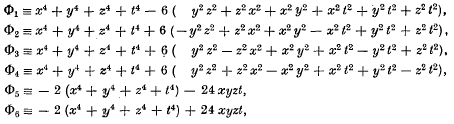
were first obtained by Maschke; it has recently been explained that the quartic surfaces obtained by equating these forms to zero are important constituents of Klein's famous configuration derived from six linear complexes that are mutually in involution. The quartic surface Φi = 0 will be denoted, for each of the six suffixes i, by Mi.
PEM volume 12 issue 4 Cover and Back matter
-
- Journal:
- Proceedings of the Edinburgh Mathematical Society / Volume 12 / Issue 4 / December 1961
- Published online by Cambridge University Press:
- 20 January 2009, pp. b1-b7
-
- Article
-
- You have access
- Export citation
Some theorems on Radical Axes
-
- Journal:
- Proceedings of the Edinburgh Mathematical Society / Volume 1 / February 1883
- Published online by Cambridge University Press:
- 20 January 2009, p. 136
-
- Article
-
- You have access
- Export citation
The Dissection of any two Triangles into mutually similar pairs of Triangles
-
- Journal:
- Proceedings of the Edinburgh Mathematical Society / Volume 18 / February 1900
- Published online by Cambridge University Press:
- 20 January 2009, pp. 5-10
-
- Article
-
- You have access
- Export citation
Asymptotic Behaviour of Eigen-Values of Certain Integral Equations
-
- Journal:
- Proceedings of the Edinburgh Mathematical Society / Volume 22 / Issue 2 / June 1979
- Published online by Cambridge University Press:
- 20 January 2009, pp. 137-144
-
- Article
-
- You have access
- Export citation
-
The integral equations we consider are

and
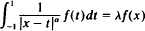
where 0 < α < 1. The asymptotic behaviour of the eigen-values of the latter equation is already known (see (1) and (4)). The former equation has been studied by many authors but as yet no explicit statement seems to have been made about the behaviour of its eigen-values.
