Refine search
Actions for selected content:
26080 results in Abstract analysis
PEM volume 26 issue 1 Cover and Back matter
-
- Journal:
- Proceedings of the Edinburgh Mathematical Society / Volume 26 / Issue 1 / February 1983
- Published online by Cambridge University Press:
- 20 January 2009, p. b1
-
- Article
-
- You have access
- Export citation
L. Nachbin, The Haar Integral (D. van Nostrand, London, 1965), xii + 156 pp., 51s.
-
- Journal:
- Proceedings of the Edinburgh Mathematical Society / Volume 16 / Issue 1 / June 1968
- Published online by Cambridge University Press:
- 20 January 2009, pp. 79-80
-
- Article
-
- You have access
- Export citation
Generators and relations of Rees matrix semigroups
-
- Journal:
- Proceedings of the Edinburgh Mathematical Society / Volume 42 / Issue 3 / October 1999
- Published online by Cambridge University Press:
- 20 January 2009, pp. 481-495
-
- Article
-
- You have access
- Export citation
Existence Theorem for Groups
-
- Journal:
- Proceedings of the Edinburgh Mathematical Society / Volume 13 / Issue 4 / December 1963
- Published online by Cambridge University Press:
- 20 January 2009, pp. 291-294
-
- Article
-
- You have access
- Export citation
On the approach of a series to its Cesàro limit
-
- Journal:
- Proceedings of the Edinburgh Mathematical Society / Volume 5 / Issue 4 / September 1938
- Published online by Cambridge University Press:
- 20 January 2009, pp. 182-201
-
- Article
-
- You have access
- Export citation
-
The object of this paper is to investigate some properties of series which satisfy conditions of the form
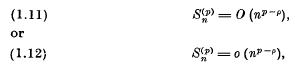
where 0 < ρ ≦ p.
 denotes, as usual, the n-th Cesàro sum of order p for the series ∑an and
  the binomial coefficient
  . It is convenient to state here some properties of and to which we must constantly refer in the sequel.
 denotes, as usual, the n-th Cesàro sum of order p for the series ∑a
 the binomial coefficient
  . It is convenient to state here some properties of
 Passman-Zalesskii Radical of group algebras
-
- Journal:
- Proceedings of the Edinburgh Mathematical Society / Volume 19 / Issue 1 / March 1974
- Published online by Cambridge University Press:
- 20 January 2009, pp. 71-72
-
- Article
-
- You have access
- Export citation
-
Recently Passman (attributing the origin of the idea to Zalesskii) has defined the following ideal in a ring, (2).
Definition. For a unitary ring R,
N * R = {α ∈ R | αS is nilpotent for all finitely generated subrings S of R}.
For a group algebra KG over a field K of characteristic p ≠ 0, he has proved the radical property:


H. Helson, Lectures on Invariant Subspaces (Academic Press Inc., New York), $5.00.
-
- Journal:
- Proceedings of the Edinburgh Mathematical Society / Volume 16 / Issue 1 / June 1968
- Published online by Cambridge University Press:
- 20 January 2009, p. 80
-
- Article
-
- You have access
- Export citation
A. F. Ruston, Fredholm theory in Banach spaces (Cambridge Tracts in Mathematics 86, Cambridge University Press, 1986), x + 293 pp. £30.
-
- Journal:
- Proceedings of the Edinburgh Mathematical Society / Volume 30 / Issue 2 / June 1987
- Published online by Cambridge University Press:
- 20 January 2009, pp. 337-338
-
- Article
-
- You have access
- Export citation
A NON-EXTENDABLE BOUNDED LINEAR MAP BETWEEN C*-ALGEBRAS
-
- Journal:
- Proceedings of the Edinburgh Mathematical Society / Volume 44 / Issue 2 / June 2001
- Published online by Cambridge University Press:
- 20 January 2009, pp. 241-248
-
- Article
-
- You have access
- Export citation
Automorphisms of normal transformation semigroups
-
- Journal:
- Proceedings of the Edinburgh Mathematical Society / Volume 28 / Issue 2 / June 1985
- Published online by Cambridge University Press:
- 20 January 2009, pp. 185-205
-
- Article
-
- You have access
- Export citation
-
Let X be an infinite set,
 be the group of all bijections of X and S be a semigroup of total transformations of X with the composition of transformations f and g in S defined by the formula
We say that S is a
-normal semigroup if
 be the group of all bijections of X and S be a semigroup of total transformations of X with the composition of transformations f and g in S defined by the formula
Marvin L. Stein and William D. Munro, Computer Programming–A Mixed Language Approach (Academic Press, 1964), 92s.
-
- Journal:
- Proceedings of the Edinburgh Mathematical Society / Volume 15 / Issue 2 / December 1966
- Published online by Cambridge University Press:
- 20 January 2009, pp. 158-159
-
- Article
-
- You have access
- Export citation
S. A. Naimpally and B. D. Warrack, Proximity Spaces (Cambridge Tracts in Mathematics and Mathematical Physics No. 59, Cambridge University Press, 1970), x+128 pp., £3.
-
- Journal:
- Proceedings of the Edinburgh Mathematical Society / Volume 17 / Issue 4 / December 1971
- Published online by Cambridge University Press:
- 20 January 2009, pp. 372-373
-
- Article
-
- You have access
- Export citation
PEM volume 15 issue 4 Cover and Front matter
-
- Journal:
- Proceedings of the Edinburgh Mathematical Society / Volume 15 / Issue 4 / December 1967
- Published online by Cambridge University Press:
- 20 January 2009, pp. f1-f2
-
- Article
-
- You have access
- Export citation
The pedal triangle
-
- Journal:
- Proceedings of the Edinburgh Mathematical Society / Volume 12 / February 1893
- Published online by Cambridge University Press:
- 20 January 2009, p. 85
-
- Article
-
- You have access
- Export citation
Inequalities for certain Classes of Convex Functions
-
- Journal:
- Proceedings of the Edinburgh Mathematical Society / Volume 11 / Issue 4 / November 1959
- Published online by Cambridge University Press:
- 20 January 2009, pp. 231-235
-
- Article
-
- You have access
- Export citation
PEM volume 8 issue 1 Cover and Back matter
-
- Journal:
- Proceedings of the Edinburgh Mathematical Society / Volume 8 / Issue 1 / October 1947
- Published online by Cambridge University Press:
- 20 January 2009, pp. b1-b2
-
- Article
-
- You have access
- Export citation
Mellin multipliers and radially symmetric Riesz potentials
-
- Journal:
- Proceedings of the Edinburgh Mathematical Society / Volume 37 / Issue 3 / October 1994
- Published online by Cambridge University Press:
- 20 January 2009, pp. 493-507
-
- Article
-
- You have access
- Export citation
On Area-Theory, and some applications
-
- Journal:
- Proceedings of the Edinburgh Mathematical Society / Volume 25 / February 1906
- Published online by Cambridge University Press:
- 20 January 2009, pp. 69-79
-
- Article
-
- You have access
- Export citation
On Kilmister's Conditions for the Existence of Linear Integrals of Dynamical Systems
-
- Journal:
- Proceedings of the Edinburgh Mathematical Society / Volume 14 / Issue 3 / June 1965
- Published online by Cambridge University Press:
- 20 January 2009, pp. 243-244
-
- Article
-
- You have access
- Export citation
-
Kilmister (1) has considered dynamical systems specified by coordinates q( = 1, 2, , n) and a Lagrangian

(with summation convention). He sought to determine generally covariant conditions for the existence of a first integral,
 , linear in the velocities. He showed that it is not, as is usually stated, necessary that there must exist an ignorable coordinate (equivalently, that b must be a Killing field:
where covariant derivation is with respect to a). On the contrary, a singular integral, in the sense that
 for all time if satisfied initially, need not be accompanied by an ignorable coordinate.
 , linear in the velocities. He showed that it is not, as is usually stated, necessary that there must exist an ignorable coordinate (equivalently, that b must be a Killing field:
 for all time if satisfied initially, need not be accompanied by an ignorable coordinate.
Asymptotic behaviour of ideals relative to injective modules over commutative Noetherian rings
-
- Journal:
- Proceedings of the Edinburgh Mathematical Society / Volume 34 / Issue 1 / February 1991
- Published online by Cambridge University Press:
- 20 January 2009, pp. 155-160
-
- Article
-
- You have access
- Export citation
