Refine search
Actions for selected content:
26080 results in Abstract analysis
A criterion for hyperbolicity
-
- Journal:
- Proceedings of the Edinburgh Mathematical Society / Volume 42 / Issue 3 / October 1999
- Published online by Cambridge University Press:
- 20 January 2009, pp. 445-454
-
- Article
-
- You have access
- Export citation
A Summary of the Theory of the Refraction of their approximately Axial Pencils through a Series of Media bounded by coaxial Spherical Surfaces, with Applications to a Photographic Triplet, &c.
-
- Journal:
- Proceedings of the Edinburgh Mathematical Society / Volume 13 / February 1894
- Published online by Cambridge University Press:
- 20 January 2009, p. 179
-
- Article
-
- You have access
- Export citation
On some properties of a triangle of given shape inscribed in a given triangle
-
- Journal:
- Proceedings of the Edinburgh Mathematical Society / Volume 9 / February 1890
- Published online by Cambridge University Press:
- 20 January 2009, pp. 39-48
-
- Article
-
- You have access
- Export citation
Approximate Solutions of Boundary Value Problems in Potential Theory with Applications to Electrostatics and Elastostatics
-
- Journal:
- Proceedings of the Edinburgh Mathematical Society / Volume 14 / Issue 2 / December 1964
- Published online by Cambridge University Press:
- 20 January 2009, pp. 89-101
-
- Article
-
- You have access
- Export citation
Office-Bearers
-
- Journal:
- Proceedings of the Edinburgh Mathematical Society / Volume 29 / February 1910
- Published online by Cambridge University Press:
- 20 January 2009, p. 1
-
- Article
-
- You have access
- Export citation
Joins of Almost Subnormal Subgroups
-
- Journal:
- Proceedings of the Edinburgh Mathematical Society / Volume 22 / Issue 1 / February 1979
- Published online by Cambridge University Press:
- 20 January 2009, pp. 33-34
-
- Article
-
- You have access
- Export citation
Some applications of the generalised Poisson-Jensen formula
-
- Journal:
- Proceedings of the Edinburgh Mathematical Society / Volume 6 / Issue 3 / August 1940
- Published online by Cambridge University Press:
- 20 January 2009, pp. 151-156
-
- Article
-
- You have access
- Export citation
Normalizers of finite multiplicity nests
-
- Journal:
- Proceedings of the Edinburgh Mathematical Society / Volume 39 / Issue 2 / June 1996
- Published online by Cambridge University Press:
- 20 January 2009, pp. 337-344
-
- Article
-
- You have access
- Export citation
On the Failure of Heilermann's Theorem
-
- Journal:
- Proceedings of the Edinburgh Mathematical Society / Volume 35 / February 1916
- Published online by Cambridge University Press:
- 20 January 2009, pp. 83-106
-
- Article
-
- You have access
- Export citation
-
The theorem of Heilermann can be stated thus:—
If the series

is converted into a continued fraction of the form

then the elements of the continued fraction are
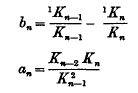
where
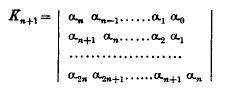
and
 is obtained from this determinant by deleting the (r + 1)th column and the last row.
 is obtained from this determinant by deleting the (r + 1)
Oscillations in a nonautonomous delay logistic difference equation
-
- Journal:
- Proceedings of the Edinburgh Mathematical Society / Volume 35 / Issue 1 / February 1992
- Published online by Cambridge University Press:
- 20 January 2009, pp. 121-131
-
- Article
-
- You have access
- Export citation
-
Consider the nonautonomous delay logistic difference equation

where (pn)n≧0 is a sequence of nonnegative numbers, (ln)n≧0 is a sequence of positive integers with limn→∞(n−ln) = ∞ and K is a positive constant. Only solutions which are positive for n≧0 are considered. We established a sharp condition under which all solutions of (E0) are oscillatory about the equilibrium point K. Also we obtained sufficient conditions for the existence of a solution of (E0) which is nonoscillatory about K.
Covering lemmas revisited
-
- Journal:
- Proceedings of the Edinburgh Mathematical Society / Volume 31 / Issue 1 / February 1988
- Published online by Cambridge University Press:
- 20 January 2009, pp. 145-150
-
- Article
-
- You have access
- Export citation
B# Modular Annihilator Algebras†
-
- Journal:
- Proceedings of the Edinburgh Mathematical Society / Volume 15 / Issue 2 / December 1966
- Published online by Cambridge University Press:
- 20 January 2009, pp. 89-102
-
- Article
-
- You have access
- Export citation
-
The structure of various classes of annihilator algebras has been known for some time. Bonsall and Goldie (1) considered semi-simple Banach algebras
 with the properties
(i)r(L)≡{x:xε
,yx=0(yεL)} ≠(0) for each proper closed left ideal L of ,(ii)l(K)≡{x:xε
,xy=0(yεK)}≠(0) for each proper closed left ideal K of ,
 with the properties
On a Problem in Partition of Numbers
-
- Journal:
- Proceedings of the Edinburgh Mathematical Society / Volume 2 / February 1883
- Published online by Cambridge University Press:
- 20 January 2009, pp. 49-50
-
- Article
-
- You have access
- Export citation
-
At a recent meeting of the Royal Society of Edinburgh, Professor Tait proposed and solved the following problem:—
To calculate the number of Partitions of any number that can be made by taking any number from 2 up to another given number.
Let us denote by
 the number of partitions of r obtained by taking any of the numbers 2, 3, 4,……(n − 1), n. In the particular case n = 7, r = 10, the actual partitions are 3 + 7, 4 + 6, 5 + 5; 2 + 2 + 6, 2 + 3 + 5, 2 + 4 + 4, 3 + 3 + 4; 2 + 2 + 2 + 4, 2 + 2 + 3 + 3; 2 + 2 + 2 + 2 + 2; ten in all. Hence
  =10.
=10.
 the number of partitions of r obtained by taking any of the numbers 2, 3, 4,……(n − 1), n. In the particular case n = 7, r = 10, the actual partitions are 3 + 7, 4 + 6, 5 + 5; 2 + 2 + 6, 2 + 3 + 5, 2 + 4 + 4, 3 + 3 + 4; 2 + 2 + 2 + 4, 2 + 2 + 3 + 3; 2 + 2 + 2 + 2 + 2; ten in all. Hence
  =10.
=10.Expansions in terms of Parabolic Cylinder Functions
-
- Journal:
- Proceedings of the Edinburgh Mathematical Society / Volume 8 / Issue 2 / October 1948
- Published online by Cambridge University Press:
- 20 January 2009, pp. 50-65
-
- Article
-
- You have access
- Export citation
-
When the plane wave equation is expressed in terms of parabolic co-ordinates x, y, the variables are separable, and the elementary solutions have the form

where x, y, μ are real. In this context, therefore, the functions Dν (z) which are directly significant are those where amp z = ± π/4 and ν + ½ is purely imaginary, rather than those where z is real and ν is a positive integer. The expansion of an arbitrary function in terms of the latter sort of D-function (substantially, in terms of Hermite polynomials) is well known. This paper is concerned with the expansion in terms of the former sort of D-function.
E. T. Copson, Metric Spaces, Cambridge Tracts in Mathematics and Mathematical Physics No. 57 (Cambridge University Press, 1968), 30s.
-
- Journal:
- Proceedings of the Edinburgh Mathematical Society / Volume 16 / Issue 3 / June 1969
- Published online by Cambridge University Press:
- 20 January 2009, p. 267
-
- Article
-
- You have access
- Export citation
List of Members
-
- Journal:
- Proceedings of the Edinburgh Mathematical Society / Volume 33 / February 1914
- Published online by Cambridge University Press:
- 20 January 2009, pp. 143-150
-
- Article
-
- You have access
- Export citation
Transverse Vibrations of an Elliptic Plate
-
- Journal:
- Proceedings of the Edinburgh Mathematical Society / Volume 44 / February 1925
- Published online by Cambridge University Press:
- 20 January 2009, pp. 32-38
-
- Article
-
- You have access
- Export citation
S. G. Hoggar Mathematics for computer graphics (Cambridge University Press, Cambridge1993), xviii + 472 pp., 0 521 37574 6, £25.
-
- Journal:
- Proceedings of the Edinburgh Mathematical Society / Volume 37 / Issue 1 / February 1994
- Published online by Cambridge University Press:
- 20 January 2009, pp. 191-192
-
- Article
-
- You have access
- Export citation
V. I. Smirmov, A Course of Higher Mathematics, Vol. I: Elementary Calculus, 546 pp., 90s.; Vol. II: Advanced Calculus, 632 pp., 90s.; Vol. III, Part 1: Linear Algebra, 326 pp., 63s.; Vol. III, Part 2: Complex Variables and Special Functions, 702 pp., 110s.; Vol. IV: Integral Equations and Partial Differential Equations, 814 pp., 126s.
-
- Journal:
- Proceedings of the Edinburgh Mathematical Society / Volume 16 / Issue 3 / June 1969
- Published online by Cambridge University Press:
- 20 January 2009, pp. 265-266
-
- Article
-
- You have access
- Export citation
Nuclearity and Banach spaces
-
- Journal:
- Proceedings of the Edinburgh Mathematical Society / Volume 20 / Issue 3 / March 1977
- Published online by Cambridge University Press:
- 20 January 2009, pp. 205-209
-
- Article
-
- You have access
- Export citation
-
Let E be a nuclear space provided with a topology different from the weak topology. Let {Ai: i ∈ I} be a fundamental system of equicontinuous subsets of the topological dual E' of E. If {Fi: i ∈ I} is a family of infinite dimensional Banach spaces with separable predual, there is a fundamental system {Bi: i ∈ I} of weakly closed absolutely convex equicontinuous subsets of E'such that
 is norm-isomorphic to Fi, for each i ∈ I. Other results related with the one above are also given.
 is norm-isomorphic to F