Refine search
Actions for selected content:
26080 results in Abstract analysis
On the representation of strictly continuous linear functionals
-
- Journal:
- Proceedings of the Edinburgh Mathematical Society / Volume 24 / Issue 2 / June 1981
- Published online by Cambridge University Press:
- 20 January 2009, pp. 123-130
-
- Article
-
- You have access
- Export citation
On the geometrical interpretation of ii
-
- Journal:
- Proceedings of the Edinburgh Mathematical Society / Volume 12 / February 1893
- Published online by Cambridge University Press:
- 20 January 2009, pp. 34-38
-
- Article
-
- You have access
- Export citation
-
If we put θ = π/2 in the well known equation

we get eiπ/2 = i; and raising both sides to the power i,


PEM volume 3 issue 2 Cover and Back matter
-
- Journal:
- Proceedings of the Edinburgh Mathematical Society / Volume 3 / Issue 2 / July 1932
- Published online by Cambridge University Press:
- 20 January 2009, pp. b1-b2
-
- Article
-
- You have access
- Export citation
Obituary: A. C. Aitken, D.Sc, F.R.S.
-
- Journal:
- Proceedings of the Edinburgh Mathematical Society / Volume 16 / Issue 2 / December 1968
- Published online by Cambridge University Press:
- 20 January 2009, pp. 151-176
-
- Article
-
- You have access
- Export citation
Limit circle criteria for 2nth order differential operators
-
- Journal:
- Proceedings of the Edinburgh Mathematical Society / Volume 24 / Issue 1 / February 1981
- Published online by Cambridge University Press:
- 20 January 2009, pp. 59-72
-
- Article
-
- You have access
- Export citation
-
A formally self-adjoint differential operator L is said to be of limit circle type at infinity if its highest order coefficient is zero-free and all solutions x of L(x) = 0 are square-integrable on [a, ∞). (We will drop reference to “at infinity” in what follows.)
For the second-order case

Dunford and Schwartz (3) p. 1409 prove that given

then L is of limit circle type if and only if

Projective Geometry of the Sphere
-
- Journal:
- Proceedings of the Edinburgh Mathematical Society / Volume 4 / February 1885
- Published online by Cambridge University Press:
- 20 January 2009, pp. 56-58
-
- Article
-
- You have access
- Export citation
On the Reduction of Ferrers' Associated Legendre Function
-
- Journal:
- Proceedings of the Edinburgh Mathematical Society / Volume 1 / Issue 4 / July 1929
- Published online by Cambridge University Press:
- 20 January 2009, pp. 241-243
-
- Article
-
- You have access
- Export citation
PEM volume 38 issue 2 Cover and Front matter
-
- Journal:
- Proceedings of the Edinburgh Mathematical Society / Volume 38 / Issue 2 / June 1995
- Published online by Cambridge University Press:
- 20 January 2009, pp. f1-f2
-
- Article
-
- You have access
- Export citation
On reduction exponents of ideals with Gorenstein formring*
-
- Journal:
- Proceedings of the Edinburgh Mathematical Society / Volume 38 / Issue 3 / October 1995
- Published online by Cambridge University Press:
- 20 January 2009, pp. 449-463
-
- Article
-
- You have access
- Export citation
Casson's invariant and surgery on knots
-
- Journal:
- Proceedings of the Edinburgh Mathematical Society / Volume 35 / Issue 3 / October 1992
- Published online by Cambridge University Press:
- 20 January 2009, pp. 383-395
-
- Article
-
- You have access
- Export citation
Biorthogonality in the banach spaces ℓp(n)*
-
- Journal:
- Proceedings of the Edinburgh Mathematical Society / Volume 39 / Issue 2 / June 1996
- Published online by Cambridge University Press:
- 20 January 2009, pp. 325-336
-
- Article
-
- You have access
- Export citation
Theorems in the Products of Belated Quantities
-
- Journal:
- Proceedings of the Edinburgh Mathematical Society / Volume 13 / February 1894
- Published online by Cambridge University Press:
- 20 January 2009, pp. 115-125
-
- Article
-
- You have access
- Export citation
-
§ 1. The object of this Note is to prove the following theorems:

in which
 and the series subject to conditions for convergence.
 and the series subject to conditions for convergence.
J. Bibby and H. Toutenburg, Prediction and Improved Estimation in Linear Models (Wiley, 1977) xiii+188 pp., £7–95.
-
- Journal:
- Proceedings of the Edinburgh Mathematical Society / Volume 22 / Issue 1 / February 1979
- Published online by Cambridge University Press:
- 20 January 2009, p. 67
-
- Article
-
- You have access
- Export citation
The partially ordered family of all ℛ-classes of S(x)
-
- Journal:
- Proceedings of the Edinburgh Mathematical Society / Volume 26 / Issue 1 / February 1983
- Published online by Cambridge University Press:
- 20 January 2009, pp. 7-13
-
- Article
-
- You have access
- Export citation
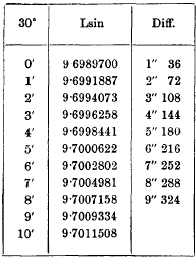
A Suggestion for the Improvement of Mathematical Tables
-
- Journal:
- Proceedings of the Edinburgh Mathematical Society / Volume 13 / February 1894
- Published online by Cambridge University Press:
- 20 January 2009, pp. 144-145
-
- Article
-
- You have access
- Export citation
-
If in Tables such as Chambers' the differences were given for a second instead of for a minute, they might be arranged (and used) follows:
A. B. Romanowska and J. D. H. Smith, Modal theory: an algebraic approach to order, geometry and convexity (Research and Exposition in Mathematics 9, Heldermann Verlag, Berlin1985) xii + 158 pp.
-
- Journal:
- Proceedings of the Edinburgh Mathematical Society / Volume 29 / Issue 1 / February 1986
- Published online by Cambridge University Press:
- 20 January 2009, p. 141
-
- Article
-
- You have access
- Export citation
Some spectral properties of an integral operator in potential theory
-
- Journal:
- Proceedings of the Edinburgh Mathematical Society / Volume 29 / Issue 3 / October 1986
- Published online by Cambridge University Press:
- 20 January 2009, pp. 405-411
-
- Article
-
- You have access
- Export citation
A Theorem on the Contact of Circles leading up to the Theorems of Feuerbach and Hart
-
- Journal:
- Proceedings of the Edinburgh Mathematical Society / Volume 33 / February 1914
- Published online by Cambridge University Press:
- 20 January 2009, pp. 42-47
-
- Article
-
- You have access
- Export citation
A Cyclic Inequality and an Extension of it. II
-
- Journal:
- Proceedings of the Edinburgh Mathematical Society / Volume 13 / Issue 2 / December 1962
- Published online by Cambridge University Press:
- 20 January 2009, pp. 143-152
-
- Article
-
- You have access
- Export citation
-
Throughout this paper, unless otherwise stated, n and L stand for positive integers and α, t, x, x1, x2, … for positive real numbers. Let

where

and

Automatic discontinuity of intertwining operators
-
- Journal:
- Proceedings of the Edinburgh Mathematical Society / Volume 25 / Issue 1 / February 1982
- Published online by Cambridge University Press:
- 20 January 2009, pp. 49-54
-
- Article
-
- You have access
- Export citation
