Refine search
Actions for selected content:
26080 results in Abstract analysis
Supplement to a Note on Recurrent Sequences
-
- Journal:
- Proceedings of the Edinburgh Mathematical Society / Volume 3 / Issue 3 / February 1933
- Published online by Cambridge University Press:
- 20 January 2009, pp. 220-222
-
- Article
-
- You have access
- Export citation
-
A lemma used in the above paper can be extended to cover the case of a sequence Sn determined by a recurrence relation of the form

r being any positive integer.
For convenience denote
 everywhere. Let us suppose that an inequality of the form
holds for p = 2, 3, … ., n — 1. The constant K can be determined from the initial values of Sn, when kn and ln have been found.
 everywhere. Let us suppose that an inequality of the form
On the Evaluation of the definite integrals
-
- Journal:
- Proceedings of the Edinburgh Mathematical Society / Volume 1 / Issue 4 / July 1929
- Published online by Cambridge University Press:
- 20 January 2009, pp. 244-245
-
- Article
-
- You have access
- Export citation
-
§ 1 Introduction. The formulae
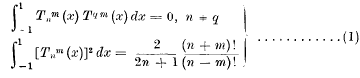
where n, q, m are positive integers, are well known. I am not aware, however, of any paper dealing with the corresponding definite integrals of products of two Ferrers' Associated Legendre Functions of different integral orders and degrees. With the help of the formulae given in my previous paper in this volume it is possible to discuss these integrals. I have found in the case of the first integral that if the orders of the two associated functions are both odd or both even and if, in each case, the degrees are both odd or both even or equal, the integral has usually a non-zero value. If, however, the orders are both odd or both even and if the degree of the function having the greater order is less than that of the other, or if the degrees are one odd and one even, the integral vanishes. Further, if one of the orders be odd and the other even, and the corresponding degrees are also even and odd (or odd and even), the integral has a non-zero value; in all other cases it vanishes. The values of the second integral can be obtained in a similar manner. An example of the methods employed and the results obtained is given in the following section.
A general mechanical description of the Conic Sections
-
- Journal:
- Proceedings of the Edinburgh Mathematical Society / Volume 18 / February 1900
- Published online by Cambridge University Press:
- 20 January 2009, p. 32
-
- Article
-
- You have access
- Export citation
Fourier's Integral
-
- Journal:
- Proceedings of the Edinburgh Mathematical Society / Volume 34 / February 1915
- Published online by Cambridge University Press:
- 20 January 2009, pp. 3-10
-
- Article
-
- You have access
- Export citation
Some Axi-Symmetric Determinants with Integers for Elements
-
- Journal:
- Proceedings of the Edinburgh Mathematical Society / Volume 43 / February 1924
- Published online by Cambridge University Press:
- 20 January 2009, pp. 64-69
-
- Article
-
- You have access
- Export citation
-
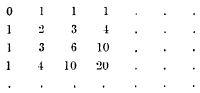
B. Pascal and others have studied the properties of the table:
Properties of some Groups of Wallace Lines
-
- Journal:
- Proceedings of the Edinburgh Mathematical Society / Volume 14 / February 1895
- Published online by Cambridge University Press:
- 20 January 2009, pp. 116-120
-
- Article
-
- You have access
- Export citation
-
Take the point P in the arc AB, and let ∠ ABP = θ, then the trilinear equation of the Wallace line of P (p say) is

(a) The lines AP, BQ, CR drawn parallel to the sides BC, CA, AB of the triangle ABC.
In this case p, q, r, by [§ 17] are readily, seen to be concurrent.
Banach algebra elements whose spectra intersect R+
-
- Journal:
- Proceedings of the Edinburgh Mathematical Society / Volume 19 / Issue 1 / March 1974
- Published online by Cambridge University Press:
- 20 January 2009, pp. 59-69
-
- Article
-
- You have access
- Export citation
-
Let A denote a complex Banach algebra with unit, Inv(A) the set of invertible elements of A, Sp(a) and r(a) the spectrum and spectral radius respectively of an element a of A. Let Γ denote the set of elements of A whose spectra contain non-negative real numbers, i.e.

The so-called Simson line
-
- Journal:
- Proceedings of the Edinburgh Mathematical Society / Volume 3 / February 1884
- Published online by Cambridge University Press:
- 20 January 2009, p. 105
-
- Article
-
- You have access
- Export citation
A Cyclic Inequality and an Extension of It. I
-
- Journal:
- Proceedings of the Edinburgh Mathematical Society / Volume 13 / Issue 1 / June 1962
- Published online by Cambridge University Press:
- 20 January 2009, pp. 79-84
-
- Article
-
- You have access
- Export citation
-
For positive integral n and positive real x1, … xn let

Where

and let

Focal Sets in Certain Riemannian Manifolds
-
- Journal:
- Proceedings of the Edinburgh Mathematical Society / Volume 27 / Issue 2 / June 1984
- Published online by Cambridge University Press:
- 20 January 2009, pp. 209-214
-
- Article
-
- You have access
- Export citation
Note on the preceding Locus
-
- Journal:
- Proceedings of the Edinburgh Mathematical Society / Volume 9 / February 1890
- Published online by Cambridge University Press:
- 20 January 2009, p. 28
-
- Article
-
- You have access
- Export citation
A variant of separability in dual systems
-
- Journal:
- Proceedings of the Edinburgh Mathematical Society / Volume 20 / Issue 4 / September 1977
- Published online by Cambridge University Press:
- 20 January 2009, pp. 317-327
-
- Article
-
- You have access
- Export citation
S. Lang, Introduction to Differentiable Manifolds (John Wiley & Sons, 1962), vii + 126 pp., 53s.
-
- Journal:
- Proceedings of the Edinburgh Mathematical Society / Volume 13 / Issue 3 / June 1963
- Published online by Cambridge University Press:
- 20 January 2009, p. 262
-
- Article
-
- You have access
- Export citation
Geometrical Note on the Orthopole
-
- Journal:
- Proceedings of the Edinburgh Mathematical Society / Volume 38 / February 1919
- Published online by Cambridge University Press:
- 20 January 2009, pp. 54-56
-
- Article
-
- You have access
- Export citation
Some axially symmetric potential problems
-
- Journal:
- Proceedings of the Edinburgh Mathematical Society / Volume 18 / Issue 1 / June 1972
- Published online by Cambridge University Press:
- 20 January 2009, pp. 55-76
-
- Article
-
- You have access
- Export citation
A note an homeomorphic measures on topological groups
-
- Journal:
- Proceedings of the Edinburgh Mathematical Society / Volume 26 / Issue 2 / June 1983
- Published online by Cambridge University Press:
- 20 January 2009, pp. 169-171
-
- Article
-
- You have access
- Export citation
-
The classical von Neumann–Oxtoby–Ulam Theorem states the following:
Given non-atomic Borel probability measures μ, λ on In such that

there exists a homeomorphism h of In onto itself fixing the boundary pointwise such that for any λ-measurable set S

It is known that the above theorem remains valid if In is replaced by any compact finite dimensional manifold [2], [4] or with I∞, the Hilbert cube, [8].

On certain Theorems in Determinants
-
- Journal:
- Proceedings of the Edinburgh Mathematical Society / Volume 27 / February 1909
- Published online by Cambridge University Press:
- 20 January 2009, pp. 67-69
-
- Article
-
- You have access
- Export citation
Krull dimension and invertible ideals in Noetherian rings
-
- Journal:
- Proceedings of the Edinburgh Mathematical Society / Volume 20 / Issue 2 / September 1976
- Published online by Cambridge University Press:
- 20 January 2009, pp. 81-86
-
- Article
-
- You have access
- Export citation
A proof that the middle points of parallel chords of a conic lie on a fixed straight line
-
- Journal:
- Proceedings of the Edinburgh Mathematical Society / Volume 24 / February 1905
- Published online by Cambridge University Press:
- 20 January 2009, pp. 59-60
-
- Article
-
- You have access
- Export citation
Some results involving weak compactness in C(X), C(υX) and C(X)′
-
- Journal:
- Proceedings of the Edinburgh Mathematical Society / Volume 19 / Issue 3 / March 1975
- Published online by Cambridge University Press:
- 20 January 2009, pp. 221-229
-
- Article
-
- You have access
- Export citation
