Refine search
Actions for selected content:
26080 results in Abstract analysis
The Vibrations of a Particle about a Position of Equilibrium—Part 2 :The Relation between the Elliptic Function and Series Solutions
-
- Journal:
- Proceedings of the Edinburgh Mathematical Society / Volume 40 / February 1921
- Published online by Cambridge University Press:
- 20 January 2009, pp. 34-49
-
- Article
-
- You have access
- Export citation
M. I. Gurevich, The Theory of Jets in an Ideal Fluid (Pergamon Press, Oxford, 1966), viii+412 pp., £5.
-
- Journal:
- Proceedings of the Edinburgh Mathematical Society / Volume 16 / Issue 2 / December 1968
- Published online by Cambridge University Press:
- 20 January 2009, p. 179
-
- Article
-
- You have access
- Export citation
Exit times for elliptic diffusions and BMO
-
- Journal:
- Proceedings of the Edinburgh Mathematical Society / Volume 30 / Issue 2 / June 1987
- Published online by Cambridge University Press:
- 20 January 2009, pp. 273-287
-
- Article
-
- You have access
- Export citation
A summability method due to linear differential equations and a uniqueness property of solutions of singular differential equations
-
- Journal:
- Proceedings of the Edinburgh Mathematical Society / Volume 20 / Issue 1 / March 1976
- Published online by Cambridge University Press:
- 20 January 2009, pp. 41-51
-
- Article
-
- You have access
- Export citation
-
The purpose of this paper is to expose a method which will match a function f(z) existing in a domain D to a formal series
 whose radius of convergence may be zero. This matching process has to be done in a “natural way”, and has to be “regular”, which means that if a power series converges absolutely in the circle E = {z | |z|<r} then the summability function f(z) produced by our method in the domain D and matched to will coincide with in the domain E∩D. Euler, in his time, matched the function
 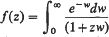 to the power series
  .
.
 whose radius of convergence may be zero. This matching process has to be done in a “natural way”, and has to be “regular”, which means that if a power series
  to the power series
  .
.Countable-codimensional subspaces of locally convex spaces
-
- Journal:
- Proceedings of the Edinburgh Mathematical Society / Volume 18 / Issue 3 / June 1973
- Published online by Cambridge University Press:
- 20 January 2009, pp. 167-172
-
- Article
-
- You have access
- Export citation
A special sublattice of the congruence lattice of a regular semigroup
-
- Journal:
- Proceedings of the Edinburgh Mathematical Society / Volume 40 / Issue 3 / October 1997
- Published online by Cambridge University Press:
- 20 January 2009, pp. 457-472
-
- Article
-
- You have access
- Export citation
-
Let S be a regular semigroup and
 be its congruence lattice. For ρ ∈ , we consider the sublattice Lρ of generated by the congruences pw where w ∈ {K, k, T, t}* and w has no subword of the form KT, TK, kt, tk. Here K, k, T, t are the operators on induced by the kernel and the trace relations on . We find explicitly the least lattice L whose homomorphic image is Lρ for all ρ ∈ and represent it as a distributive lattice in terms of generators and relations. We also consider special cases: bands of groups, E-unitary regular semigroups, completely simple semigroups, rectangular groups as well as varieties of completely regular semigroups.
 be its congruence lattice. For ρ ∈
 PEM volume 16 issue 4 Cover and Back matter
-
- Journal:
- Proceedings of the Edinburgh Mathematical Society / Volume 16 / Issue 4 / December 1969
- Published online by Cambridge University Press:
- 20 January 2009, pp. b1-b8
-
- Article
-
- You have access
- Export citation
Démonstrations de deux théorèmes de Géométrie
-
- Journal:
- Proceedings of the Edinburgh Mathematical Society / Volume 23 / February 1904
- Published online by Cambridge University Press:
- 20 January 2009, p. 49
-
- Article
-
- You have access
- Export citation
-
Soit ABCD un rectangle, AC l'une de ses diagonales; si l'on prend un point M sur la diagonale et qu'on mène les parallèles aux côtés, on a deux rectangles AEFD, AGHB équivalents.
Soit en effet AB une force, AD une autre force, AC sera la résultante; et si l'on prend les moments des deux forces par rapport à un point M de la résultante on aura

ce qui démontre le théorème.
Decompositions of vector measures in Riesz spaces and Banach lattices
-
- Journal:
- Proceedings of the Edinburgh Mathematical Society / Volume 29 / Issue 1 / February 1986
- Published online by Cambridge University Press:
- 20 January 2009, pp. 23-39
-
- Article
-
- You have access
- Export citation
A Basic-sine and cosine with symbolical solutions of certain differential equations
-
- Journal:
- Proceedings of the Edinburgh Mathematical Society / Volume 22 / February 1903
- Published online by Cambridge University Press:
- 20 January 2009, pp. 28-39
-
- Article
-
- You have access
- Export citation
-
The object of this paper is to introduce certain functions analogous to the circular functions. The functions will be denoted by

Formulæ analogous to
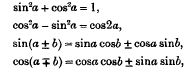
will be obtained, and the use of the functions in symbolical solutions of certain differential equations exemplified. The connection of the functions with generalised Bessel-functions of order half an odd integer will be shown.
PEM volume 26 issue 3 Cover and Back matter
-
- Journal:
- Proceedings of the Edinburgh Mathematical Society / Volume 26 / Issue 3 / October 1983
- Published online by Cambridge University Press:
- 20 January 2009, pp. b1-b6
-
- Article
-
- You have access
- Export citation
E. A. Maxwell, Fallacies in Mathematics, (Cambridge University Press1955), 95 pp., 13s. 6d.
-
- Journal:
- Proceedings of the Edinburgh Mathematical Society / Volume 11 / Issue 3 / May 1959
- Published online by Cambridge University Press:
- 20 January 2009, pp. 193-194
-
- Article
-
- You have access
- Export citation
The Turning-Values of a Cubic Function and the nature of the roots of a Cubic Equation
-
- Journal:
- Proceedings of the Edinburgh Mathematical Society / Volume 22 / February 1903
- Published online by Cambridge University Press:
- 20 January 2009, pp. 86-89
-
- Article
-
- You have access
- Export citation
-
The first part of this paper depends on the theorem that if a, b, c are three positive quantities such that

then abc is a maximum when a=b=c; with the corollary that if a, b, c are three negative quantities such that
then abc is a minimum when a = b = c.
On the deformation of the tangent m-plane of a

-
- Journal:
- Proceedings of the Edinburgh Mathematical Society / Volume 5 / Issue 4 / September 1938
- Published online by Cambridge University Press:
- 20 January 2009, pp. 202-206
-
- Article
-
- You have access
- Export citation
-
Schouten and van Kampen (1) have studied the deformation of a
. Applying the methods of that paper to the tangent vectors  , which exist by hypothesis at all points of a certain region Vm′ (m′ > m) of Vn, we shall have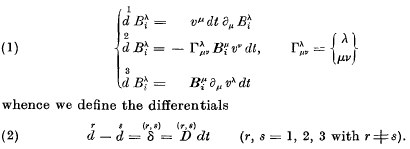
Whence we define the differentials

In the application of the
 to
to  the lower index is treated as an ordinal index only. We shall not be concerned with any extension of the to indices other than those of the general Vb (see 1, equ. 3.24).

 , which exist by hypothesis at all points of a certain region V
 to
to  the lower index is treated as an ordinal index only. We shall not be concerned with any extension of the
 PEM volume 42 issue 1 Cover and Back matter
-
- Journal:
- Proceedings of the Edinburgh Mathematical Society / Volume 42 / Issue 1 / February 1999
- Published online by Cambridge University Press:
- 20 January 2009, pp. b1-b2
-
- Article
-
- You have access
- Export citation
On the Fourier coefficients of a discontinuous function
-
- Journal:
- Proceedings of the Edinburgh Mathematical Society / Volume 6 / Issue 4 / October 1941
- Published online by Cambridge University Press:
- 20 January 2009, pp. 231-256
-
- Article
-
- You have access
- Export citation
-
We suppose throughout that f(t) is periodic with period 2π, and Lebesgue-integrable in (− π, π).
We write

and suppose that the Fourier series of φ(t) and ψ(t) are respectively
 cos nt and
  sin nt. Then the Fourier series and allied series of f(t) at the point t = x are respectively and , where A0 = ½a0, An = ancos nx + bnsin nx, Bn = bncos nx − ansin nx and an, bn are the Fourier coefficients of f(t).
 cos nt and
  sin nt. Then the Fourier series and allied series of f(t) at the point t = x are respectively
 Index of Papers Published in This Volume Arranged According to Names of Authors
-
- Journal:
- Proceedings of the Edinburgh Mathematical Society / Volume 2 / Issue 4 / June 1931
- Published online by Cambridge University Press:
- 20 January 2009, p. 273
-
- Article
-
- You have access
- Export citation
Infinite metacyclic groups and their non-abelian tensor squares
-
- Journal:
- Proceedings of the Edinburgh Mathematical Society / Volume 43 / Issue 3 / October 2000
- Published online by Cambridge University Press:
- 20 January 2009, pp. 651-662
-
- Article
-
- You have access
- Export citation
Structure theorems for groups with dihedral 3-normalisers
-
- Journal:
- Proceedings of the Edinburgh Mathematical Society / Volume 21 / Issue 2 / September 1978
- Published online by Cambridge University Press:
- 20 January 2009, pp. 175-186
-
- Article
-
- You have access
- Export citation
Notes on Inequalities
-
- Journal:
- Proceedings of the Edinburgh Mathematical Society / Volume 23 / February 1904
- Published online by Cambridge University Press:
- 20 January 2009, pp. 89-93
-
- Article
-
- You have access
- Export citation
