Refine search
Actions for selected content:
26080 results in Abstract analysis
The following Presents to the Library have been received, for which the Society tenders its grateful thanks:—
-
- Journal:
- Proceedings of the Edinburgh Mathematical Society / Volume 29 / February 1910
- Published online by Cambridge University Press:
- 20 January 2009, pp. vi-vii
-
- Article
-
- You have access
- Export citation
Local uniqueness in boundary problems†
-
- Journal:
- Proceedings of the Edinburgh Mathematical Society / Volume 17 / Issue 1 / June 1970
- Published online by Cambridge University Press:
- 20 January 2009, pp. 23-36
-
- Article
-
- You have access
- Export citation
-
The study of periodic, irrotational waves of finite amplitude in an incompressible fluid of infinite depth was reduced by Levi-Civita (1) to the determination of a function

regular analytic in the interior of the unit circle ρ = 1 and which satisfies the condition

PEM volume 43 issue 2 Cover and Front matter
-
- Journal:
- Proceedings of the Edinburgh Mathematical Society / Volume 43 / Issue 2 / June 2000
- Published online by Cambridge University Press:
- 20 January 2009, pp. f1-f2
-
- Article
-
- You have access
- Export citation
The following Presents to the Library have been received, for which the Society tenders its grateful thanks
-
- Journal:
- Proceedings of the Edinburgh Mathematical Society / Volume 6 / Issue 4 / October 1941
- Published online by Cambridge University Press:
- 20 January 2009, pp. 267-268
-
- Article
-
- You have access
- Export citation
Kinematic formula and tube formula in space of constant curvature
-
- Journal:
- Proceedings of the Edinburgh Mathematical Society / Volume 33 / Issue 1 / February 1990
- Published online by Cambridge University Press:
- 20 January 2009, pp. 79-88
-
- Article
-
- You have access
- Export citation
Generalisation of the “Orthopole” and Allied Theorems
-
- Journal:
- Proceedings of the Edinburgh Mathematical Society / Volume 31 / February 1912
- Published online by Cambridge University Press:
- 20 January 2009, pp. 17-34
-
- Article
-
- You have access
- Export citation
The Bolyai-Lobatschewsky Non-Euclidean Geometry: an Elementary Interpretation of this Geometry, and some Results which follow from this Interpretation
-
- Journal:
- Proceedings of the Edinburgh Mathematical Society / Volume 28 / February 1909
- Published online by Cambridge University Press:
- 20 January 2009, pp. 95-120
-
- Article
-
- You have access
- Export citation
Generation of an acoustic pulse by a baffled circular piston
-
- Journal:
- Proceedings of the Edinburgh Mathematical Society / Volume 15 / Issue 4 / December 1967
- Published online by Cambridge University Press:
- 20 January 2009, pp. 263-277
-
- Article
-
- You have access
- Export citation
P. M. Cohn, Free rings and their relations (London Mathematical Society Monograph No. 19, Academic Press, 2nd ed.1985), £66.50.
-
- Journal:
- Proceedings of the Edinburgh Mathematical Society / Volume 30 / Issue 2 / June 1987
- Published online by Cambridge University Press:
- 20 January 2009, pp. 333-334
-
- Article
-
- You have access
- Export citation
Low codimensional embeddings of Sp(n) and Su(n)
-
- Journal:
- Proceedings of the Edinburgh Mathematical Society / Volume 27 / Issue 1 / February 1984
- Published online by Cambridge University Press:
- 20 January 2009, pp. 25-29
-
- Article
-
- You have access
- Export citation
Note on the Theorems of Menelaus and Ceva
-
- Journal:
- Proceedings of the Edinburgh Mathematical Society / Volume 20 / February 1901
- Published online by Cambridge University Press:
- 20 January 2009, pp. 35-39
-
- Article
-
- You have access
- Export citation
-
Menelaus's theorem is
If a transversal DEF cut the sides of triangle ABC at the points D B F, then
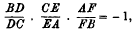
and conversely.
A Generalization and Simple Proof of Kronecker's Theorem* Concerning the Minors of a Compound Determinant
-
- Journal:
- Proceedings of the Edinburgh Mathematical Society / Volume 43 / February 1924
- Published online by Cambridge University Press:
- 20 January 2009, pp. 48-49
-
- Article
-
- You have access
- Export citation
-
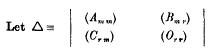
where (Am m) represents a square of m rows and m columns of a's; (Bm r) represents a rectangle of m rows and r columns of b's; (Cr m) represents a rectangle of r rows and m columns of c's;, and (Orr) represents a square of r rows and r columns of zeros.
On Self-Adjoint Partial Differential Equations of the Second Order
-
- Journal:
- Proceedings of the Edinburgh Mathematical Society / Volume 43 / February 1924
- Published online by Cambridge University Press:
- 20 January 2009, pp. 35-38
-
- Article
-
- You have access
- Export citation
-
Let
 be a linear differential expression involving n independent variables xi the coefficients Aik Bi, and C being functions of the independent variables but not involving the dependent variable u. Associated with F(u) is the adjoint expression
 be a linear differential expression involving n independent variables x
Almost diagonal systems in asymptotic integration
-
- Journal:
- Proceedings of the Edinburgh Mathematical Society / Volume 28 / Issue 2 / June 1985
- Published online by Cambridge University Press:
- 20 January 2009, pp. 143-158
-
- Article
-
- You have access
- Export citation
-
Consider the ordinary linear matrix differential system

ψ(x) is a scalar mapping, X and A(x) are n by n matrices. Both belong to C1([a,∞)) for some integer l. The stability and asymptotic behaviour of its solutions have been subject to much investigation. See Bellman [2], Levinson [24], Hartman and Wintner [20], Devinatz [9], Fedoryuk [11], Harris and Lutz [16,17,18] and Cassell [30]. The special interest in eigenvalue problems and in the deficiency index problem stimulated a continued interest in asymptotic integration. See e.g. Naimark [36], Eastham and Grundniewicz [10] and [8,9]. Harris and Lutz [16,17,18] succeeded in explaining how to derive many known theorems in asymptotic integration by repeatedly using certain “(1 + Q)” linear transformations.
The Shoemaker's Knife
-
- Journal:
- Proceedings of the Edinburgh Mathematical Society / Volume 3 / February 1884
- Published online by Cambridge University Press:
- 20 January 2009, pp. 2-11
-
- Article
-
- You have access
- Export citation
PEM volume 17 issue 3 Cover and Front matter
-
- Journal:
- Proceedings of the Edinburgh Mathematical Society / Volume 17 / Issue 3 / June 1971
- Published online by Cambridge University Press:
- 20 January 2009, pp. f1-f2
-
- Article
-
- You have access
- Export citation
On the Singular Points of Plane Curves
-
- Journal:
- Proceedings of the Edinburgh Mathematical Society / Volume 21 / February 1902
- Published online by Cambridge University Press:
- 20 January 2009, pp. 96-110
-
- Article
-
- You have access
- Export citation
-
In the general equation of a curve that passes through the origin,

u1 ≡ a1x + b1y = 0 is the equation to the tangent at the origin; for, y q g when x and y are very small, we may neglect all the terms in comparison with those involving the first powers of x and y. If neither a1 nor b1 vanishes, we may, without loss of generality, write the equation in the form

On two linear vector spaces associated with a vector in an Ln
-
- Journal:
- Proceedings of the Edinburgh Mathematical Society / Volume 6 / Issue 3 / August 1940
- Published online by Cambridge University Press:
- 20 January 2009, pp. 172-175
-
- Article
-
- You have access
- Export citation
-
Let υλ be a vector (i.e. a vector field) in an affinely connected space Ln, ∇k the symbol of covariant differentiation, and r the rank of the matrix ‖∇k υλ‖ then there exist two sets of n − r independent vectors
 and
and  which satisfy respectively the equations
 and
and  which satisfy respectively the equations
More on automorphism groups of laminated near-rings
-
- Journal:
- Proceedings of the Edinburgh Mathematical Society / Volume 31 / Issue 2 / June 1988
- Published online by Cambridge University Press:
- 20 January 2009, pp. 185-195
-
- Article
-
- You have access
- Export citation
-
We will assume throughout this paper that polynomials are nonconstant. Let P be any complex polynomial and let
 p denote the near-ring of all continuous selfmaps of the complex plane where addition of functions is pointwise and multiplication is defined by fg = f ο P ο g for all f,g∈p. The near-ring p is referred to as a laminated near-ring and P is referred to as the laminating element or laminator. In [1] the problem was posed of determining Aut p the automorphism group of p. It was shown that exactly three infinite groups occur as automorphism groups of the laminated near-rings p and for each of the three groups those polynomials P were characterized such that Aut p is isomorphic to that particular group. The infinite groups turn out to be GL(2), the full linear group of all 2×2 nonsingular real matrices and two of its subgroups.

Twisted local-product manifolds
-
- Journal:
- Proceedings of the Edinburgh Mathematical Society / Volume 17 / Issue 1 / June 1970
- Published online by Cambridge University Press:
- 20 January 2009, pp. 59-63
-
- Article
-
- You have access
- Export citation
