Refine search
Actions for selected content:
26080 results in Abstract analysis
Finite groups which are products of pairwise totally permutable subgroups
-
- Journal:
- Proceedings of the Edinburgh Mathematical Society / Volume 41 / Issue 3 / October 1998
- Published online by Cambridge University Press:
- 20 January 2009, pp. 567-572
-
- Article
-
- You have access
- Export citation
-
Finite groups which are products of pairwise totally permutable subgroups are studied in this paper. The
 -residual, -projectors and -normalizers in such groups are obtained from the corresponding subgroups of the factor subgroups under suitable hypotheses.
 -residual,
 The tensor product of distributive lattices: structural results
-
- Journal:
- Proceedings of the Edinburgh Mathematical Society / Volume 27 / Issue 3 / October 1984
- Published online by Cambridge University Press:
- 20 January 2009, pp. 237-245
-
- Article
-
- You have access
- Export citation
Combinatorial L2-determinants
-
- Journal:
- Proceedings of the Edinburgh Mathematical Society / Volume 43 / Issue 1 / February 2000
- Published online by Cambridge University Press:
- 20 January 2009, pp. 185-194
-
- Article
-
- You have access
- Export citation
Properties of the figure consisting of a triangle, and the squares described on its sides
-
- Journal:
- Proceedings of the Edinburgh Mathematical Society / Volume 6 / February 1887
- Published online by Cambridge University Press:
- 20 January 2009, pp. 2-12
-
- Article
-
- You have access
- Export citation
On the Latent Roots of Compound Determinants and Brill's Determinants
-
- Journal:
- Proceedings of the Edinburgh Mathematical Society / Volume 35 / February 1916
- Published online by Cambridge University Press:
- 20 January 2009, pp. 2-9
-
- Article
-
- You have access
- Export citation
-
The roots of the equation in λ
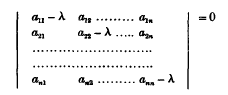
were named by Sylvester the latent roots of the determinant | a11a22 … ann |. So early as 1852, Sylvester showed that if any determinant D is given, we can at once write down a determinant whose latent roots are the squares of the latent roots of D: this determinant is in fact the square of D, the process of squaring being performed by multiplying rows into columns : so that, e.g. if the latent roots of
 are λ1 and λ2, then the roots of
 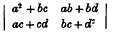 are
are  and
and  . Spottiswoode had also shown in 1851 that the latent roots of the reciprocal of a determinant are the reciprocals of the latent roots of the determinant itself. Both these theorems were soon found to be particular cases of a general theorem which was enunciated by Sylvester thus: The latent roots of any function of a matrix are respectively the same functions of the latent roots of the matrix itself.
 are λ
are λ are
are  and
and  . Spottiswoode had also shown in 1851 that the latent roots of the reciprocal of a determinant are the reciprocals of the latent roots of the determinant itself. Both these theorems were soon found to be particular cases of a general theorem which was enunciated by Sylvester thus: The latent roots of any function of a matrix are respectively the same functions of the latent roots of the matrix itself.
Demonstrations of a Pair of Theorems in Geometry
-
- Journal:
- Proceedings of the Edinburgh Mathematical Society / Volume 20 / February 1901
- Published online by Cambridge University Press:
- 20 January 2009, pp. 16-17
-
- Article
-
- You have access
- Export citation
l-adic and Z/l∞-algebraic and topological K-theory
-
- Journal:
- Proceedings of the Edinburgh Mathematical Society / Volume 28 / Issue 1 / February 1985
- Published online by Cambridge University Press:
- 20 January 2009, pp. 73-90
-
- Article
-
- You have access
- Export citation
-
Let l be an odd prime and let A be a commutative ring containing 1/l. Let K*(A;Z/lv) denote the mod lv algebraic K-theory of A [3]. As explained in [4] there exists a “Bott element” βv∈K21v–1(l–1)(Z[1/l];Z/lv) and, using the K-theory product we may, following [16, Part IV], form

which is defined as the direct limit of iterated multiplication by βv. There is a canonical localisation map

PEM volume 7 issue 2 Cover and Back matter
-
- Journal:
- Proceedings of the Edinburgh Mathematical Society / Volume 7 / Issue 2 / April 1945
- Published online by Cambridge University Press:
- 20 January 2009, pp. b1-b2
-
- Article
-
- You have access
- Export citation
PEM volume 20 issue 4 Cover and Front matter
-
- Journal:
- Proceedings of the Edinburgh Mathematical Society / Volume 20 / Issue 4 / September 1977
- Published online by Cambridge University Press:
- 20 January 2009, pp. f1-f2
-
- Article
-
- You have access
- Export citation
Derivation of Solutions of the Klein-Gordon Equation from Solutions of the Wave Equation
-
- Journal:
- Proceedings of the Edinburgh Mathematical Society / Volume 15 / Issue 2 / December 1966
- Published online by Cambridge University Press:
- 20 January 2009, pp. 125-129
-
- Article
-
- You have access
- Export citation
-
The Klein–Gordon equation

Ω being a constant of dimensions [time]-1 and c being a constant velocity, appears in nuclear physics (1) and, when the Laplacian operator is twodimensional, in the theory of long gravity waves on a rotating earth (2). If Ω is zero it reduces to the wave equation

Kötter's synthetic geometry of algebraic curves
-
- Journal:
- Proceedings of the Edinburgh Mathematical Society / Volume 7 / February 1888
- Published online by Cambridge University Press:
- 20 January 2009, pp. 46-61
-
- Article
-
- You have access
- Export citation
PEM volume 14 issue 3 Cover and Front matter
-
- Journal:
- Proceedings of the Edinburgh Mathematical Society / Volume 14 / Issue 3 / June 1965
- Published online by Cambridge University Press:
- 20 January 2009, pp. f1-f2
-
- Article
-
- You have access
- Export citation
Note on the Kinematics of a Quadrilateral
-
- Journal:
- Proceedings of the Edinburgh Mathematical Society / Volume 5 / February 1886
- Published online by Cambridge University Press:
- 20 January 2009, pp. 92-93
-
- Article
-
- You have access
- Export citation
-
I send a note on the following problem, a solution of which was requested of me by one of the tutors at King's College, Cambridge.
We are given a quadrilateral of four jointed bars ABCD (fig. 83). The bar CD being held fast, find the tangent to the locus of P, the intersection of DA, CB in any position; and verify the following construction for the radius of curvature of the path of P:—
Let PQ be the third diagonal, draw through P a perpendicular to PQ meeting BA, CD in L and L′; through L and L′ draw parallels to PQ meeting AD in M and M′; through M and M′ draw perpendiculars to AD meeting the normal at P in O and O′; then will

Note on the Centre of Gravity of a Circular Arc
-
- Journal:
- Proceedings of the Edinburgh Mathematical Society / Volume 16 / February 1897
- Published online by Cambridge University Press:
- 20 January 2009, pp. 49-50
-
- Article
-
- You have access
- Export citation
R. C. Lyndon, Notes on Logic (D. van Nostrand, 1966), 20s.
-
- Journal:
- Proceedings of the Edinburgh Mathematical Society / Volume 16 / Issue 1 / June 1968
- Published online by Cambridge University Press:
- 20 January 2009, p. 83
-
- Article
-
- You have access
- Export citation
On a Class of Continued Fractions
-
- Journal:
- Proceedings of the Edinburgh Mathematical Society / Volume 35 / February 1916
- Published online by Cambridge University Press:
- 20 January 2009, pp. 38-45
-
- Article
-
- You have access
- Export citation
-
The continued fractions treated in this paper are of the general form

where s0, s1, s2, … are real integers (positive, negative, or zero). An arbitrary real number can, of course, be developed in such a fraction in an infinite variety of ways. The continued fractions discussed here have a number of striking properties and present numerous contrasts with the ordinary continued fraction usually employed.
Certain Expansions in the Algebra of Quantum Mechanics1
-
- Journal:
- Proceedings of the Edinburgh Mathematical Society / Volume 3 / Issue 2 / July 1932
- Published online by Cambridge University Press:
- 20 January 2009, pp. 118-127
-
- Article
-
- You have access
- Export citation
-
§ 1. Introduction. The algebra of quantum mechanics is characterized by the fact that the variables p, q obey all the laws of ordinary algebra except that multiplication is non-commutative and instead there exists a relation of the form

where c is a real or complex scalar constant and is thus commutative with both p and q.
Residuated regular semigroups
-
- Journal:
- Proceedings of the Edinburgh Mathematical Society / Volume 35 / Issue 3 / October 1992
- Published online by Cambridge University Press:
- 20 January 2009, pp. 501-509
-
- Article
-
- You have access
- Export citation
-
We prove that in a residuated regular semigroup the elements of the form
 and are idempotents, and derive some consequences of this fact. In particular, we show how the maximality of such idempotents is related to the semigroup being naturally ordered, and obtain from this a characterisation of the boot-lace semigroup of [2].
 and
and A short notice of the additions to the Mathematical Theory of Heat since the transmission of Fourier's Memoir of 1811 to the French Academy
-
- Journal:
- Proceedings of the Edinburgh Mathematical Society / Volume 7 / February 1888
- Published online by Cambridge University Press:
- 20 January 2009, pp. 5-8
-
- Article
-
- You have access
- Export citation
The asymptotic behaviour of the mean-square of fractional part sums
-
- Journal:
- Proceedings of the Edinburgh Mathematical Society / Volume 43 / Issue 2 / June 2000
- Published online by Cambridge University Press:
- 20 January 2009, pp. 309-323
-
- Article
-
- You have access
- Export citation
