Refine search
Actions for selected content:
26080 results in Abstract analysis
On the Ganea strong category in proper homotopy
-
- Journal:
- Proceedings of the Edinburgh Mathematical Society / Volume 41 / Issue 2 / June 1998
- Published online by Cambridge University Press:
- 20 January 2009, pp. 247-263
-
- Article
-
- You have access
- Export citation
Integrals of the form
 and allied Integrals
-
- Journal:
- Proceedings of the Edinburgh Mathematical Society / Volume 10 / February 1891
- Published online by Cambridge University Press:
- 20 January 2009, pp. 83-90
-
- Article
-
- You have access
- Export citation
-
1. If θ be the eccentric angle of a point P on an ellipse whose semi-axes are a and b and if x, y be the rectangular co-ordinates of a point Q, then PQ2 = (x − acosθ)2 + (y − bsinθ)2. When a = b and x2 + y2 = f2, PQ2 = f2 2afcosθ + a2, if the line from which θ is measured passes through Q. The integral
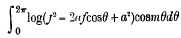
is a well-known one. I propose in the present paper to consider the more general form which the integral takes when P lies on an ellipse.
 and allied Integrals
Construction of Schauder decomposition on banach spaces of periodic functions
-
- Journal:
- Proceedings of the Edinburgh Mathematical Society / Volume 41 / Issue 1 / February 1998
- Published online by Cambridge University Press:
- 20 January 2009, pp. 61-91
-
- Article
-
- You have access
- Export citation
-
This paper deals with Schauder decompositions of Banach spaces X2π of 2π-periodic functions by projection operators Pk onto the subspaces Vk, k = 0,1,…, which form a multiresolution of X2π,. The results unify the study of wavelet decompositions by orthogonal projections in the Hilbert space
 on one hand and by interpolatory projections in the Banach space C2π on the other. The approach, using “orthogonal splines”, is constructive and leads to the construction of a Schauder decomposition of X2π and a biorthogonal system for X2π, and its dual X2π. Decomposition and reconstruction algorithms are derived from the construction.
 on one hand and by interpolatory projections in the Banach space C
Invariant matrices and S-functions
-
- Journal:
- Proceedings of the Edinburgh Mathematical Society / Volume 5 / Issue 1 / October 1936
- Published online by Cambridge University Press:
- 20 January 2009, pp. 43-45
-
- Article
-
- You have access
- Export citation
Ueber die Endlichkeit der Invarianten binärer Formen
-
- Journal:
- Proceedings of the Edinburgh Mathematical Society / Volume 3 / Issue 3 / February 1933
- Published online by Cambridge University Press:
- 20 January 2009, pp. 223-230
-
- Article
-
- You have access
- Export citation
M. C. Crabb and I. M. James Fibrewise homotopy theory (Springer Monographs in Mathematics, Springer, 1998), viii + 341 pp., 1 85233 014 7 (hardcover), £49.50.
-
- Journal:
- Proceedings of the Edinburgh Mathematical Society / Volume 43 / Issue 2 / June 2000
- Published online by Cambridge University Press:
- 20 January 2009, pp. 441-442
-
- Article
-
- You have access
- Export citation
Tame near-rings and N-groups
-
- Journal:
- Proceedings of the Edinburgh Mathematical Society / Volume 23 / Issue 3 / October 1980
- Published online by Cambridge University Press:
- 20 January 2009, pp. 275-296
-
- Article
-
- You have access
- Export citation
D. R. Adams and L. I. Hedberg Function spaces and potential theory (Grundlehren der mathematischen Wissenschaften, Band 314, Springer-Verlag, Berlin–Heidelberg–New York–London–Paris–Tokyo–Hong Kong, 1996), xi + 366 pp., 3 540 57060 8, (hardcover) DM148.
-
- Journal:
- Proceedings of the Edinburgh Mathematical Society / Volume 40 / Issue 2 / June 1997
- Published online by Cambridge University Press:
- 20 January 2009, pp. 406-407
-
- Article
-
- You have access
- Export citation
Note on a Difference-Product Inequality
-
- Journal:
- Proceedings of the Edinburgh Mathematical Society / Volume 13 / Issue 2 / December 1962
- Published online by Cambridge University Press:
- 20 January 2009, pp. 173-174
-
- Article
-
- You have access
- Export citation
-
L. J. Mordell has recently considered (1) the squared modulus of a complex difference-product, namely

under the conditions

and also under the quite different condition

He proves that under (2) the maximum of δ is nn, and is attained when and only when the zr are vertices of a regular n-gon on the unit circle.
V. N. Sachkov Combinatorial methods in discrete mathematics (Encyclopedia of Mathematics and its Applications, Vol. 55, Cambridge University Press, Cambridge, 1996), xiii + 306 pp., 0 521 45513 8 (hardback), £45 (US$69.95).
-
- Journal:
- Proceedings of the Edinburgh Mathematical Society / Volume 40 / Issue 1 / February 1997
- Published online by Cambridge University Press:
- 20 January 2009, p. 213
-
- Article
-
- You have access
- Export citation
A. Lunardi Analytic semigroups and optimal regularity in parabolic problems (Progress in Nonlinear Differential Equations and their Applications Vol. 16, Birkhäuser, Basel, Boston, Berlin 1995) xvii + 424 pp., 3 7643 5172 1, about £100.
-
- Journal:
- Proceedings of the Edinburgh Mathematical Society / Volume 39 / Issue 1 / February 1996
- Published online by Cambridge University Press:
- 20 January 2009, pp. 191-192
-
- Article
-
- You have access
- Export citation
Aronszajn's theorem for some nonlinear Dirichlet problems with unbounded nonlinearities
-
- Journal:
- Proceedings of the Edinburgh Mathematical Society / Volume 31 / Issue 3 / October 1988
- Published online by Cambridge University Press:
- 20 January 2009, pp. 345-351
-
- Article
-
- You have access
- Export citation
-
We consider the Dirichlet problem

where g is continuous and h ∈ L2(0, π).
PEM volume 15 Cover and Front matter
-
- Journal:
- Proceedings of the Edinburgh Mathematical Society / Volume 15 / February 1896
- Published online by Cambridge University Press:
- 20 January 2009, pp. f1-f5
-
- Article
-
- You have access
- Export citation
PEM volume 33 issue 2 Cover and Front matter
-
- Journal:
- Proceedings of the Edinburgh Mathematical Society / Volume 33 / Issue 2 / June 1990
- Published online by Cambridge University Press:
- 20 January 2009, pp. f1-f2
-
- Article
-
- You have access
- Export citation
H. R. Pitt, Integration, Measure and Probability (Oliver and Boyd Ltd., 1963), viii + 201 pp., 25s
-
- Journal:
- Proceedings of the Edinburgh Mathematical Society / Volume 14 / Issue 1 / June 1964
- Published online by Cambridge University Press:
- 20 January 2009, p. 81
-
- Article
-
- You have access
- Export citation
R. W. Dickey, Bifurcation problems in nonlinear elasticity (Pitman, 1976), 119pp.
-
- Journal:
- Proceedings of the Edinburgh Mathematical Society / Volume 22 / Issue 1 / February 1979
- Published online by Cambridge University Press:
- 20 January 2009, pp. 74-75
-
- Article
-
- You have access
- Export citation
The interpolation proof of Grothendieck's inequality
-
- Journal:
- Proceedings of the Edinburgh Mathematical Society / Volume 28 / Issue 2 / June 1985
- Published online by Cambridge University Press:
- 20 January 2009, pp. 217-223
-
- Article
-
- You have access
- Export citation
-
This note is an exposition of the simple and elegant approach to Grothendieck's inequality given in [2] and lsqb;4], with one further simplification. The process of factorizing through L2 ([2], p. 21) introduces a factor of
 into the final constant. We show that this step can be avoided.
 into the final constant. We show that this step can be avoided.
The following Presents to the Library have been received, for which the Society tenders its grateful thanks
-
- Journal:
- Proceedings of the Edinburgh Mathematical Society / Volume 40 / February 1921
- Published online by Cambridge University Press:
- 20 January 2009, pp. vii-viii
-
- Article
-
- You have access
- Export citation
Groups with restriction on their infinite subnormal subgroups
-
- Journal:
- Proceedings of the Edinburgh Mathematical Society / Volume 31 / Issue 2 / June 1988
- Published online by Cambridge University Press:
- 20 January 2009, pp. 231-241
-
- Article
-
- You have access
- Export citation
Subgroups of finite index in groups with finite complete rewriting systems
-
- Journal:
- Proceedings of the Edinburgh Mathematical Society / Volume 43 / Issue 1 / February 2000
- Published online by Cambridge University Press:
- 20 January 2009, pp. 177-183
-
- Article
-
- You have access
- Export citation
