Refine search
Actions for selected content:
26080 results in Abstract analysis
Embedding near-rings into polynomial near-rings
-
- Journal:
- Proceedings of the Edinburgh Mathematical Society / Volume 25 / Issue 1 / February 1982
- Published online by Cambridge University Press:
- 20 January 2009, pp. 73-79
-
- Article
-
- You have access
- Export citation
Constanda, C. Direct and indirect boundary integral equation methods (Monographs and Surveys in Pure and Applied Mathematics no. 107, Chapman & Hall/CRC, 2000), vi+201 pp., 0 8493 0639 6, £43.99
-
- Journal:
- Proceedings of the Edinburgh Mathematical Society / Volume 44 / Issue 2 / June 2001
- Published online by Cambridge University Press:
- 20 January 2009, pp. 446-447
-
- Article
-
- You have access
- Export citation
Cottet, G.-H. and Koumoutsakos, P. D.Vortex methods: theory and practice (Cambridge, 2000), xiii+313 pp., 0 521 62186 0 (hardback), £37.50 (US$59.95)
-
- Journal:
- Proceedings of the Edinburgh Mathematical Society / Volume 44 / Issue 2 / June 2001
- Published online by Cambridge University Press:
- 20 January 2009, pp. 445-446
-
- Article
-
- You have access
- Export citation
PEM volume 12 Back matter and figures
-
- Journal:
- Proceedings of the Edinburgh Mathematical Society / Volume 12 / February 1893
- Published online by Cambridge University Press:
- 20 January 2009, pp. b1-b11
-
- Article
-
- You have access
- Export citation
Multipliers for semigroups
-
- Journal:
- Proceedings of the Edinburgh Mathematical Society / Volume 39 / Issue 2 / June 1996
- Published online by Cambridge University Press:
- 20 January 2009, pp. 241-252
-
- Article
-
- You have access
- Export citation
On One Connexion Between Levi-Civita Parallelism and Einstein's Teleparallelism
-
- Journal:
- Proceedings of the Edinburgh Mathematical Society / Volume 2 / Issue 4 / June 1931
- Published online by Cambridge University Press:
- 20 January 2009, pp. 252-255
-
- Article
-
- You have access
- Export citation
-
In a recent paper Einstein has proposed a new type of geometry in which it is possible to give an arbitrary vector in the field a displacement which conserves parallelism at a distance. It may be briefly stated as follows:
Let the metric ofthe space, supposed to be of n dimensions, be given by
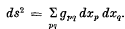
At each point of the space we consider a set of n unit vectors, denoted by the n2 quantities phq, which form an orthogonal ennuple such that


Spherical Geometry
-
- Journal:
- Proceedings of the Edinburgh Mathematical Society / Volume 2 / February 1883
- Published online by Cambridge University Press:
- 20 January 2009, pp. 8-16
-
- Article
-
- You have access
- Export citation
Theral O. Moore, Elementary General Topology (Prentice-Hall), 174 pp., 48s
-
- Journal:
- Proceedings of the Edinburgh Mathematical Society / Volume 15 / Issue 4 / December 1967
- Published online by Cambridge University Press:
- 20 January 2009, pp. 324-325
-
- Article
-
- You have access
- Export citation
Green's and allied theorems: a historical sketch
-
- Journal:
- Proceedings of the Edinburgh Mathematical Society / Volume 8 / February 1889
- Published online by Cambridge University Press:
- 20 January 2009, pp. 2-5
-
- Article
-
- You have access
- Export citation
-
The chief purpose of the paper was to indicate the rise of transformations of the type
 where the integral in the first member of the equation is taken throughout a closed surface, and that in the second member over the surface, a being the angle made with the axis of x by the normal to the element dS drawn outwards. It is on this transformation the analytical proof of Green's theorem depends, and it was shown to have been employed in various forms by Poisson, Duhamel, Gauss, and others, before Green's essay was generally known on the Continent. It may be observed that the essay was published at Nottingham in 1828, and seems to have been unknown to continental mathematicians till its reprint in Crelle's Journal, vols. 39 (1850), 44 (1852), and 47 (1854).
 where the integral in the first member of the equation is taken throughout a closed surface, and that in the second member over the surface, a being the angle made with the axis of x by the normal to the element dS drawn outwards. It is on this transformation the analytical proof of Green's theorem depends, and it was shown to have been employed in various forms by Poisson, Duhamel, Gauss, and others, before Green's essay was generally known on the Continent. It may be observed that the essay was published at Nottingham in 1828, and seems to have been unknown to continental mathematicians till its reprint in Crelle's Journal, vols. 39 (1850), 44 (1852), and 47 (1854).
The Tritangent Circles of a Circular Quartic Curve
-
- Journal:
- Proceedings of the Edinburgh Mathematical Society / Volume 3 / Issue 1 / March 1932
- Published online by Cambridge University Press:
- 20 January 2009, pp. 46-52
-
- Article
-
- You have access
- Export citation
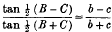
Geometrical Proof of
-
- Journal:
- Proceedings of the Edinburgh Mathematical Society / Volume 38 / February 1919
- Published online by Cambridge University Press:
- 20 January 2009, p. 58
-
- Article
-
- You have access
- Export citation
Rings characterized by their right ideals or cyclic modules
-
- Journal:
- Proceedings of the Edinburgh Mathematical Society / Volume 32 / Issue 3 / October 1989
- Published online by Cambridge University Press:
- 20 January 2009, pp. 355-362
-
- Article
-
- You have access
- Export citation
An estimate for trigonometrical sums over square-free integers with a constant number of prime factors
-
- Journal:
- Proceedings of the Edinburgh Mathematical Society / Volume 15 / Issue 4 / December 1967
- Published online by Cambridge University Press:
- 20 January 2009, pp. 249-255
-
- Article
-
- You have access
- Export citation
-
1. In deriving an expression for the number of representations of a sufficiently large integer N in the form

where k: is a positive integer, s(k) a suitably large function of k and pi is a prime number, i = 1, 2, …, s(k), by Vinogradov's method it is necessary to obtain estimates for trigonometrical sums of the type

where ω = l/k and the real number a satisfies 0 ≦ α ≦ 1 and is “near” a rational number a/q, (a, q) = 1, with “large” denominator q. See Estermann (1), Chapter 3, for the case k = 1 or Hua (2), for the general case. The meaning of “near” and “arge” is made clear below—Lemma 4—as it is necessary for us to quote Hua's estimate. In this paper, in Theorem 1, an estimate is obtained for the trigonometrical sum

where α satisfies the same conditions as above and where π denotes a squarefree number with r prime factors. This estimate enables one to derive expressions for the number of representations of a sufficiently large integer N in the form

where s(k) has the same meaning as above and where πri, i = 1, 2, …, s(k), denotes a square-free integer with ri prime factors.
Tangents to a conic (or to confocal conics) at right angles meet on a circle
-
- Journal:
- Proceedings of the Edinburgh Mathematical Society / Volume 19 / February 1900
- Published online by Cambridge University Press:
- 20 January 2009, p. 34
-
- Article
-
- You have access
- Export citation
Presents to the Library
-
- Journal:
- Proceedings of the Edinburgh Mathematical Society / Volume 30 / February 1911
- Published online by Cambridge University Press:
- 20 January 2009, pp. vii-viii
-
- Article
-
- You have access
- Export citation
Book Received
-
- Journal:
- Proceedings of the Edinburgh Mathematical Society / Volume 25 / Issue 3 / October 1982
- Published online by Cambridge University Press:
- 20 January 2009, p. 282
-
- Article
-
- You have access
- Export citation
Proofs of some optical theorems
-
- Journal:
- Proceedings of the Edinburgh Mathematical Society / Volume 9 / February 1890
- Published online by Cambridge University Press:
- 20 January 2009, p. 2
-
- Article
-
- You have access
- Export citation
The semicentre of a group algebra
-
- Journal:
- Proceedings of the Edinburgh Mathematical Society / Volume 42 / Issue 1 / February 1999
- Published online by Cambridge University Press:
- 20 January 2009, pp. 95-111
-
- Article
-
- You have access
- Export citation
Some Fractional q-Integrals and q-Derivatives†
-
- Journal:
- Proceedings of the Edinburgh Mathematical Society / Volume 15 / Issue 2 / December 1966
- Published online by Cambridge University Press:
- 20 January 2009, pp. 135-140
-
- Article
-
- You have access
- Export citation
-
A q-analogue of the integral ∣f(t)dt is defined by means of

which is an inverse of the q–derivative

The present author (2) has recently obtained a q–nalogue of a formula of Cauchy, namely,

where, for real or complex α and N a positive integer,

On the problem of the electrified disc
-
- Journal:
- Proceedings of the Edinburgh Mathematical Society / Volume 8 / Issue 1 / October 1947
- Published online by Cambridge University Press:
- 20 January 2009, pp. 14-19
-
- Article
-
- You have access
- Export citation
