Refine search
Actions for selected content:
26079 results in Abstract analysis
Intrinsic harmonicily of Morse functions
-
- Journal:
- Mathematika / Volume 50 / Issue 1-2 / December 2003
- Published online by Cambridge University Press:
- 26 February 2010, pp. 167-170
- Print publication:
- December 2003
-
- Article
- Export citation
Uniqueness of positive solutions of nonlinear elliptic equations with exponential growth
-
- Journal:
- Proceedings of the Royal Society of Edinburgh. Section A: Mathematics / Volume 133 / Issue 6 / December 2003
- Published online by Cambridge University Press:
- 12 July 2007, pp. 1409-1420
- Print publication:
- December 2003
-
- Article
- Export citation
-
By combining a technique inspired to the theory of sublinear elliptic equations with the Emden-Fowler inversion technique of Atkinson and Peletier, we obtain uniqueness of positive solutions of the following equation
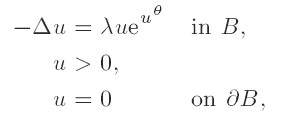 where B ⊂ Rn is the ball of radius one, λ > 0 and 1 < ϑ ≤ 2.
On a lattice point problem arising in the spectral analysis of periodic operators
- Part of
-
- Journal:
- Mathematika / Volume 50 / Issue 1-2 / December 2003
- Published online by Cambridge University Press:
- 26 February 2010, pp. 87-98
- Print publication:
- December 2003
-
- Article
- Export citation
-
Let N(ρ; ω) be the number of points of a d-dimensional lattice Γ. where d≥2, inside a ball of radius ρ centred at the point ω. Denote by
 (ρ) the number N(ρ; ω) averaged over ω in the elementary cell Ω of the lattice Γ. The main result is the following lower bound for
  for dimensions d ≅ l(mod 4):
 (ρ) the number N(ρ; ω) averaged over ω in the elementary cell Ω of the lattice Γ. The main result is the following lower bound for
  for dimensions d ≅ l(mod 4):
A counter-example in G-convergence of non-divergence elliptic operators
-
- Journal:
- Proceedings of the Royal Society of Edinburgh. Section A: Mathematics / Volume 133 / Issue 6 / December 2003
- Published online by Cambridge University Press:
- 12 July 2007, pp. 1299-1310
- Print publication:
- December 2003
-
- Article
- Export citation
Normality and fixpoints of analytic functions
-
- Journal:
- Proceedings of the Royal Society of Edinburgh. Section A: Mathematics / Volume 133 / Issue 6 / December 2003
- Published online by Cambridge University Press:
- 12 July 2007, pp. 1335-1339
- Print publication:
- December 2003
-
- Article
- Export citation
The form of the spectral functions associated with Dirac equations
- Part of
-
- Journal:
- Mathematika / Volume 50 / Issue 1-2 / December 2003
- Published online by Cambridge University Press:
- 26 February 2010, pp. 153-165
- Print publication:
- December 2003
-
- Article
- Export citation
-
§1. Introduction. In this paper, we consider the spectral functions ρα(μ) for μ ∈ R associated with a Dirac equation on [0, ∞) given by

together with the initial condition

Homogenization of Dirichlet parabolic systems with variable monotone operators in general perforated domains
-
- Journal:
- Proceedings of the Royal Society of Edinburgh. Section A: Mathematics / Volume 133 / Issue 6 / December 2003
- Published online by Cambridge University Press:
- 12 July 2007, pp. 1231-1248
- Print publication:
- December 2003
-
- Article
- Export citation
How can we recover Baire class one functions?
- Part of
-
- Journal:
- Mathematika / Volume 50 / Issue 1-2 / December 2003
- Published online by Cambridge University Press:
- 26 February 2010, pp. 171-198
- Print publication:
- December 2003
-
- Article
- Export citation
On an elliptic problem with boundary blow-up and a singular weight: the radial case
-
- Journal:
- Proceedings of the Royal Society of Edinburgh. Section A: Mathematics / Volume 133 / Issue 6 / December 2003
- Published online by Cambridge University Press:
- 12 July 2007, pp. 1283-1297
- Print publication:
- December 2003
-
- Article
- Export citation
When do sections of different dimensions determine a convex body?
- Part of
-
- Journal:
- Mathematika / Volume 50 / Issue 1-2 / December 2003
- Published online by Cambridge University Press:
- 26 February 2010, pp. 35-55
- Print publication:
- December 2003
-
- Article
- Export citation
Partial regularity of local minimizers of quasiconvex integrals with sub-quadratic growth
-
- Journal:
- Proceedings of the Royal Society of Edinburgh. Section A: Mathematics / Volume 133 / Issue 6 / December 2003
- Published online by Cambridge University Press:
- 12 July 2007, pp. 1249-1262
- Print publication:
- December 2003
-
- Article
- Export citation
-
We prove partial regularity for local minimizers of quasiconvex integrals of the form I(v) = ∫ΩF(Dv(x))dx, where the integrand f(ξ) has sub-quadratic growth, i.e. |F(ξ)| ≤ L(1 + |ξ|p), with 1 < p < 2. A function u ∈ W1,p(Ω;RN) is a W1,q(Ω;RN) local minimizer of I(v) if there exists a δ > 0 such that I(u) ≤ I(v) whenever v
and ‖Dv − Du‖q ≤ δ.
On skew-symmetric maps on Lie algebras
-
- Journal:
- Proceedings of the Royal Society of Edinburgh. Section A: Mathematics / Volume 133 / Issue 6 / December 2003
- Published online by Cambridge University Press:
- 12 July 2007, pp. 1273-1281
- Print publication:
- December 2003
-
- Article
- Export citation
Singularities of line congruences
-
- Journal:
- Proceedings of the Royal Society of Edinburgh. Section A: Mathematics / Volume 133 / Issue 6 / December 2003
- Published online by Cambridge University Press:
- 12 July 2007, pp. 1341-1359
- Print publication:
- December 2003
-
- Article
- Export citation
Density-dependent incompressible viscous fluids in critical spaces
-
- Journal:
- Proceedings of the Royal Society of Edinburgh. Section A: Mathematics / Volume 133 / Issue 6 / December 2003
- Published online by Cambridge University Press:
- 12 July 2007, pp. 1311-1334
- Print publication:
- December 2003
-
- Article
- Export citation
Contents
-
- Book:
- Introduction to Banach Algebras, Operators, and Harmonic Analysis
- Published online:
- 29 December 2009
- Print publication:
- 13 November 2003, pp v-vi
-
- Chapter
- Export citation
Part III - Invariant subspaces
-
- Book:
- Introduction to Banach Algebras, Operators, and Harmonic Analysis
- Published online:
- 29 December 2009
- Print publication:
- 13 November 2003, pp 135-136
-
- Chapter
- Export citation
21 - Basic notions from operator theory
-
- Book:
- Introduction to Banach Algebras, Operators, and Harmonic Analysis
- Published online:
- 29 December 2009
- Print publication:
- 13 November 2003, pp 201-211
-
- Chapter
- Export citation
14 - Unitary dilations and the H∞-functional class
-
- Book:
- Introduction to Banach Algebras, Operators, and Harmonic Analysis
- Published online:
- 29 December 2009
- Print publication:
- 13 November 2003, pp 143-153
-
- Chapter
- Export citation
11 - Amenable groups
-
- Book:
- Introduction to Banach Algebras, Operators, and Harmonic Analysis
- Published online:
- 29 December 2009
- Print publication:
- 13 November 2003, pp 109-120
-
- Chapter
- Export citation
Part V - Single-valued extension property and Fredholm theory
-
- Book:
- Introduction to Banach Algebras, Operators, and Harmonic Analysis
- Published online:
- 29 December 2009
- Print publication:
- 13 November 2003, pp 265-266
-
- Chapter
- Export citation
