Refine search
Actions for selected content:
26078 results in Abstract analysis
Quasiregular mappings and Young measures
-
- Journal:
- Proceedings of the Royal Society of Edinburgh. Section A: Mathematics / Volume 132 / Issue 5 / October 2002
- Published online by Cambridge University Press:
- 12 July 2007, pp. 1045-1056
- Print publication:
- October 2002
-
- Article
- Export citation
Submanifolds with constant scalar curvature
-
- Journal:
- Proceedings of the Royal Society of Edinburgh. Section A: Mathematics / Volume 132 / Issue 5 / October 2002
- Published online by Cambridge University Press:
- 12 July 2007, pp. 1163-1183
- Print publication:
- October 2002
-
- Article
- Export citation
-
In this paper, we study n-dimensional complete submanifolds with constant scalar curvature in the Euclidean space En+p and n-dimensional compact submanifolds with constant scalar curvature in the unit sphere Sn+p(1). We prove that the totally umbilical sphere Sn(r), totally geodesic Euclidean space En and generalized cylinder Sn−1(c) × E1 are the only n-dimensional (n > 2) complete submanifolds Mn with constant scalar curvature n(n − 1)r in the Euclidean space En+p, which satisfy the following condition:
 where S denotes the squared norm of the second fundamental form of Mn. For compact submanifolds with constant scalar curvature in the unit sphere Sn+p(1), we also obtain a corresponding result (see theorem 1.3).

GLUING OF ABELIAN CATEGORIES AND DIFFERENTIAL OPERATORS ON THE BASIC AFFINE SPACE
-
- Journal:
- Journal of the Institute of Mathematics of Jussieu / Volume 1 / Issue 4 / October 2002
- Published online by Cambridge University Press:
- 14 October 2002, pp. 543-557
- Print publication:
- October 2002
-
- Article
- Export citation
From the discrete to the continuous coagulation–fragmentation equations
-
- Journal:
- Proceedings of the Royal Society of Edinburgh. Section A: Mathematics / Volume 132 / Issue 5 / October 2002
- Published online by Cambridge University Press:
- 12 July 2007, pp. 1219-1248
- Print publication:
- October 2002
-
- Article
- Export citation
𝔻n-forced symmetry breaking of 𝕆(2)-equivariant problems
-
- Journal:
- Proceedings of the Royal Society of Edinburgh. Section A: Mathematics / Volume 132 / Issue 5 / October 2002
- Published online by Cambridge University Press:
- 12 July 2007, pp. 1185-1218
- Print publication:
- October 2002
-
- Article
- Export citation
-
We use singularity theory to classify forced symmetry-breaking bifurcation problems
 where f1 is 𝕆(2)-equivariant and f2 is 𝔻n-equivariant with the orthogonal group actions on z ∈ ℝ2. Forced symmetry breaking occurs when the symmetry of the equation changes when parameters are varied. We explicitly apply our results to the branching of subharmonic solutions in a model periodic perturbation of an autonomous equation and sketch further applications.

Convergence theorems for intermediate problems. II
-
- Journal:
- Proceedings of the Royal Society of Edinburgh. Section A: Mathematics / Volume 132 / Issue 5 / October 2002
- Published online by Cambridge University Press:
- 12 July 2007, pp. 1057-1072
- Print publication:
- October 2002
-
- Article
- Export citation
Submanifolds with constant scalar curvature
-
- Journal:
- Proceedings of the Royal Society of Edinburgh. Section A: Mathematics / Volume 132 / Issue 5 / October 2002
- Published online by Cambridge University Press:
- 12 July 2007, pp. 1163-1183
- Print publication:
- October 2002
-
- Article
- Export citation
-
In this paper, we study n-dimensional complete submanifolds with constant scalar curvature in the Euclidean space En+p and n-dimensional compact submanifolds with constant scalar curvature in the unit sphere Sn+p(1). We prove that the totally umbilical sphere Sn(r), totally geodesic Euclidean space En and generalized cylinder Sn−1(c) × E1 are the only n-dimensional (n > 2) complete submanifolds Mn with constant scalar curvature n(n − 1)r in the Euclidean space En+p, which satisfy the following condition:
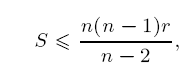 where S denotes the squared norm of the second fundamental form of Mn. For compact submanifolds with constant scalar curvature in the unit sphere Sn+p(1), we also obtain a corresponding result (see theorem 1.3).
ON DETERMINATION OF A GAUGE FIELD ON ℝd FROM ITS NON-ABELIAN RADON TRANSFORM ALONG ORIENTED STRAIGHT LINES
-
- Journal:
- Journal of the Institute of Mathematics of Jussieu / Volume 1 / Issue 4 / October 2002
- Published online by Cambridge University Press:
- 14 October 2002, pp. 559-629
- Print publication:
- October 2002
-
- Article
- Export citation
Totally multiplicatively prime algebras
-
- Journal:
- Proceedings of the Royal Society of Edinburgh. Section A: Mathematics / Volume 132 / Issue 5 / October 2002
- Published online by Cambridge University Press:
- 12 July 2007, pp. 1145-1162
- Print publication:
- October 2002
-
- Article
- Export citation
Thin-film-growth models: roughness and correlation functions
-
- Journal:
- European Journal of Applied Mathematics / Volume 13 / Issue 4 / August 2002
- Published online by Cambridge University Press:
- 25 September 2002, pp. 385-402
-
- Article
- Export citation
A stochastic model of sedimentation: probabilities and multifractality
-
- Journal:
- European Journal of Applied Mathematics / Volume 13 / Issue 4 / August 2002
- Published online by Cambridge University Press:
- 25 September 2002, pp. 371-383
-
- Article
- Export citation
Analysis and computations for a model of quasi-static deformation of a thinning sheet arising in superplastic forming
-
- Journal:
- European Journal of Applied Mathematics / Volume 13 / Issue 4 / August 2002
- Published online by Cambridge University Press:
- 25 September 2002, pp. 403-429
-
- Article
- Export citation
Global in time solution to the Hele-Shaw problem with a change of topology
-
- Journal:
- European Journal of Applied Mathematics / Volume 13 / Issue 4 / August 2002
- Published online by Cambridge University Press:
- 25 September 2002, pp. 431-447
-
- Article
- Export citation
Digital inpainting based on the Mumford–Shah–Euler image model
-
- Journal:
- European Journal of Applied Mathematics / Volume 13 / Issue 4 / August 2002
- Published online by Cambridge University Press:
- 25 September 2002, pp. 353-370
-
- Article
- Export citation
Bonferroni-Type Inequalities via Chordal Graphs
-
- Journal:
- Combinatorics, Probability and Computing / Volume 11 / Issue 4 / July 2002
- Published online by Cambridge University Press:
- 06 September 2002, pp. 349-351
-
- Article
- Export citation
Quickselect and the Dickman Function
-
- Journal:
- Combinatorics, Probability and Computing / Volume 11 / Issue 4 / July 2002
- Published online by Cambridge University Press:
- 06 September 2002, pp. 353-371
-
- Article
- Export citation
Constructing Trees in Graphs whose Complement has no K2,s
-
- Journal:
- Combinatorics, Probability and Computing / Volume 11 / Issue 4 / July 2002
- Published online by Cambridge University Press:
- 06 September 2002, pp. 343-347
-
- Article
- Export citation
Pattern Avoidance and Overlap in Strings
-
- Journal:
- Combinatorics, Probability and Computing / Volume 11 / Issue 4 / July 2002
- Published online by Cambridge University Press:
- 06 September 2002, pp. 393-402
-
- Article
- Export citation
A Note on Rough Isometry Invariance of Resistance
-
- Journal:
- Combinatorics, Probability and Computing / Volume 11 / Issue 4 / July 2002
- Published online by Cambridge University Press:
- 06 September 2002, pp. 427-432
-
- Article
- Export citation
Asymptotic Enumeration of Graphs with a Given Upper Bound on the Maximum Degree
-
- Journal:
- Combinatorics, Probability and Computing / Volume 11 / Issue 4 / July 2002
- Published online by Cambridge University Press:
- 06 September 2002, pp. 373-392
-
- Article
- Export citation
