Refine search
Actions for selected content:
9084 results in Discrete Mathematics, Information Theory and Coding
The zeros of a function occurring in the solution of the Graetz problem
- Part of
-
- Journal:
- Mathematika / Volume 21 / Issue 1 / June 1974
- Published online by Cambridge University Press:
- 26 February 2010, pp. 55-63
- Print publication:
- June 1974
-
- Article
- Export citation
The average size of gaps between primes
-
- Journal:
- Mathematika / Volume 21 / Issue 1 / June 1974
- Published online by Cambridge University Press:
- 26 February 2010, pp. 96-100
- Print publication:
- June 1974
-
- Article
- Export citation
-
Erdoső has asked whether there exists a positive constant c < 1 such that
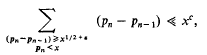
where pn is the n-th prime. In 1943 Selberg «3» proved, on the assumption of the Riemann Hypothesis, that
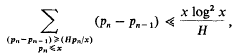
uniformly for H > 0. By an elementary extension of Selberg's method we prove the following two results free of any unproved assumptions.
Class groups of metacyclic groups of order p'q,p a regular prime
-
- Journal:
- Mathematika / Volume 21 / Issue 1 / June 1974
- Published online by Cambridge University Press:
- 26 February 2010, pp. 90-95
- Print publication:
- June 1974
-
- Article
- Export citation
-
Let p be an odd prime, let q be a divisor of p – 1, and let α be a primitive q-th root modulo p. For each natural number r the metacyclic group Gr is defined by

Primitive Radon partitions
-
- Journal:
- Mathematika / Volume 21 / Issue 1 / June 1974
- Published online by Cambridge University Press:
- 26 February 2010, pp. 32-37
- Print publication:
- June 1974
-
- Article
- Export citation
-
Radon's theorem [8] asserts that, if X is a finite set of s points in Rd and s ≥ d + 2, then X admits a. Radon partition, that is, a partition {X1; X2} of X into disjoint subsets X1 and X2, such that

The stability of an expanding circular vortex sheet
- Part of
-
- Journal:
- Mathematika / Volume 21 / Issue 1 / June 1974
- Published online by Cambridge University Press:
- 26 February 2010, pp. 128-133
- Print publication:
- June 1974
-
- Article
- Export citation
On isolated fixed points of group actions on poincaré complexes
-
- Journal:
- Mathematika / Volume 21 / Issue 1 / June 1974
- Published online by Cambridge University Press:
- 26 February 2010, pp. 114-115
- Print publication:
- June 1974
-
- Article
- Export citation
On the structure of instability bursts in three-dimensional parallel flow
- Part of
-
- Journal:
- Mathematika / Volume 21 / Issue 1 / June 1974
- Published online by Cambridge University Press:
- 26 February 2010, pp. 134-146
- Print publication:
- June 1974
-
- Article
- Export citation
Note on difference-covers that are not k-sum-covers
- Part of
-
- Journal:
- Mathematika / Volume 21 / Issue 1 / June 1974
- Published online by Cambridge University Press:
- 26 February 2010, pp. 107-109
- Print publication:
- June 1974
-
- Article
- Export citation
-
For some integer modulus q let F be a subset of Z(q), the additive group of residues modulo q. As in «1» we shall write

and

The 3-class groups of non-Galois cubic fields—I
-
- Journal:
- Mathematika / Volume 21 / Issue 1 / June 1974
- Published online by Cambridge University Press:
- 26 February 2010, pp. 72-89
- Print publication:
- June 1974
-
- Article
- Export citation
-
Let K3 be a non-Galois cubic extension of the rationals and let K6 be its normal closure. Under K6 there is a unique quadratic field K2. For i = 2, 3, 6 we define C1i; to be the 3-class group of K2 and ri to be the rank of Cli. We suppose that K2 is complex and that K6/K2 is unramified. Our main result is

MTK volume 21 issue 1 Front matter
-
- Journal:
- Mathematika / Volume 21 / Issue 1 / June 1974
- Published online by Cambridge University Press:
- 26 February 2010, pp. f1-f2
- Print publication:
- June 1974
-
- Article
-
- You have access
- Export citation
Decomposition of convex bodies
- Part of
-
- Journal:
- Mathematika / Volume 21 / Issue 1 / June 1974
- Published online by Cambridge University Press:
- 26 February 2010, pp. 19-25
- Print publication:
- June 1974
-
- Article
- Export citation
Families of compact sets and their universals
- Part of
-
- Journal:
- Mathematika / Volume 21 / Issue 1 / June 1974
- Published online by Cambridge University Press:
- 26 February 2010, pp. 116-127
- Print publication:
- June 1974
-
- Article
- Export citation
-
§1. Introduction and Summary. Throughout X is a complete separable metric space. We write K1 for the family of non-empty compact subsets of X. K1 may be endowed with a metric (first introduced by Hausdorff) under which K1 is complete and separable. We shall make use of the subbase for this metrizable topology of K1 given by sets of the two forms

for U open in X (see Kuratowski [4] or E. Michael [9] for a discussion of topologies on the space of subsets of X). if
 we shall be concerned with sets in [0, 1] × X which are universal for ℋ. To define these let us make the convention that, for D ⊆ [0, 1] × X, we write
D is said to be universal for ℋ if

 we shall be concerned with sets in [0, 1] ×
Note on the slow rotation of a concave spherical lens or bowl in two immiscible semi-infinite viscous fluids
- Part of
-
- Journal:
- Mathematika / Volume 21 / Issue 1 / June 1974
- Published online by Cambridge University Press:
- 26 February 2010, pp. 147-154
- Print publication:
- June 1974
-
- Article
- Export citation
Problems related to a conjecture by Grünbaum
- Part of
-
- Journal:
- Mathematika / Volume 21 / Issue 1 / June 1974
- Published online by Cambridge University Press:
- 26 February 2010, pp. 45-54
- Print publication:
- June 1974
-
- Article
- Export citation
A Problem of Erdős and Kátai
-
- Journal:
- Mathematika / Volume 21 / Issue 1 / June 1974
- Published online by Cambridge University Press:
- 26 February 2010, pp. 110-113
- Print publication:
- June 1974
-
- Article
- Export citation
-
In this paper I prove the following result:
Theorem. Let f(d) be a multiplicative function such that |f(d)| ≤ 1 and ∑{ l/p : p ε P} = ∞, where P denotes the set of primes p for which f{p) = −1, and let v(n) denote the number of distinct prime factors ofn. Then for almost all n,
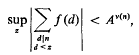
where A is an arbitrary constant > 3/e.
On asymmetry classes of convex bodies
- Part of
-
- Journal:
- Mathematika / Volume 21 / Issue 1 / June 1974
- Published online by Cambridge University Press:
- 26 February 2010, pp. 12-18
- Print publication:
- June 1974
-
- Article
- Export citation
-
Asymmetry classes of convex bodies have been introduced and investigated by G. Ewald and G. C. Shephard [2], [3], [6]. These classes are defined as follows. Let
 denote the set of all convex bodies in n-dimensional Euclidean space ℝn. For K1, K2 ∊ write K1 ∼ K2 if there exist centrally symmetric convex bodies S1, S2 ∊ such that
where + denotes Minkowski addition. Then ∼ is an equivalence relation on
and the corresponding classes are called asymmetry classes. The asymmetry class which contains K is denoted by [K].
 denote the set of all convex bodies in
On maximal simplices inscribed in a central convex set
- Part of
-
- Journal:
- Mathematika / Volume 21 / Issue 1 / June 1974
- Published online by Cambridge University Press:
- 26 February 2010, pp. 38-44
- Print publication:
- June 1974
-
- Article
- Export citation
13 - The Tutte polynomial
-
- Book:
- Algebraic Graph Theory
- Published online:
- 05 August 2012
- Print publication:
- 16 May 1974, pp 97-105
-
- Chapter
- Export citation
5 - Spanning trees and associated structures
-
- Book:
- Algebraic Graph Theory
- Published online:
- 05 August 2012
- Print publication:
- 16 May 1974, pp 31-37
-
- Chapter
- Export citation
18 - Symmetric graphs of degree three
-
- Book:
- Algebraic Graph Theory
- Published online:
- 05 August 2012
- Print publication:
- 16 May 1974, pp 138-148
-
- Chapter
- Export citation
