Refine search
Actions for selected content:
6997 results in Mathematical modeling and methods
On nonblocking multiconnection networks composed of digital switching matrices
-
- Journal:
- Journal of the Australian Mathematical Society. Series B. Applied Mathematics / Volume 31 / Issue 2 / October 1989
- Published online by Cambridge University Press:
- 17 February 2009, pp. 188-203
-
- Article
-
- You have access
- Export citation
Singular perturbation methods for a class of initial and boundary value problems in multi-parameter classical digital control systems
-
- Journal:
- The ANZIAM Journal / Volume 46 / Issue 1 / July 2004
- Published online by Cambridge University Press:
- 17 February 2009, pp. 67-77
-
- Article
-
- You have access
- Export citation
Asymptotic behavior of solutions to the Stefan problem with a kinetic condition at the free boundary
-
- Journal:
- Journal of the Australian Mathematical Society. Series B. Applied Mathematics / Volume 31 / Issue 1 / July 1989
- Published online by Cambridge University Press:
- 17 February 2009, pp. 81-96
-
- Article
-
- You have access
- Export citation
-
We study the large time behaviour of the free boundary for a one-phase Stefan problem with supercooling and a kinetic condition u = −ε|⋅ṡ| at the free boundary x = s(t). The problem is posed on the semi-infinite strip [0,∞) with unit Stefan number and bounded initial temperature ϕ(x) ≤ 0, such that ϕ → −1 − δ as x → ∞, where δ is constant. Special solutions and the asymptotic behaviour of the free boundary are considered for the cases ε ≥ 0 with δ negative, positive and zero, respectively. We show that, for ε > 0, the free boundary is asymptotic to
 , δt/ε if < δ > 0 respectively, and that when δ = 0 the large time behaviour of the free boundary depends more sensitively on the initial temperature. We also give a brief summary of the corresponding results for a radially symmetric spherical crystal with kinetic undercooling and Gibbs-Thomson conditions at the free boundary.
 , δ
, δAn analysis of the impact of T. M. Cherry's work on asymptotic expansions
-
- Journal:
- Journal of the Australian Mathematical Society. Series B. Applied Mathematics / Volume 30 / Issue 4 / April 1989
- Published online by Cambridge University Press:
- 17 February 2009, pp. 378-388
-
- Article
-
- You have access
- Export citation
Modelling the spread of grass fires
-
- Journal:
- Journal of the Australian Mathematical Society. Series B. Applied Mathematics / Volume 23 / Issue 4 / April 1982
- Published online by Cambridge University Press:
- 17 February 2009, pp. 451-466
-
- Article
-
- You have access
- Export citation
Contents
-
- Journal:
- Journal of the Australian Mathematical Society. Series B. Applied Mathematics / Volume 19 / Issue 4 / December 1976
- Published online by Cambridge University Press:
- 17 February 2009, pp. 513-514
-
- Article
-
- You have access
- Export citation
Facility location via continuous optimization with discontinuous objective functions
-
- Journal:
- The ANZIAM Journal / Volume 48 / Issue 3 / January 2007
- Published online by Cambridge University Press:
- 17 February 2009, pp. 315-325
-
- Article
-
- You have access
- Export citation
Optimal control of a chemical reactor
-
- Journal:
- Journal of the Australian Mathematical Society. Series B. Applied Mathematics / Volume 39 / Issue 1 / July 1997
- Published online by Cambridge University Press:
- 17 February 2009, pp. 61-76
-
- Article
-
- You have access
- Export citation
The molecular weight distribution problem and reptation mixing rules
-
- Journal:
- The ANZIAM Journal / Volume 42 / Issue 1 / July 2000
- Published online by Cambridge University Press:
- 17 February 2009, pp. 26-40
-
- Article
-
- You have access
- Export citation
ANZ volume 23 issue 2 Cover and Front matter
-
- Journal:
- Journal of the Australian Mathematical Society. Series B. Applied Mathematics / Volume 23 / Issue 2 / October 1981
- Published online by Cambridge University Press:
- 17 February 2009, pp. f1-f2
-
- Article
-
- You have access
- Export citation
ANZ volume 35 issue 2 Cover and Front matter
-
- Journal:
- Journal of the Australian Mathematical Society. Series B. Applied Mathematics / Volume 35 / Issue 2 / October 1993
- Published online by Cambridge University Press:
- 17 February 2009, pp. f1-f2
-
- Article
-
- You have access
- Export citation
A dynamical systems model of the limiting oxygen index test
-
- Journal:
- The ANZIAM Journal / Volume 43 / Issue 1 / July 2001
- Published online by Cambridge University Press:
- 17 February 2009, pp. 105-117
-
- Article
-
- You have access
- Export citation
Mesh independence and fast local convergence of a primal-dual active-set method for mixed control-state constrained elliptic control problems
-
- Journal:
- The ANZIAM Journal / Volume 49 / Issue 1 / July 2007
- Published online by Cambridge University Press:
- 17 February 2009, pp. 1-38
-
- Article
-
- You have access
- Export citation
Parseval's integral and the Jacobi expansions in series of Bessel fuinctions
-
- Journal:
- Journal of the Australian Mathematical Society. Series B. Applied Mathematics / Volume 27 / Issue 3 / January 1986
- Published online by Cambridge University Press:
- 17 February 2009, pp. 370-375
-
- Article
-
- You have access
- Export citation
-
The sums
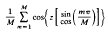
are shown to approximate J0 (z); the error terms are series in higher order Bessel functions, leading with J2M (z). Similar sums approximate J1(z). These sums may be looked on as extensions of the Jacobi expansions for cos z and sin z in series of Bessel functions. They become numerically useful for M > |z|.
Solvability of some Abel-type integral equations involving the Gauss hypergeometric function as kernels in the spaces of summable functions
-
- Journal:
- The ANZIAM Journal / Volume 43 / Issue 2 / October 2001
- Published online by Cambridge University Press:
- 17 February 2009, pp. 291-320
-
- Article
-
- You have access
- Export citation
Effects of velocity-slip and viscosity variation on journal bearings
-
- Journal:
- The ANZIAM Journal / Volume 46 / Issue 1 / July 2004
- Published online by Cambridge University Press:
- 17 February 2009, pp. 143-155
-
- Article
-
- You have access
- Export citation
Joined dissimilar orthotropic elastic cylindrical membranes under internal pressure and longitudinal tension
-
- Journal:
- Journal of the Australian Mathematical Society. Series B. Applied Mathematics / Volume 34 / Issue 3 / January 1993
- Published online by Cambridge University Press:
- 17 February 2009, pp. 296-317
-
- Article
-
- You have access
- Export citation
The Wiener-Hopf integral equation for fractional Riesz-Bessel motion
-
- Journal:
- The ANZIAM Journal / Volume 42 / Issue 1 / July 2000
- Published online by Cambridge University Press:
- 17 February 2009, pp. 41-54
-
- Article
-
- You have access
- Export citation
Oscilations of higher-order neutral equations
-
- Journal:
- Journal of the Australian Mathematical Society. Series B. Applied Mathematics / Volume 27 / Issue 4 / April 1986
- Published online by Cambridge University Press:
- 17 February 2009, pp. 502-511
-
- Article
-
- You have access
- Export citation
Including ionisation in a simple model of single-bubble sonoluminescence
-
- Journal:
- The ANZIAM Journal / Volume 47 / Issue 3 / January 2006
- Published online by Cambridge University Press:
- 17 February 2009, pp. 333-358
-
- Article
-
- You have access
- Export citation
