Refine search
Actions for selected content:
6994 results in Mathematical modeling and methods
Rumours with general initial conditions
-
- Journal:
- The ANZIAM Journal / Volume 45 / Issue 3 / January 2004
- Published online by Cambridge University Press:
- 17 February 2009, pp. 393-400
-
- Article
-
- You have access
- Export citation
Stability analysis of Runge–Kutta methods applied to a basic Volterra integral equation
-
- Journal:
- Journal of the Australian Mathematical Society. Series B. Applied Mathematics / Volume 22 / Issue 4 / April 1981
- Published online by Cambridge University Press:
- 17 February 2009, pp. 515-538
-
- Article
-
- You have access
- Export citation
-
Our purpose in this paper is to display the stability analysis of Runge–Kutta methods applied to a Volterra integral equation of a simple form. As prerequisite we define, and then develop the structure of, the class of Runge–Kutta methods considered. The test equation is taken as the “;basic” equation
 ; the simple form of this equation permits ready insight into features which are more obscure when considering (as elsewhere [1], [2], [6]) equations of a more complicated form. Due to the structure of the methods and the nature of the test equation, the stability analysis reduces to the study of recurrence relations of the form Фk + 1 = MФ k + γk (k = 0, 1, 2, …) which are common in stability discussions in numerical analysis.
 ; the simple form of this equation permits ready insight into features which are more obscure when considering (as elsewhere [1], [2], [6]) equations of a more complicated form. Due to the structure of the methods and the nature of the test equation, the stability analysis reduces to the study of recurrence relations of the form Ф
Analytic solution of the linearized shallow-water wave equations for certain continuous depth variations
-
- Journal:
- Journal of the Australian Mathematical Society. Series B. Applied Mathematics / Volume 19 / Issue 1 / June 1975
- Published online by Cambridge University Press:
- 17 February 2009, pp. 81-94
-
- Article
-
- You have access
- Export citation
On wave motion in a two-layered liquid of infinite depth in the presence of surface and interfacial tension
-
- Journal:
- Journal of the Australian Mathematical Society. Series B. Applied Mathematics / Volume 35 / Issue 3 / January 1994
- Published online by Cambridge University Press:
- 17 February 2009, pp. 302-322
-
- Article
-
- You have access
- Export citation
Existence of stationary vacuum solutions of Einstein's equations in an exterior domain
-
- Journal:
- Journal of the Australian Mathematical Society. Series B. Applied Mathematics / Volume 41 / Issue 2 / October 1999
- Published online by Cambridge University Press:
- 17 February 2009, pp. 231-247
-
- Article
-
- You have access
- Export citation
-
A proof is given for the existence and uniqueness of a stationary vacuum solution (M, g, ξ) of the boundary value problem consisting of Einstein's equations in an exterior domain M diffeomorphic to R × Σ (where Σ = R3\B(0, R)) and boundary data depending on the Killing field ξ on ∂Σ. The boundary data must be sufficiently close to that of a stationary, spatially conformally flat vacuum solution
 .
.
 .
.A quadrature method for constant-coefficient Cauchy singular integral equations on an interval
-
- Journal:
- The ANZIAM Journal / Volume 42 / Issue 2 / October 2000
- Published online by Cambridge University Press:
- 17 February 2009, pp. 287-311
-
- Article
-
- You have access
- Export citation
ANZ volume 31 issue 3 Cover and Front matter
-
- Journal:
- Journal of the Australian Mathematical Society. Series B. Applied Mathematics / Volume 31 / Issue 3 / January 1990
- Published online by Cambridge University Press:
- 17 February 2009, pp. f1-f2
-
- Article
-
- You have access
- Export citation
The stability of a curved, heated boundary layer: linear and nonlinear problems
-
- Journal:
- The ANZIAM Journal / Volume 46 / Issue 4 / April 2005
- Published online by Cambridge University Press:
- 17 February 2009, pp. 507-543
-
- Article
-
- You have access
- Export citation
On the condition number of integral equations in linear elasticity using the modified Green's function
-
- Journal:
- The ANZIAM Journal / Volume 44 / Issue 3 / January 2003
- Published online by Cambridge University Press:
- 17 February 2009, pp. 431-446
-
- Article
-
- You have access
- Export citation
The allometric hypothesis when the size variable is uncertain: issues in the study of carcass composition by serial slaughter
-
- Journal:
- Journal of the Australian Mathematical Society. Series B. Applied Mathematics / Volume 38 / Issue 4 / April 1997
- Published online by Cambridge University Press:
- 17 February 2009, pp. 477-488
-
- Article
-
- You have access
- Export citation
Global existence for the generalised 2D Ginzburg-Landau equation
-
- Journal:
- The ANZIAM Journal / Volume 44 / Issue 3 / January 2003
- Published online by Cambridge University Press:
- 17 February 2009, pp. 381-392
-
- Article
-
- You have access
- Export citation
Bifurcation and stability of periodic solutions from a zero eigenvalue
-
- Journal:
- Journal of the Australian Mathematical Society. Series B. Applied Mathematics / Volume 21 / Issue 1 / April 1979
- Published online by Cambridge University Press:
- 17 February 2009, pp. 2-20
-
- Article
-
- You have access
- Export citation
Inverse power law potentials about polygonal prisms and in polygonal cavities†
-
- Journal:
- Journal of the Australian Mathematical Society. Series B. Applied Mathematics / Volume 20 / Issue 4 / December 1978
- Published online by Cambridge University Press:
- 17 February 2009, p. 508
-
- Article
-
- You have access
- Export citation
-
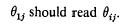
Page 242, bottom line.

Page 243, right side of equation (6).

Page 243, right side of equations (8) and (9).

Page 250, line 4 of Section 7.
A mathematical analysis of wind effects on a long-jumper
-
- Journal:
- Journal of the Australian Mathematical Society. Series B. Applied Mathematics / Volume 33 / Issue 1 / July 1991
- Published online by Cambridge University Press:
- 17 February 2009, pp. 65-76
-
- Article
-
- You have access
- Export citation
ANZ volume 25 issue 1 Cover and Front matter
-
- Journal:
- Journal of the Australian Mathematical Society. Series B. Applied Mathematics / Volume 25 / Issue 1 / July 1983
- Published online by Cambridge University Press:
- 17 February 2009, pp. f1-f3
-
- Article
-
- You have access
- Export citation
What is invexity?
-
- Journal:
- Journal of the Australian Mathematical Society. Series B. Applied Mathematics / Volume 28 / Issue 1 / July 1986
- Published online by Cambridge University Press:
- 17 February 2009, pp. 1-9
-
- Article
-
- You have access
- Export citation
ANZ volume 29 issue 3 Cover and Front matter
-
- Journal:
- Journal of the Australian Mathematical Society. Series B. Applied Mathematics / Volume 29 / Issue 3 / January 1988
- Published online by Cambridge University Press:
- 17 February 2009, pp. f1-f2
-
- Article
-
- You have access
- Export citation
ANZ volume 37 issue 3 Cover and Back matter
-
- Journal:
- Journal of the Australian Mathematical Society. Series B. Applied Mathematics / Volume 37 / Issue 3 / January 1996
- Published online by Cambridge University Press:
- 17 February 2009, pp. b1-b2
-
- Article
-
- You have access
- Export citation
Simple nonlinear dual control problems
-
- Journal:
- Journal of the Australian Mathematical Society. Series B. Applied Mathematics / Volume 27 / Issue 2 / October 1985
- Published online by Cambridge University Press:
- 17 February 2009, pp. 131-144
-
- Article
-
- You have access
- Export citation
The propagation of small amplitude long waves on the surface of superfluid helium
-
- Journal:
- Journal of the Australian Mathematical Society. Series B. Applied Mathematics / Volume 25 / Issue 3 / January 1984
- Published online by Cambridge University Press:
- 17 February 2009, pp. 311-348
-
- Article
-
- You have access
- Export citation
