Refine search
Actions for selected content:
14297 results in Mathematical physics
A note on morphisms to wreath products
- Part of
-
- Journal:
- Mathematical Proceedings of the Cambridge Philosophical Society / Volume 180 / Issue 2 / March 2026
- Published online by Cambridge University Press:
- 08 October 2025, pp. 247-274
- Print publication:
- March 2026
-
- Article
- Export citation
-
Given a morphism $\varphi \;:\; G \to A \wr B$ from a finitely presented group G to a wreath product $A \wr B$, we show that, if the image of $\varphi$ is a sufficiently large subgroup, then $\mathrm{ker}(\varphi)$ contains a non-abelian free subgroup and $\varphi$ factors through an acylindrically hyperbolic quotient of G. As direct applications, we classify the finitely presented subgroups in $A \wr B$ up to isomorphism and we deduce that a finitely presented group having a wreath product $(\text{non-trivial}) \wr (\text{infinite})$ as a quotient must be SQ-universal (extending theorems of Baumslag and Cornulier–Kar). Finally, we exploit our theorem in order to describe the structure of the automorphism groups of several families of wreath products, highlighting an interesting connection with the Kaplansky conjecture on units in group rings.


PSP volume 179 issue 3 Cover and Back matter
-
- Journal:
- Mathematical Proceedings of the Cambridge Philosophical Society / Volume 179 / Issue 3 / November 2025
- Published online by Cambridge University Press:
- 06 October 2025, pp. b1-b2
- Print publication:
- November 2025
-
- Article
-
- You have access
- Export citation
PSP volume 179 issue 3 Cover and Front matter
-
- Journal:
- Mathematical Proceedings of the Cambridge Philosophical Society / Volume 179 / Issue 3 / November 2025
- Published online by Cambridge University Press:
- 06 October 2025, pp. f1-f2
- Print publication:
- November 2025
-
- Article
-
- You have access
- Export citation
Combinatorial cusp count and clover invariants
- Part of
-
- Journal:
- Mathematical Proceedings of the Cambridge Philosophical Society / Volume 180 / Issue 2 / March 2026
- Published online by Cambridge University Press:
- 03 October 2025, pp. 237-245
- Print publication:
- March 2026
-
- Article
-
- You have access
- Open access
- HTML
- Export citation
-
We construct efficient topological cobordisms between torus links and large connected sums of trefoil knots. As an application, we show that the signature invariant $\sigma_\omega$ at $\omega=\zeta_6$ takes essentially minimal values on torus links among all concordance homomorphisms with the same normalisation on the trefoil knot.


Inducibility of rainbow graphs
- Part of
-
- Journal:
- Mathematical Proceedings of the Cambridge Philosophical Society / Volume 180 / Issue 1 / January 2026
- Published online by Cambridge University Press:
- 02 October 2025, pp. 191-218
- Print publication:
- January 2026
-
- Article
-
- You have access
- Open access
- HTML
- Export citation
-
We prove that there is an absolute constant $C{\,\gt\,}0$ such that every k-vertex connected rainbow graph R with minimum degree at least $C\log k$ has inducibility $k!/(k^k-k)$. The same result holds if $k\ge 11$, and R is a clique. This answers a question posed by Huang, that is a generalisation of an old problem of Erdös and Sós. It remains open to determine the minimum k for which this is true.


Ordered bases, order-preserving automorphisms and bi-orderable link groups
- Part of
-
- Journal:
- Mathematical Proceedings of the Cambridge Philosophical Society / Volume 180 / Issue 1 / January 2026
- Published online by Cambridge University Press:
- 02 October 2025, pp. 219-235
- Print publication:
- January 2026
-
- Article
-
- You have access
- Open access
- HTML
- Export citation
On absolute continuity and maximal Garsia entropy for self-similar measures with algebraic contraction ratio
-
- Journal:
- Mathematical Proceedings of the Cambridge Philosophical Society / Volume 180 / Issue 1 / January 2026
- Published online by Cambridge University Press:
- 24 September 2025, pp. 145-190
- Print publication:
- January 2026
-
- Article
- Export citation
-
We consider the self-similar measure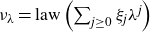 $\nu_\lambda=\text{law}\left(\sum_{j \geq 0} \xi_j \lambda^j\right)$ on $\mathbb{R}$, where $|\lambda| \lt 1$ and the $\xi_j \sim \nu$ are independent, identically distributed with respect to a measure $\nu$ finitely supported on $\mathbb{Z}$. One example of such a measure is a Bernoulli convolution. It is known that for certain combinations of algebraic $\lambda$ and $\nu$ uniform on an interval, $\nu_\lambda$ is absolutely continuous and its Fourier transform has power decay; in the proof, it is exploited that for these combinations, a quantity called the Garsia entropy $h_{\lambda}(\nu)$ is maximal.
In this paper, we show that the phenomenon of $h_{\lambda}(\nu)$ being maximal is equivalent to absolute continuity of a self-affine measure $\mu_\lambda$, which is naturally associated to $\lambda$ and projects onto $\nu_\lambda$. We also classify all combinations for which this phenomenon occurs: we find that if an algebraic $\lambda$ without a Galois conjugate of modulus exactly one has a $\nu$ such that $h_{\lambda}(\nu)$ is maximal, then all Galois conjugates of $\lambda$ must be smaller in modulus than one and $\nu$ must satisfy a certain finite set of linear equations in terms of $\lambda$. Lastly, we show that in this case, the measure $\mu_\lambda$ is not only absolutely continuous but also has power Fourier decay, which implies the same for $\nu_\lambda$.


On homological properties of the Schlichting completion
- Part of
-
- Journal:
- Mathematical Proceedings of the Cambridge Philosophical Society / Volume 180 / Issue 1 / January 2026
- Published online by Cambridge University Press:
- 04 September 2025, pp. 133-144
- Print publication:
- January 2026
-
- Article
-
- You have access
- Open access
- HTML
- Export citation
On the Assouad spectrum of Hölder and Sobolev graphs
- Part of
-
- Journal:
- Mathematical Proceedings of the Cambridge Philosophical Society / Volume 180 / Issue 1 / January 2026
- Published online by Cambridge University Press:
- 01 September 2025, pp. 105-131
- Print publication:
- January 2026
-
- Article
-
- You have access
- Open access
- HTML
- Export citation
-
We provide upper bounds for the Assouad spectrum $\dim_A^\theta(\mathrm{Gr}({\kern2pt}f))$ of the graph of a real-valued Hölder or Sobolev function f defined on an interval $I \subset \mathbb{R}$. We demonstrate via examples that all of our bounds are sharp. In the setting of Hölder graphs, we further provide a geometric algorithm which takes as input the graph of an $\alpha$-Hölder continuous function satisfying a matching lower oscillation condition with exponent $\alpha$ and returns the graph of a new $\alpha$-Hölder continuous function for which the Assouad $\theta$-spectrum realizes the stated upper bound for all $\theta\in (0,1)$. Examples of functions to which this algorithm applies include the continuous nowhere differentiable functions of Weierstrass and Takagi.


A partial resolution of Hedden’s conjecture on satellite homomorphisms
- Part of
-
- Journal:
- Mathematical Proceedings of the Cambridge Philosophical Society / Volume 180 / Issue 1 / January 2026
- Published online by Cambridge University Press:
- 29 August 2025, pp. 93-104
- Print publication:
- January 2026
-
- Article
-
- You have access
- Open access
- HTML
- Export citation
Murmurations of modular forms and p-power coefficients
- Part of
-
- Journal:
- Mathematical Proceedings of the Cambridge Philosophical Society / Volume 180 / Issue 1 / January 2026
- Published online by Cambridge University Press:
- 26 August 2025, pp. 65-92
- Print publication:
- January 2026
-
- Article
-
- You have access
- Open access
- HTML
- Export citation
Quasi-invariant lifts of completely positive maps for groupoid actions
- Part of
-
- Journal:
- Mathematical Proceedings of the Cambridge Philosophical Society / Volume 180 / Issue 1 / January 2026
- Published online by Cambridge University Press:
- 19 August 2025, pp. 35-63
- Print publication:
- January 2026
-
- Article
- Export citation
-
Let G be a locally compact, Hausdorff, second countable groupoid and A be a separable, $C_0(G^{(0)})$-nuclear, G- $C^*$-algebra. We prove the existence of quasi-invariant, completely positive and contractive lifts for equivariant, completely positive and contractive maps from A into a separable, quotient $C^*$-algebra. Along the way, we construct the Busby invariant for G-actions.


PSP volume 179 issue 2 Cover and Front matter
-
- Journal:
- Mathematical Proceedings of the Cambridge Philosophical Society / Volume 179 / Issue 2 / September 2025
- Published online by Cambridge University Press:
- 15 August 2025, pp. f1-f2
- Print publication:
- September 2025
-
- Article
-
- You have access
- Export citation
PSP volume 179 issue 2 Cover and Back matter
-
- Journal:
- Mathematical Proceedings of the Cambridge Philosophical Society / Volume 179 / Issue 2 / September 2025
- Published online by Cambridge University Press:
- 15 August 2025, pp. b1-b2
- Print publication:
- September 2025
-
- Article
-
- You have access
- Export citation
Appendix D - Vector Space, Dual Space and Hilbert Space
-
- Book:
- Statistical Mechanics for Physicists and Mathematicians
- Published online:
- 28 July 2025
- Print publication:
- 14 August 2025, pp 301-304
-
- Chapter
- Export citation
Frontmatter
-
- Book:
- Statistical Mechanics for Physicists and Mathematicians
- Published online:
- 28 July 2025
- Print publication:
- 14 August 2025, pp i-iv
-
- Chapter
- Export citation
Preface
-
- Book:
- Statistical Mechanics for Physicists and Mathematicians
- Published online:
- 28 July 2025
- Print publication:
- 14 August 2025, pp ix-xii
-
- Chapter
- Export citation
6 - Quantum Statistical Mechanics for Systems of Identical Part
-
- Book:
- Statistical Mechanics for Physicists and Mathematicians
- Published online:
- 28 July 2025
- Print publication:
- 14 August 2025, pp 221-260
-
- Chapter
- Export citation
Appendix A - Legendre Transformations
-
- Book:
- Statistical Mechanics for Physicists and Mathematicians
- Published online:
- 28 July 2025
- Print publication:
- 14 August 2025, pp 288-292
-
- Chapter
- Export citation
List of Mathematical Symbols
-
- Book:
- Statistical Mechanics for Physicists and Mathematicians
- Published online:
- 28 July 2025
- Print publication:
- 14 August 2025, pp xiii-xiv
-
- Chapter
- Export citation
