Refine search
Actions for selected content:
238502 results in Physics and Astronomy
Index
-
- Book:
- Celestial and Stellar Dynamics
- Published online:
- 16 January 2025
- Print publication:
- 30 January 2025, pp 229-232
-
- Chapter
- Export citation
Further Reading, Bibliography, and Figure Credits
-
- Book:
- Celestial and Stellar Dynamics
- Published online:
- 16 January 2025
- Print publication:
- 30 January 2025, pp 222-228
-
- Chapter
- Export citation
9 - The Moral Status of the Trip
-
- Book:
- Starbound
- Published online:
- 12 December 2024
- Print publication:
- 30 January 2025, pp 164-179
-
- Chapter
- Export citation
3 - Resonances and Chaos
-
- Book:
- Celestial and Stellar Dynamics
- Published online:
- 16 January 2025
- Print publication:
- 30 January 2025, pp 41-62
-
- Chapter
- Export citation
5 - Where To?
-
- Book:
- Starbound
- Published online:
- 12 December 2024
- Print publication:
- 30 January 2025, pp 76-95
-
- Chapter
- Export citation
6 - The World Ship
-
- Book:
- Starbound
- Published online:
- 12 December 2024
- Print publication:
- 30 January 2025, pp 96-118
-
- Chapter
- Export citation
12 - The Odds
-
- Book:
- Starbound
- Published online:
- 12 December 2024
- Print publication:
- 30 January 2025, pp 216-222
-
- Chapter
- Export citation
7 - Hail Mary Propulsion Systems, Inc.
-
- Book:
- Starbound
- Published online:
- 12 December 2024
- Print publication:
- 30 January 2025, pp 119-142
-
- Chapter
- Export citation
10 - Let Us Hibernate
-
- Book:
- Starbound
- Published online:
- 12 December 2024
- Print publication:
- 30 January 2025, pp 180-195
-
- Chapter
- Export citation
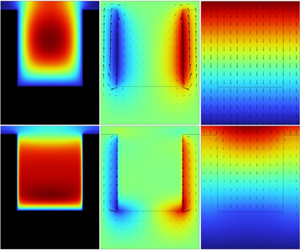
Thermoelectric magnetohydrodynamic flow in a liquid metal-infused trench
-
- Journal:
- Journal of Fluid Mechanics / Volume 1004 / 10 February 2025
- Published online by Cambridge University Press:
- 28 January 2025, A2
-
- Article
-
- You have access
- Open access
- HTML
- Export citation
The CRAFT coherent (CRACO) upgrade I: System description and results of the 110-ms radio transient pilot survey
-
- Journal:
- Publications of the Astronomical Society of Australia / Volume 42 / 2025
- Published online by Cambridge University Press:
- 28 January 2025, e005
-
- Article
-
- You have access
- Open access
- HTML
- Export citation
-
We present the first results from a new backend on the Australian Square Kilometre Array Pathfinder, the Commensal Realtime ASKAP Fast Transient COherent (CRACO) upgrade. CRACO records millisecond time resolution visibility data, and searches for dispersed fast transient signals including fast radio bursts (FRB), pulsars, and ultra-long period objects (ULPO). With the visibility data, CRACO can localise the transient events to arcsecond-level precision after the detection. Here, we describe the CRACO system and report the result from a sky survey carried out by CRACO at 110-ms resolution during its commissioning phase. During the survey, CRACO detected two FRBs (including one discovered solely with CRACO, FRB 20231027A), reported more precise localisations for four pulsars, discovered two new RRATs, and detected one known ULPO, GPM J1839 $-$10, through its sub-pulse structure. We present a sensitivity calibration of CRACO, finding that it achieves the expected sensitivity of 11.6 Jy ms to bursts of 110 ms duration or less. CRACO is currently running at a 13.8 ms time resolution and aims at a 1.7 ms time resolution before the end of 2024. The planned CRACO has an expected sensitivity of 1.5 Jy ms to bursts of 1.7 ms duration or less and can detect $10\times$ more FRBs than the current CRAFT incoherent sum system (i.e. 0.5 $-$2 localised FRBs per day), enabling us to better constrain the models for FRBs and use them as cosmological probes.


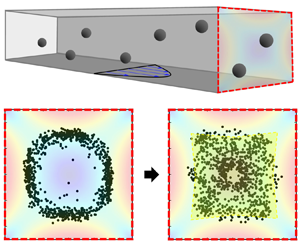
Suppression of the Segré–Silberberg effect by polymer additives
-
- Journal:
- Journal of Fluid Mechanics / Volume 1004 / 10 February 2025
- Published online by Cambridge University Press:
- 28 January 2025, A5
-
- Article
- Export citation
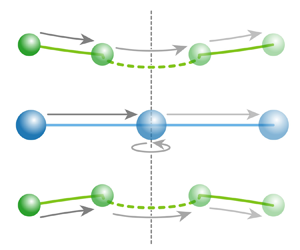
Control of microparticles through hydrodynamic interactions
-
- Journal:
- Journal of Fluid Mechanics / Volume 1004 / 10 February 2025
- Published online by Cambridge University Press:
- 28 January 2025, A4
-
- Article
-
- You have access
- Open access
- HTML
- Export citation
-
The controllability of passive microparticles that are advected with the fluid flow generated by an actively controlled one is studied. The particles are assumed to be suspended in a viscous fluid and well separated so that the far-field Stokes flow solutions may be used to describe their interactions. Explicit elementary moves parametrized by an amplitude $\varepsilon >0$ are devised for the active particle. Applying concepts from geometric control theory, the leading-order resulting displacements of the passive particles in the limit $\varepsilon \to 0$ are used to propose strategies for moving one active particle and one or two passive particles, proving controllability in such systems. The leading-order (in $\varepsilon$) theoretical predictions of the particle displacements are compared with those obtained numerically and it is found that the discrepancy is small even when $\varepsilon \approx 1$. These results demonstrate the potential for a single actuated particle to perform complex micromanipulations of passive particles in a suspension.


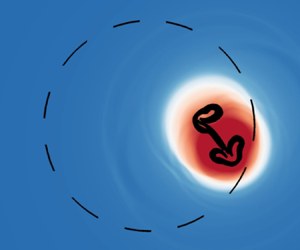
Inertial collapse of a gas bubble in a shear flow near a rigid wall
-
- Journal:
- Journal of Fluid Mechanics / Volume 1004 / 10 February 2025
- Published online by Cambridge University Press:
- 28 January 2025, A3
-
- Article
-
- You have access
- Open access
- HTML
- Export citation
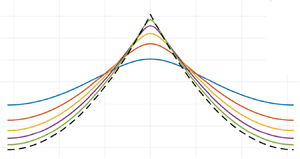
On smooth and peaked travelling waves in a local model for shallow water waves
-
- Journal:
- Journal of Fluid Mechanics / Volume 1004 / 10 February 2025
- Published online by Cambridge University Press:
- 28 January 2025, A1
-
- Article
-
- You have access
- Open access
- HTML
- Export citation
Dynamics and kinetics in structural biology: the example of DNA photolyase
-
- Journal:
- Quarterly Reviews of Biophysics / Volume 58 / 2025
- Published online by Cambridge University Press:
- 27 January 2025, e8
-
- Article
-
- You have access
- Open access
- HTML
- Export citation
Less wound and more asymmetric: JWST confirms the evolution of spiral structure in galaxies at $z \lesssim 3$
-
- Journal:
- Publications of the Astronomical Society of Australia / Volume 42 / 2025
- Published online by Cambridge University Press:
- 27 January 2025, e029
-
- Article
-
- You have access
- Open access
- HTML
- Export citation

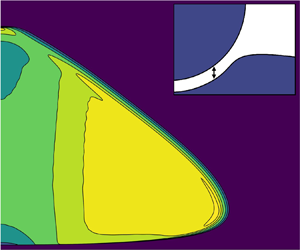
On the bounce: developing reduced models for air–liquid interactions in droplet rebounds
-
- Journal:
- Journal of Fluid Mechanics / Volume 1002 / 10 January 2025
- Published online by Cambridge University Press:
- 27 January 2025, F1
-
- Article
-
- You have access
- HTML
- Export citation
Collisionless zonal-flow dynamics in quasisymmetric stellarators
-
- Journal:
- Journal of Plasma Physics / Volume 91 / Issue 1 / February 2025
- Published online by Cambridge University Press:
- 27 January 2025, E28
-
- Article
-
- You have access
- Open access
- HTML
- Export citation
-
The linear collisionless plasma response to a zonal-density perturbation in quasisymmetric stellarators is studied, including the geodesic-acoustic-mode oscillations and the Rosenbluth–Hinton residual flow. While the geodesic-acoustic-mode oscillations in quasiaxisymmetric configurations are similar to tokamaks, they become non-existent in quasi-helically symmetric configurations when the effective safety factor in helical-angle coordinates is small. Compared with concentric-circular tokamaks, the Rosenbluth–Hinton residual is also found to be multiplied by a geometric factor $\mathcal {C}$
 that arises from the flux-surface-averaged classical polarization. Using the near-axis-expansion framework, we derive an analytic expression for $\mathcal {C}$
 , which varies significantly among different configurations. These analytic results are compared with numerical simulation results from the global gyrokinetic particle-in-cell code GTC, and good agreement with the theoretical Rosenbluth–Hinton residual level is achieved when the quasisymmetry error is small enough.


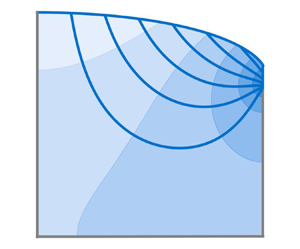
Active volume of water in a laboratory aquifer
-
- Journal:
- Journal of Fluid Mechanics / Volume 1002 / 10 January 2025
- Published online by Cambridge University Press:
- 27 January 2025, A36
-
- Article
- Export citation
