Refine search
Actions for selected content:
238502 results in Physics and Astronomy
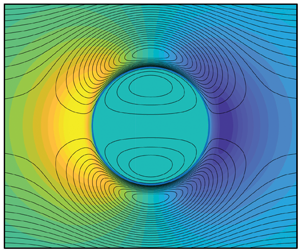
Roles of interfacial-exchange kinetics and interfacial-charge mobility on fluid-sphere electrophoresis
-
- Journal:
- Journal of Fluid Mechanics / Volume 1005 / 25 February 2025
- Published online by Cambridge University Press:
- 12 February 2025, A1
-
- Article
-
- You have access
- Open access
- HTML
- Export citation
-
Electrophoretic characterization of nano- and micro-metre scaled bubbles and drops is increasingly important in environmental and health sciences. Despite more than a hundred years of study, the interpretation of bubble electrophoresis data remains an unresolved fundamental problem that bridges fluid mechanics and interfacial science. This paper examines, from a theoretical perspective, how the electrophoretic mobility of small drops and bubbles responds to the interfacial kinetic-exchange rate and interfacial-charge mobility: factors that have been largely overlooked, but which provide new insights on the interpretation of $\zeta$-potentials, which are routinely used to assess surface charge density. A variety of outcomes are demonstrated, each reflecting subtle balances of hydrodynamic and electrical forces, modulated by interfacial thermodynamics and transport. Among the findings is that irreversibly bound charge with low interfacial mobility furnishes rigid-sphere behaviour; whereas interfacial charge with high mobility produces the characteristically high electrophoretic mobilities of non-conducting, uniformly charged fluid spheres. Outcomes are more complex when drops and bubbles have interfacial charge that seeks local equilibrium with the immediately adjacent electrolyte. For example, the present model shows that interfacial-charge mobility regularizes the singular behaviour predicted by theories for fluid spheres bearing high, perfectly uniform surface charge.

Application of Lagrangian techniques for calculating the on-axis rotational transform
-
- Journal:
- Journal of Plasma Physics / Volume 91 / Issue 1 / February 2025
- Published online by Cambridge University Press:
- 12 February 2025, E34
-
- Article
-
- You have access
- Open access
- HTML
- Export citation
-
The Floquet exponents of periodic field lines are studied through the variations of the magnetic action on the magnetic axis, which is assumed to be elliptical. The near-axis formalism developed by Mercier, Solov'ev and Shafranov is combined with a Lagrangian approach. The on-axis Floquet exponent is shown to coincide with the on-axis rotational transform. A discrete solution suitable for numerical implementation is introduced, which gives the Floquet exponents as solutions to an eigenvalue problem. This discrete formalism expresses the exponents as the eigenvalues of a $6\times 6$
 matrix.

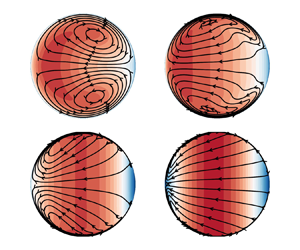
Direct numerical simulation study of turbulent pipe flow with imposed radial rotation
-
- Journal:
- Journal of Fluid Mechanics / Volume 1004 / 10 February 2025
- Published online by Cambridge University Press:
- 11 February 2025, A15
-
- Article
-
- You have access
- Open access
- HTML
- Export citation
Constraining the link between the 2175Å dust absorption feature and PAHs in Nearby Star-Forming Galaxies using Swift/UVOT and JWST/MIRI
-
- Journal:
- Publications of the Astronomical Society of Australia / Volume 42 / 2025
- Published online by Cambridge University Press:
- 11 February 2025, e022
-
- Article
-
- You have access
- Open access
- HTML
- Export citation
-
The 2175Å bump is a prominent absorption feature at ultraviolet (UV) wavelengths in dust extinction and attenuation curves. Understanding the relative strength of this feature is important for making accurate dust corrections at both low- and high-redshift. This feature is postulated to arise from polycyclic aromatic hydrocarbon (PAH) dust grains; however, the carrier has not been definitively established. We present results on the correlation between the 2175Å feature and PAH abundances in a spatially-resolved manner for 15 local galaxies in the PHANGS-JWST survey that have NUV and mid-IR imaging data from Swift/UVOT and JWST/MIRI, respectively. We find a moderate positive correlation between the 2175Å feature strength and PAH abundance (Spearman’s coefficient, $0.3 \lesssim \rho \lesssim 0.5$), albeit with large intrinsic scatter. However, most of this trend can be attributed to a stronger negative correlation of both quantities with SFR surface density and specific-SFR (proxies of ionising radiation; $\rho\sim-0.6$). The latter trends are consistent with previous findings that both the 2175Å carrier and PAHs are small grains that are easily destroyed by UV photons, although the proxy for PAH abundance (based on photometry) could also be influenced by dust heating. When controlling for SFR surface density, we find weaker correlations between the 2175Å feature and PAH abundances ( $\rho \lesssim 0.3$), disfavouring a direct link. However, analyses based on spectroscopic (instead of photometric) measurements of the 2175Å feature and PAH features are required to verify our findings. No significant trends with gas-phase metallicity or galactocentric radii are found for the 2175Å feature and PAHs; however, the metallicity range of our sample is limited ( $8.40 \lt 12+\log[\mathrm{O/H}] \lt 8.65$). We provide prescriptions for the strength of the 2175Å feature and PAHs in local massive (metal-rich) galaxies with SFR surface density and specific-SFR; however, the former should be used with caution due to the fact that bump strengths measured from Swift/UVOT are expected to be underestimated.


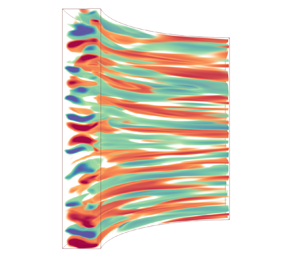
Elastic turbulence in space
-
- Journal:
- Journal of Fluid Mechanics / Volume 1004 / 10 February 2025
- Published online by Cambridge University Press:
- 11 February 2025, F1
-
- Article
-
- You have access
- Open access
- HTML
- Export citation
Tessellation-based analysis of impurity clustering in the edge plasma of tokamaks
- Part of
-
- Journal:
- Journal of Plasma Physics / Volume 91 / Issue 1 / February 2025
- Published online by Cambridge University Press:
- 11 February 2025, E30
-
- Article
-
- You have access
- Open access
- HTML
- Export citation
A mechanism that could stop the acceleration process within a collisionless shock
-
- Journal:
- Laser and Particle Beams / Volume 43 / 2025
- Published online by Cambridge University Press:
- 10 February 2025, e1
-
- Article
-
- You have access
- Open access
- HTML
- Export citation
WALLABY Pilot Survey: HI source-finding with a machine learning framework
-
- Journal:
- Publications of the Astronomical Society of Australia / Volume 42 / 2025
- Published online by Cambridge University Press:
- 10 February 2025, e033
-
- Article
-
- You have access
- Open access
- HTML
- Export citation
-
The data volumes generated by theWidefield ASKAP L-band Legacy All-sky Blind surveY atomic hydrogen (Hi) survey using the Australian Square Kilometre Array Pathfinder (ASKAP) necessitate greater automation and reliable automation in the task of source finding and cataloguing. To this end, we introduce and explore a novel deep learning framework for detecting low signal-to-noise ratio (SNR) Hi sources in an automated fashion. Specifically, our proposed method provides an automated process for separating true Hi detections from false positives when used in combination with the source finding application output candidate catalogues. Leveraging the spatial and depth capabilities of 3D convolutional neural networks, our method is specifically designed to recognize patterns and features in three-dimensional space, making it uniquely suited for rejecting false-positive sources in low SNR scenarios generated by conventional linear methods. As a result, our approach is significantly more accurate in source detection and results in considerably fewer false detections compared to previous linear statistics-based source finding algorithms. Performance tests using mock galaxies injected into real ASKAP data cubes reveal our method’s capability to achieve near-100% completeness and reliability at a relatively low integrated SNR $\sim3-5$. An at-scale version of this tool will greatly maximise the science output from the upcoming widefield Hi surveys.

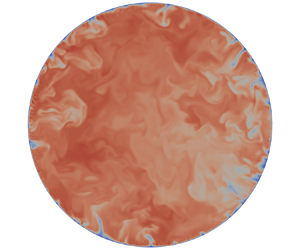
Thermal convection in the internally heated sphere
-
- Journal:
- Journal of Fluid Mechanics / Volume 1004 / 10 February 2025
- Published online by Cambridge University Press:
- 10 February 2025, A14
-
- Article
-
- You have access
- Open access
- HTML
- Export citation
-
We present the first nonlinear results on the problem of non-rotating thermal convection in an internally heated full sphere. A nonlinear stability analysis by the energy method yields that, at least for no-slip boundary conditions, the critical Rayleigh numbers for linear stability and nonlinear stability coincide. We then explore different ranges of the parameter regime using direct numerical simulations. We first report on the system behaviour for a fixed Prandtl number of unity and both stress-free and no-slip boundary conditions up to very high forcing, reaching Rayleigh number $Ra=2\times 10^{12}$, approximately 250 million times the critical value ( $Ra_c$) for the onset of convection under no-slip conditions. For both boundary conditions, we observe a scaling for the advective heat transfer measured by the Nusselt number $Nu$ close to $Nu \sim Ra^{1/4}$. This is consistent with a scaling prediction that we formulate analogously to the classical scaling in Rayleigh–Bénard convection. We then investigate the Prandtl number dependence at low to intermediate forcing for stress-free boundary conditions in the ranges $0.1 \leq Pr \leq 30$ and $Ra_c=3091\leq Ra \leq 3\times 10^5 \approx 100Ra_c$. We find five distinct dynamical regimes depending on the Prandtl number, describe each regime individually and issue heuristic interpretations of the system behaviour where possible.


Long-term spin-down and low luminosity regime in the Be/X-ray binary pulsar GX 304-1
-
- Journal:
- Publications of the Astronomical Society of Australia / Volume 42 / 2025
- Published online by Cambridge University Press:
- 10 February 2025, e037
-
- Article
-
- You have access
- Open access
- HTML
- Export citation
-
We carry out timing and spectral studies of the Be/X-ray binary pulsar GX 304-1 using NuStar and XMM-Newton observations. We construct the long-term spin period evolution of the pulsar which changes from a long-term spin-up ( $\sim1.3 \times 10^{-13}$ Hz s $^{-1}$) to a long-term spin-down ( $\sim-3.4 \times 10^{-14}$ Hz s $^{-1}$) trend during a low luminosity state ( $\sim10^{34-35}$ erg s $^{-1}$). A prolonged low luminosity regime ( $L_X \sim 10^{34-35}$ erg s $^{-1}$) was detected during 2005–2010 and spanning nearly five years since 2018 December. The XMM-Newton and NuStar spectra can be described with a power law plus blackbody model having an estimated luminosity of $\sim2.5 \times 10^{33}$ and $\sim3.6 \times 10^{33}$ erg s $^{-1}$, respectively. The inferred radius of the blackbody emission is about 100–110 m which suggests a polar-cap origin of this component. From long-term ultraviolet observations of the companion star, an increase in the ultraviolet signatures is detected preceding the X-ray outbursts. The spectral energy distribution of the companion star is constructed which provides a clue of possible UV excess when X-ray outbursts were detected from the neutron star compared to the quiescent phase. We explore plausible mechanisms to explain the long-term spin-down and extended low luminosity manifestation in this pulsar. We find that sustained accretion from a cold disc may explain the prolonged low luminosity state of the pulsar since December 2018 but the pulsar was undergoing normal accretion during the low luminosity period spanning 2005–2010.


MagNetUS: a magnetized plasma research ecosystem
- Part of
-
- Journal:
- Journal of Plasma Physics / Volume 91 / Issue 1 / February 2025
- Published online by Cambridge University Press:
- 10 February 2025, E32
-
- Article
-
- You have access
- Open access
- HTML
- Export citation
Causal temporal reasoning for Markov decision processes
-
- Journal:
- Research Directions: Cyber-Physical Systems / Volume 3 / 2025
- Published online by Cambridge University Press:
- 10 February 2025, e3
-
- Article
-
- You have access
- Open access
- HTML
- Export citation
Characterization of admissible quasisymmetries
-
- Journal:
- Journal of Plasma Physics / Volume 91 / Issue 1 / February 2025
- Published online by Cambridge University Press:
- 10 February 2025, E33
-
- Article
-
- You have access
- Open access
- HTML
- Export citation

Uncovering Quantum Field Theory and the Standard Model
- From Fundamental Concepts to Dynamical Mechanisms
-
- Published online:
- 06 February 2025
- Print publication:
- 02 January 2025
-
- Textbook
- Export citation

An Introduction to Continuum Physics
-
- Published online:
- 06 February 2025
- Print publication:
- 13 February 2025
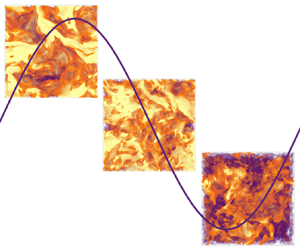
Temporal large-scale intermittency and its impact on the statistics of turbulence
-
- Journal:
- Journal of Fluid Mechanics / Volume 1004 / 10 February 2025
- Published online by Cambridge University Press:
- 06 February 2025, A12
-
- Article
-
- You have access
- Open access
- HTML
- Export citation

On the interaction between planar incident shock with finite width and cylindrical boundary layer at Mach 2.0
-
- Journal:
- Journal of Fluid Mechanics / Volume 1002 / 10 January 2025
- Published online by Cambridge University Press:
- 06 February 2025, A41
-
- Article
- Export citation
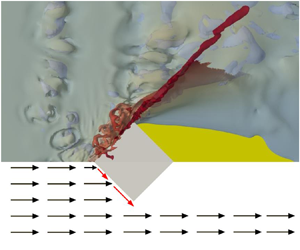
Green water loads on prismatic obstacles
-
- Journal:
- Journal of Fluid Mechanics / Volume 1004 / 10 February 2025
- Published online by Cambridge University Press:
- 04 February 2025, A8
-
- Article
-
- You have access
- Open access
- HTML
- Export citation
Using binary population synthesis to examine the impact of binary evolution on the C, N, O, and S-process yields of solar-metallicity low- and intermediate-mass stars
-
- Journal:
- Publications of the Astronomical Society of Australia / Volume 42 / 2025
- Published online by Cambridge University Press:
- 04 February 2025, e020
-
- Article
-
- You have access
- Open access
- HTML
- Export citation
-
Asymptotic giant branch (AGB) stars play a significant role in our understanding of the origin of the elements. They contribute to the abundances of C, N, and approximately 50% of the abundances of the elements heavier than iron. An aspect often neglected in studies of AGB stars is the impact of a stellar companion on AGB stellar evolution and nucleosynthesis. In this study, we update the stellar abundances of AGB stars in the binary population synthesis code binary_c and calibrate our treatment of the third dredge-up using observations of Galactic carbon stars. We model stellar populations of low- to intermediate-mass stars at solar-metallicity and examine the stellar wind contributions to C, N, O, Sr, Ba, and Pb yields at binary fractions between 0 and 1. For a stellar population with a binary fraction of 0.7, we find $\sim$20–25% less C and s-process elements ejected than from a population composed of only single stars, and we find little change in the N and O yields. We also compare our models with observed abundances from Ba stars and find our models can reproduce most Ba star abundances, but our population estimates a higher frequency of Ba stars with a surface [Ce/Y] > $+0.2\,$dex. Our models also predict the rare existence of Ba stars with masses $ \gt 10\,\textrm{M}_{\odot}$.


Machinery, mechanism, and information in post-transcription control of gene expression, from the perspective of unstable RNA
-
- Journal:
- Quarterly Reviews of Biophysics / Volume 58 / 2025
- Published online by Cambridge University Press:
- 04 February 2025, e10
-
- Article
-
- You have access
- Open access
- HTML
- Export citation
