Refine search
Actions for selected content:
238502 results in Physics and Astronomy
Optimal feeding in swimming and attached ciliates
-
- Journal:
- Journal of Fluid Mechanics / Volume 1003 / 25 January 2025
- Published online by Cambridge University Press:
- 20 January 2025, A26
-
- Article
-
- You have access
- Open access
- HTML
- Export citation
-
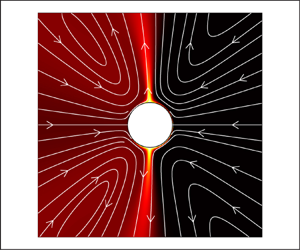
Ciliated microorganisms near the base of the aquatic food chain either swim to encounter prey or attach at a substrate and generate feeding currents to capture passing particles. Here, we represent attached and swimming ciliates using a popular spherical model in viscous fluid with slip surface velocity that affords analytical expressions of ciliary flows. We solve an advection–diffusion equation for the concentration of dissolved nutrients, where the Péclet number ( $Pe$) reflects the ratio of diffusive to advective time scales. For a fixed hydrodynamic power expenditure, we ask what ciliary surface velocities maximize nutrient flux at the microorganism's surface. We find that surface motions that optimize feeding depend on $Pe$. For freely swimming microorganisms at finite $Pe$, it is optimal to swim by employing a ‘treadmill’ surface motion, but in the limit of large $Pe$, there is no difference between this treadmill solution and a symmetric dipolar surface velocity that keeps the organism stationary. For attached microorganisms, the treadmill solution is optimal for feeding at $Pe$ below a critical value, but at larger $Pe$ values, the dipolar surface motion is optimal. We verified these results in open-loop numerical simulations and asymptotic analysis, and using an adjoint-based optimization method. Our findings challenge existing claims that optimal feeding is optimal swimming across all Péclet numbers, and provide new insights into the prevalence of both attached and swimming solutions in oceanic microorganisms.


Investigation of mode changing of PSR J1921+1419 with FAST
-
- Journal:
- Publications of the Astronomical Society of Australia / Volume 42 / 2025
- Published online by Cambridge University Press:
- 17 January 2025, e011
-
- Article
-
- You have access
- Open access
- HTML
- Export citation
-
The single pulses of PSR J1921+1419 were examined in detail using high-sensitivity observations from the Five-hundred-meter Aperture Spherical radio Telescope (FAST) at a central frequency of 1250 MHz. The high-sensitivity observations indicate that the pulsar exhibits two distinct emission modes, which are classified as strong and weak modes based on the intensity of the single pulses. In our observations, the times spent in both modes are nearly equal, and each is about half of the total observation time. The minimum duration of both modes is $1\,P$ and the maximum duration is $13\,P$, where P is the pulsar spin period. Additionally, the mean intensity of the weak mode is less than half of that of the strong mode. Notably, the switching between these modes demonstrates a clear quasi-periodicity with a modulation period of approximately $10 \pm 2\,P$. An analysis of the polarisation properties of both modes indicates that they originate from the same region within the magnetosphere of the pulsar. Finally, the viewing geometry was analysed based on the kinematical effects.


X-ray speckle reduction using a high-speed piezoelectric deformable mirror system
-
- Journal:
- High Power Laser Science and Engineering / Volume 13 / 2025
- Published online by Cambridge University Press:
- 17 January 2025, e22
-
- Article
-
- You have access
- Open access
- HTML
- Export citation
S-layers: from a serendipitous discovery to a toolkit for nanobiotechnology
-
- Journal:
- Quarterly Reviews of Biophysics / Volume 58 / 2025
- Published online by Cambridge University Press:
- 17 January 2025, e4
-
- Article
-
- You have access
- Open access
- HTML
- Export citation
A catalogue of complex radio sources in the Rapid ASKAP Continuum Survey created using a self-organising map
-
- Journal:
- Publications of the Astronomical Society of Australia / Volume 42 / 2025
- Published online by Cambridge University Press:
- 17 January 2025, e013
-
- Article
-
- You have access
- Open access
- HTML
- Export citation
-
Next generations of radio surveys are expected to identify tens of millions of new sources and identifying and classifying their morphologies will require novel and more efficient methods. Self-organising maps (SOMs), a type of unsupervised machine learning, can be used to address this problem. We map 251 259 multi-Gaussian sources from Rapid ASKAP Continuum Survey (RACS) onto a SOM with discrete neurons. Similarity metrics, such as Euclidean distances, can be used to identify the best-matching neuron or unit (BMU) for each input image. We establish a reliability threshold by visually inspecting a subset of input images and their corresponding BMU. We label the individual neurons based on observed morphologies, and these labels are included in our value-added catalogue of RACS sources. Sources for which the Euclidean distance to their BMU is $\lesssim$5 (accounting for approximately 79 $\%$ of sources) have an estimated $ \gt $90% reliability for their SOM-derived morphological labels. This reliability falls to less than 70 $\%$ at Euclidean distances $\gtrsim$7. Beyond this threshold it is unlikely that the morphological label will accurately describe a given source. Our catalogue of complex radio sources from RACS with their SOM-derived morphological labels from this work will be made publicly available.



Celestial and Stellar Dynamics
-
- Published online:
- 16 January 2025
- Print publication:
- 30 January 2025
-
- Textbook
- Export citation
10 - Self-Energy and Screened Interaction: Exact Results
-
- Book:
- Nonequilibrium Many-Body Theory of Quantum Systems
- Published online:
- 02 January 2025
- Print publication:
- 16 January 2025, pp 257-274
-
- Chapter
- Export citation
Appendix K: - Time-Dependent Landauer–Büttiker Formula
-
- Book:
- Nonequilibrium Many-Body Theory of Quantum Systems
- Published online:
- 02 January 2025
- Print publication:
- 16 January 2025, pp 641-650
-
- Chapter
- Export citation
Appendix H: - From δ-like Peaks to Continuous Spectral Functions
-
- Book:
- Nonequilibrium Many-Body Theory of Quantum Systems
- Published online:
- 02 January 2025
- Print publication:
- 16 January 2025, pp 621-624
-
- Chapter
- Export citation
Appendix J: - How to Solve the Kadanoff–Baym Equations in Practice
-
- Book:
- Nonequilibrium Many-Body Theory of Quantum Systems
- Published online:
- 02 January 2025
- Print publication:
- 16 January 2025, pp 633-640
-
- Chapter
- Export citation
Poiseuille flow of a concentrated suspension of squirmers
-
- Journal:
- Journal of Fluid Mechanics / Volume 1003 / 25 January 2025
- Published online by Cambridge University Press:
- 16 January 2025, A23
-
- Article
-
- You have access
- Open access
- HTML
- Export citation
11 - Grand Potential: Diagrammatic Expansion and Variational Forms
-
- Book:
- Nonequilibrium Many-Body Theory of Quantum Systems
- Published online:
- 02 January 2025
- Print publication:
- 16 January 2025, pp 275-312
-
- Chapter
- Export citation
Appendix M: - Lippmann–Schwinger Equation and Cross Section
-
- Book:
- Nonequilibrium Many-Body Theory of Quantum Systems
- Published online:
- 02 January 2025
- Print publication:
- 16 January 2025, pp 655-660
-
- Chapter
- Export citation
Appendix G: - BBGKY Hierarchy
-
- Book:
- Nonequilibrium Many-Body Theory of Quantum Systems
- Published online:
- 02 January 2025
- Print publication:
- 16 January 2025, pp 617-620
-
- Chapter
- Export citation
Fundamental Constants and Basic Relations
-
- Book:
- Nonequilibrium Many-Body Theory of Quantum Systems
- Published online:
- 02 January 2025
- Print publication:
- 16 January 2025, pp xxi-xxii
-
- Chapter
- Export citation
3 - Time-Dependent Problems and Equations of Motion
-
- Book:
- Nonequilibrium Many-Body Theory of Quantum Systems
- Published online:
- 02 January 2025
- Print publication:
- 16 January 2025, pp 79-92
-
- Chapter
- Export citation
1 - Second Quantization
-
- Book:
- Nonequilibrium Many-Body Theory of Quantum Systems
- Published online:
- 02 January 2025
- Print publication:
- 16 January 2025, pp 1-34
-
- Chapter
- Export citation
Appendix B: - Graphical Approach to Permanents and Determinants
-
- Book:
- Nonequilibrium Many-Body Theory of Quantum Systems
- Published online:
- 02 January 2025
- Print publication:
- 16 January 2025, pp 577-588
-
- Chapter
- Export citation
Generation of radioisotopes for medical applications using high-repetition, high-intensity lasers
-
- Journal:
- High Power Laser Science and Engineering / Volume 13 / 2025
- Published online by Cambridge University Press:
- 16 January 2025, e11
-
- Article
-
- You have access
- Open access
- HTML
- Export citation
-
We used the PW high-repetition laser facility VEGA-3 at Centro de Láseres Pulsados in Salamanca, with the goal of studying the generation of radioisotopes using laser-driven proton beams. Various types of targets have been irradiated, including in particular several targets containing boron to generate α-particles through the hydrogen–boron fusion reaction. We have successfully identified γ-ray lines from several radioisotopes created by irradiation using laser-generated α-particles or protons including 43Sc, 44Sc, 48Sc, 7Be, 11C and 18F. We show that radioisotope generation can be used as a diagnostic tool to evaluate α-particle generation in laser-driven proton–boron fusion experiments. We also show the production of 11C radioisotopes, $\approx 6 \times 10^{6}$, and of 44Sc radioisotopes, $\approx 5 \times 10^{4}$ per laser shot. This result can open the way to develop laser-driven radiation sources of radioisotopes for medical applications.


Alfvén waves at low magnetic Reynolds number: transitions between diffusion, dispersive Alfvén waves and nonlinear propagation
-
- Journal:
- Journal of Fluid Mechanics / Volume 1003 / 25 January 2025
- Published online by Cambridge University Press:
- 16 January 2025, A19
-
- Article
-
- You have access
- Open access
- HTML
- Export citation
-
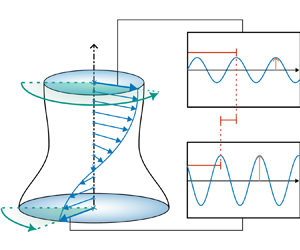
We seek the conditions in which Alfvén waves (AW) can be produced in laboratory-scale liquid metal experiments, i.e. at low magnetic Reynolds Number ( $Rm$). Alfvén waves are incompressible waves propagating along magnetic fields typically found in geophysical and astrophysical systems. Despite the high values of $Rm$ in these flows, AW can undergo high dissipation in thin regions, for example in the solar corona where anomalous heating occurs (Davila, Astrophys. J., vol. 317, 1987, p. 514; Singh & Subramanian, Sol. Phys., vol. 243, 2007, pp. 163–169). Understanding how AW dissipate energy and studying their nonlinear regime in controlled laboratory conditions may thus offer a convenient alternative to observations to understand these mechanisms at a fundamental level. Until now, however, only linear waves have been experimentally produced in liquid metals because of the large magnetic dissipation they undergo when $Rm\ll 1$ and the conditions of their existence at low $Rm$ are not understood. To address these questions, we force AW with an alternating electric current in a liquid metal in a transverse magnetic field. We provide the first mathematical derivation of a wave-bearing extension of the usual low- $Rm$ magnetohydrodynamics (MHD) approximation to identify two linear regimes: the purely diffusive regime exists when $N_{\omega }$, the ratio of the oscillation period to the time scale of diffusive two-dimensionalisation by the Lorentz force, is small; the propagative regime is governed by the ratio of the forcing period to the AW propagation time scale, which we call the Jameson number $Ja$ after (Jameson, J. Fluid Mech., vol. 19, issue 4, 1964, pp. 513–527). In this regime, AW are dissipative and dispersive as they propagate more slowly where transverse velocity gradients are higher. Both regimes are recovered in the FlowCube experiment (Pothérat & Klein, J. Fluid Mech., vol. 761, 2014, pp. 168–205), in excellent agreement with the model up to $Ja \lesssim 0.85$ but near the $Ja=1$ resonance, high amplitude waves become clearly nonlinear. Hence, in electrically driving AW, we identified the purely diffusive MHD regime, the regime where linear, dispersive AW propagate, and the regime of nonlinear propagation.


