Refine search
Actions for selected content:
238502 results in Physics and Astronomy
Appendix N: - Hedin Equations from a Generating Functional
-
- Book:
- Nonequilibrium Many-Body Theory of Quantum Systems
- Published online:
- 02 January 2025
- Print publication:
- 16 January 2025, pp 661-666
-
- Chapter
- Export citation
5 - Nonequilibrium Green’s Functions
-
- Book:
- Nonequilibrium Many-Body Theory of Quantum Systems
- Published online:
- 02 January 2025
- Print publication:
- 16 January 2025, pp 123-146
-
- Chapter
- Export citation
Appendix O: - Why the Name Random Phase Approximation?
-
- Book:
- Nonequilibrium Many-Body Theory of Quantum Systems
- Published online:
- 02 January 2025
- Print publication:
- 16 January 2025, pp 667-672
-
- Chapter
- Export citation
9 - Kadanoff–Baym Equations
-
- Book:
- Nonequilibrium Many-Body Theory of Quantum Systems
- Published online:
- 02 January 2025
- Print publication:
- 16 January 2025, pp 235-256
-
- Chapter
- Export citation
Contents
-
- Book:
- Nonequilibrium Many-Body Theory of Quantum Systems
- Published online:
- 02 January 2025
- Print publication:
- 16 January 2025, pp vii-xii
-
- Chapter
- Export citation
14 - Two-Particle Green’s Function: Diagrammatic Expansion
-
- Book:
- Nonequilibrium Many-Body Theory of Quantum Systems
- Published online:
- 02 January 2025
- Print publication:
- 16 January 2025, pp 357-410
-
- Chapter
- Export citation
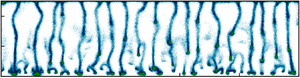
Emergent asymmetry in confined bioconvection
-
- Journal:
- Journal of Fluid Mechanics / Volume 1003 / 25 January 2025
- Published online by Cambridge University Press:
- 16 January 2025, A21
-
- Article
- Export citation
Appendix P: - Kramers–Kronig Relations
-
- Book:
- Nonequilibrium Many-Body Theory of Quantum Systems
- Published online:
- 02 January 2025
- Print publication:
- 16 January 2025, pp 673-674
-
- Chapter
- Export citation
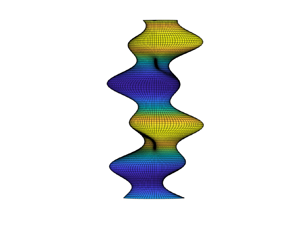
Stability of cylindrical, multicomponent vesicles
-
- Journal:
- Journal of Fluid Mechanics / Volume 1003 / 25 January 2025
- Published online by Cambridge University Press:
- 16 January 2025, A18
-
- Article
-
- You have access
- Open access
- HTML
- Export citation
Preface to the First Edition
-
- Book:
- Nonequilibrium Many-Body Theory of Quantum Systems
- Published online:
- 02 January 2025
- Print publication:
- 16 January 2025, pp xv-xviii
-
- Chapter
- Export citation
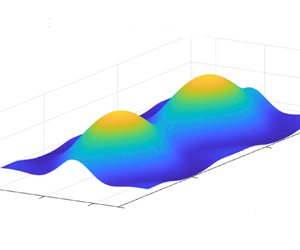
Stability of an elongated thickness fluctuation in a horizontal soap film
-
- Journal:
- Journal of Fluid Mechanics / Volume 1003 / 25 January 2025
- Published online by Cambridge University Press:
- 16 January 2025, A22
-
- Article
-
- You have access
- Open access
- HTML
- Export citation
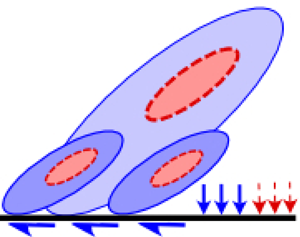
Active and inactive contributions to the wall pressure and wall-shear stress in turbulent boundary layers
-
- Journal:
- Journal of Fluid Mechanics / Volume 1003 / 25 January 2025
- Published online by Cambridge University Press:
- 16 January 2025, A24
-
- Article
-
- You have access
- Open access
- HTML
- Export citation
-
A phenomenological description is presented to explain the intermediate and low-frequency/large-scale contributions to the wall-shear-stress ( ${\tau }_w$) and wall-pressure ( $\,{p}_w$) spectra of canonical turbulent boundary layers, both of which are well known to increase with Reynolds number, albeit in a distinct manner. The explanation is based on the concept of active and inactive motions (Townsend, J. Fluid Mech., vol. 11, issue 1, 1961, pp. 97–120) associated with the attached-eddy hypothesis. Unique data sets of simultaneously acquired ${\tau }_w$, ${p}_w$ and velocity-fluctuation time series in the log region are considered, across a friction-Reynolds-number ( $Re_{\tau }$) range of $ {O}(10^3) \lesssim Re_{\tau } \lesssim {O}(10^6)$. A recently proposed energy-decomposition methodology (Deshpande et al., J. Fluid Mech., vol. 914, 2021, A5) is implemented to reveal the active and inactive contributions to the ${\tau }_w$- and $p_w$-spectra. Empirical evidence is provided in support of Bradshaw's (J. Fluid Mech., vol. 30, issue 2, 1967, pp. 241–258) hypothesis that the inactive motions are responsible for the non-local wall-ward transport of the large-scale inertia-dominated energy, which is produced in the log region by active motions. This explains the large-scale signatures in the ${\tau }_w$-spectrum, which grow with $Re_{\tau }$ despite the statistically weak signature of large-scale turbulence production, in the near-wall region. For wall pressure, active and inactive motions respectively contribute to the intermediate and large scales of the $p_w$-spectrum. Both these contributions are found to increase with increasing $Re_{\tau }$ owing to the broadening and energization of the wall-scaled (attached) eddy hierarchy. This potentially explains the rapid $Re_{\tau }$-growth of the $p_w$-spectra relative to ${\tau }_w$, given the dependence of the latter only on the inactive contributions.


Dedication
-
- Book:
- Nonequilibrium Many-Body Theory of Quantum Systems
- Published online:
- 02 January 2025
- Print publication:
- 16 January 2025, pp v-vi
-
- Chapter
- Export citation
6 - One-Particle Green’s Function: Exact Results
-
- Book:
- Nonequilibrium Many-Body Theory of Quantum Systems
- Published online:
- 02 January 2025
- Print publication:
- 16 January 2025, pp 147-194
-
- Chapter
- Export citation
Appendix A: - From the N Roots of 1 to the Dirac δ-Function
-
- Book:
- Nonequilibrium Many-Body Theory of Quantum Systems
- Published online:
- 02 January 2025
- Print publication:
- 16 January 2025, pp 573-576
-
- Chapter
- Export citation
References
-
- Book:
- Nonequilibrium Many-Body Theory of Quantum Systems
- Published online:
- 02 January 2025
- Print publication:
- 16 January 2025, pp 675-688
-
- Chapter
- Export citation
Abbreviations and Acronyms
-
- Book:
- Nonequilibrium Many-Body Theory of Quantum Systems
- Published online:
- 02 January 2025
- Print publication:
- 16 January 2025, pp xix-xx
-
- Chapter
- Export citation
15 - Electron Gas: Equilibrium and Nonequilibrium Correlation Effects
-
- Book:
- Nonequilibrium Many-Body Theory of Quantum Systems
- Published online:
- 02 January 2025
- Print publication:
- 16 January 2025, pp 411-450
-
- Chapter
- Export citation

From resting potential to dynamics: advances in membrane voltage indicators and imaging techniques
-
- Journal:
- Quarterly Reviews of Biophysics / Volume 58 / 2025
- Published online by Cambridge University Press:
- 16 January 2025, e7
-
- Article
- Export citation
2 - Getting Familiar with Second Quantization: Model Hamiltonians
-
- Book:
- Nonequilibrium Many-Body Theory of Quantum Systems
- Published online:
- 02 January 2025
- Print publication:
- 16 January 2025, pp 35-78
-
- Chapter
- Export citation
