Refine search
Actions for selected content:
238502 results in Physics and Astronomy
7 - One-Particle Green’s Function: Diagrammatic Expansion
-
- Book:
- Nonequilibrium Many-Body Theory of Quantum Systems
- Published online:
- 02 January 2025
- Print publication:
- 16 January 2025, pp 195-214
-
- Chapter
- Export citation
Effects of X-ray pre-ablation on the implosion process for double-cone ignition
- Part of
-
- Journal:
- High Power Laser Science and Engineering / Volume 13 / 2025
- Published online by Cambridge University Press:
- 16 January 2025, e24
-
- Article
-
- You have access
- Open access
- HTML
- Export citation
17 - From Green’s Functions to Simplified Many-Body Approaches
-
- Book:
- Nonequilibrium Many-Body Theory of Quantum Systems
- Published online:
- 02 January 2025
- Print publication:
- 16 January 2025, pp 521-572
-
- Chapter
- Export citation
Appendix C: - Green’s Functions and Lattice Symmetry
-
- Book:
- Nonequilibrium Many-Body Theory of Quantum Systems
- Published online:
- 02 January 2025
- Print publication:
- 16 January 2025, pp 589-594
-
- Chapter
- Export citation
Appendix F: - Asymptotic Expansions
-
- Book:
- Nonequilibrium Many-Body Theory of Quantum Systems
- Published online:
- 02 January 2025
- Print publication:
- 16 January 2025, pp 613-616
-
- Chapter
- Export citation

Turbulent kinetic energy budget in compressible turbulent mixing layers: effects of large-scale structures
-
- Journal:
- Journal of Fluid Mechanics / Volume 1003 / 25 January 2025
- Published online by Cambridge University Press:
- 16 January 2025, A25
-
- Article
- Export citation
-
Direct numerical simulations of temporally developing compressible mixing layers have been performed to investigate the effects of large-scale structures (LSSs) on turbulent kinetic energy (TKE) budgets at convective Mach numbers ranging from $M_c=0.2$ to $1.8$ and at Taylor Reynolds numbers up to 290. In the core region of mixing layers, the volume fraction of low-speed LSSs decreases linearly with respect to the vertical distance at a Mach-number-independent rate. The contributions of low-speed LSSs to TKE, and its budget, including production, dissipation, pressure-strain and spatial diffusion terms, are primarily concentrated in the upper region of mixing layer. The streamwise and vertical mass flux coupling terms mainly transport TKE downwards in low-speed LSSs, and their magnitudes are comparable to the other dominant terms. Near the edges of LSSs, the sources and losses of all three components of TKE are completely different to each other, and dominated by turbulent diffusion, pressure diffusion, pressure-strain and dissipation terms. The TKE, their total variation and dissipation are significantly amplified at edges of low-speed LSSs, especially at the upper edge. This observation supports the existence of amplitude modulation exerted by the LSSs onto the near-edge small-scale structures in mixing layers. The level of amplitude modulation is strongest for the vertical velocity, followed by the streamwise velocity, and weakest for the spanwise velocity. Additionally, the amplitude modulation effect decreases significantly with increasing convective Mach number. The results on the amplitude modulation effect is helpful for developing predictive models of budget terms of TKE in mixing layers.


Appendix E: - Density Matrices and Pair Correlation Function
-
- Book:
- Nonequilibrium Many-Body Theory of Quantum Systems
- Published online:
- 02 January 2025
- Print publication:
- 16 January 2025, pp 603-612
-
- Chapter
- Export citation
Appendix D: - Thermodynamics and Quantum Statistical Mechanics
-
- Book:
- Nonequilibrium Many-Body Theory of Quantum Systems
- Published online:
- 02 January 2025
- Print publication:
- 16 January 2025, pp 595-602
-
- Chapter
- Export citation
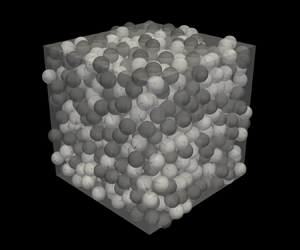
Hydrodynamic diffusion in apolar active suspensions of squirmers
-
- Journal:
- Journal of Fluid Mechanics / Volume 1003 / 25 January 2025
- Published online by Cambridge University Press:
- 16 January 2025, A17
-
- Article
-
- You have access
- Open access
- HTML
- Export citation
16 - Green’s Functions for Nonequilibrium Fermion–Boson Systems
-
- Book:
- Nonequilibrium Many-Body Theory of Quantum Systems
- Published online:
- 02 January 2025
- Print publication:
- 16 January 2025, pp 451-520
-
- Chapter
- Export citation
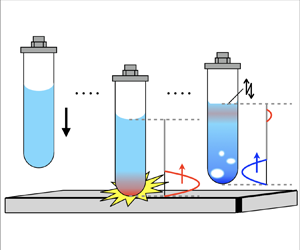
Pressure fluctuations of liquids under short-time acceleration
-
- Journal:
- Journal of Fluid Mechanics / Volume 1003 / 25 January 2025
- Published online by Cambridge University Press:
- 16 January 2025, A20
-
- Article
-
- You have access
- Open access
- HTML
- Export citation
-
This study investigates experimentally the pressure fluctuations of liquids in a column under short-time acceleration. It demonstrates that the Strouhal number $St=L/(c\,\Delta t)$, where $L$,
$L$,  $c$ and $\Delta t$ are the liquid column length, speed of sound, and acceleration duration, respectively, provides a measure of the pressure fluctuations for intermediate $St$ values. On the one hand, the incompressible fluid theory implies that the magnitude of the averaged pressure fluctuation $\bar {P}$ becomes negligible for $St\ll 1$. On the other hand, the water hammer theory predicts that the pressure tends to $\rho cu_0$ (where $u_0$ is the change in the liquid velocity) for $St\geq O(1)$. For intermediate $St$ values, there is no consensus on the value of $\bar {P}$. In our experiments, $L$,
$L$,  $c$ and $\Delta t$ are varied so that $0.02 \leq St \leq 2.2$. The results suggest that the incompressible fluid theory holds only up to $St\sim 0.2$, and that $St$ governs the pressure fluctuations under different experimental conditions for higher $St$ values. The data relating to a hydrogel also tend to collapse to a unified trend. The inception of cavitation in the liquid starts at $St\sim 0.2$ for various $\Delta t$, indicating that the liquid pressure goes lower than the liquid vapour pressure. To understand this mechanism, we employ a one-dimensional wave propagation model with a pressure wavefront of finite thickness that scales with $\Delta t$. The model provides a reasonable description of the experimental results as a function of $St$.
$St$.


Appendix I: - Fermi Golden Rule and Shortcomings of Linear Response Theory
-
- Book:
- Nonequilibrium Many-Body Theory of Quantum Systems
- Published online:
- 02 January 2025
- Print publication:
- 16 January 2025, pp 625-632
-
- Chapter
- Export citation
8 - Hartree–Fock Approximation
-
- Book:
- Nonequilibrium Many-Body Theory of Quantum Systems
- Published online:
- 02 January 2025
- Print publication:
- 16 January 2025, pp 215-234
-
- Chapter
- Export citation
Index
-
- Book:
- Nonequilibrium Many-Body Theory of Quantum Systems
- Published online:
- 02 January 2025
- Print publication:
- 16 January 2025, pp 689-698
-
- Chapter
- Export citation
Frontmatter
-
- Book:
- Nonequilibrium Many-Body Theory of Quantum Systems
- Published online:
- 02 January 2025
- Print publication:
- 16 January 2025, pp i-iv
-
- Chapter
- Export citation
13 - Linear Response Theory
-
- Book:
- Nonequilibrium Many-Body Theory of Quantum Systems
- Published online:
- 02 January 2025
- Print publication:
- 16 January 2025, pp 333-356
-
- Chapter
- Export citation
12 - Conserving Approximations
-
- Book:
- Nonequilibrium Many-Body Theory of Quantum Systems
- Published online:
- 02 January 2025
- Print publication:
- 16 January 2025, pp 313-332
-
- Chapter
- Export citation
Preface to the Second Edition
-
- Book:
- Nonequilibrium Many-Body Theory of Quantum Systems
- Published online:
- 02 January 2025
- Print publication:
- 16 January 2025, pp xiii-xiv
-
- Chapter
- Export citation
4 - The Contour Idea
-
- Book:
- Nonequilibrium Many-Body Theory of Quantum Systems
- Published online:
- 02 January 2025
- Print publication:
- 16 January 2025, pp 93-122
-
- Chapter
- Export citation
Appendix L: - Virial Theorem for Conserving Approximations
-
- Book:
- Nonequilibrium Many-Body Theory of Quantum Systems
- Published online:
- 02 January 2025
- Print publication:
- 16 January 2025, pp 651-654
-
- Chapter
- Export citation
