Refine search
Actions for selected content:
238502 results in Physics and Astronomy
Structural biology inside multicellular specimens using electron cryotomography
-
- Journal:
- Quarterly Reviews of Biophysics / Volume 58 / 2025
- Published online by Cambridge University Press:
- 13 January 2025, e6
-
- Article
-
- You have access
- HTML
- Export citation
Damping of solitons by coastal vegetation
-
- Journal:
- Journal of Fluid Mechanics / Volume 1002 / 10 January 2025
- Published online by Cambridge University Press:
- 10 January 2025, A45
-
- Article
- Export citation
On the suspension and deposition within turbidity currents
-
- Journal:
- Journal of Fluid Mechanics / Volume 1003 / 25 January 2025
- Published online by Cambridge University Press:
- 10 January 2025, A1
-
- Article
-
- You have access
- Open access
- HTML
- Export citation
Free-surface jetting driven by a cavitating vortex ring
-
- Journal:
- Journal of Fluid Mechanics / Volume 1003 / 25 January 2025
- Published online by Cambridge University Press:
- 10 January 2025, A4
-
- Article
-
- You have access
- Open access
- HTML
- Export citation
-
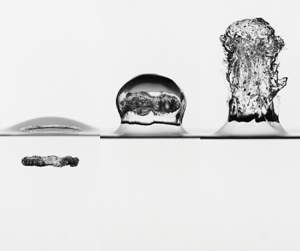
The collapse of an initially spherical cavitation bubble near a free surface leads to the formation of two jets: a downward jet into the liquid, and an upward jet penetrating the free surface. In this study, we examine the surprising interaction of a bubble trapped in a stable cavitating vortex ring approaching a free surface. As a result, a single fast and tall liquid jet forms. We find that this jet is observed only above critical Froude numbers ( $Fr$) and Weber numbers ( $We$) when ${Fr}^2 (1.6-2.73/{We}) > 1$, illustrating the importance of inertia, gravity and surface tension in accelerating this novel jet and thereby reaching heights several hundred times the radius of the vortex ring. Our experimental results are supported by numerical simulations, revealing that the underlying mechanism driving the vortex ring acceleration is the disruption of the equilibrium of high-pressure regions at the front and rear of the vortex ring caused by the free surface. Quantitative analysis based on the energy relationships elucidates that the velocity ratio between the maximum velocity of the free-surface jet and the translational velocity of the vortex ring is relatively stable yet is attenuated by surface tension when the jet is mild.


Ultrafast characterization of plasma critical surface evolution in inertial confinement fusion experiments with chirped laser pulses
-
- Journal:
- High Power Laser Science and Engineering / Volume 13 / 2025
- Published online by Cambridge University Press:
- 10 January 2025, e13
-
- Article
-
- You have access
- Open access
- HTML
- Export citation
Modulational instability of geodesic-acoustic-mode packets
- Part of
-
- Journal:
- Journal of Plasma Physics / Volume 91 / Issue 1 / February 2025
- Published online by Cambridge University Press:
- 10 January 2025, E17
-
- Article
-
- You have access
- Open access
- HTML
- Export citation
-
Isolated, undamped geodesic-acoustic-mode (GAM) packets have been demonstrated to obey a (focusing) nonlinear Schrödinger equation (NLSE) (E. Poli, Phys. Plasmas, 2021). This equation predicts susceptibility of GAM packets to the modulational instability (MI). The necessary conditions for this instability are analysed analytically and numerically using the NLSE model. The predictions of the NLSE are compared with gyrokinetic simulations performed with the global particle-in-cell code ORB5, where GAM packets are created from initial perturbations of the axisymmetric radial electric field $E_r$
 . An instability of the GAM packets with respect to modulations is observed both in cases in which an initial perturbation is imposed and when the instability develops spontaneously. However, significant differences in the dynamics of the small scales are discerned between the NLSE and gyrokinetic simulations. These discrepancies are mainly due to the radial dependence of the strength of the nonlinear term, which we do not retain in the solution of the NLSE, and to the damping of higher radial spectral components $k_r$
 . The damping of the high-$k_r$
 components, which develop as a consequence of the nonlinearity, can be understood in terms of Landau damping. The influence of the ion Larmor radius $\rho _i$
 as well as the perturbation wavevector $k_\text {pert}$
 on this effect is studied. For the parameters considered here the aforementioned damping mechanism hinders the MI process significantly from developing to its full extent and is strong enough to stabilize some of the (according to the undamped NLSE model) unstable wavevectors.


Large-eddy simulation of high-Reynolds-number turbulent channel flow controlled using streamwise travelling wave-like wall deformation for drag reduction
-
- Journal:
- Journal of Fluid Mechanics / Volume 1003 / 25 January 2025
- Published online by Cambridge University Press:
- 10 January 2025, A2
-
- Article
- Export citation
-
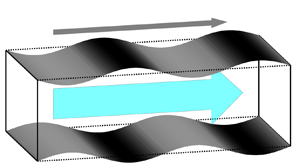
We investigate the drag reduction effect of the streamwise travelling wave-like wall deformation in a high-Reynolds-number turbulent channel flow by large-eddy simulation (LES). First, we assess the validity of subgrid-scale models in uncontrolled and controlled flows. For friction Reynolds numbers $Re_\tau = 360$ and $720$, the Smagorinsky and wall-adapting local eddy-viscosity (WALE) models with a damping function can reproduce well the mean velocity profile obtained by direct numerical simulation (DNS) in both the uncontrolled and controlled flows, leading to a small difference in drag reduction rate between LES and DNS. The LES with finer grid resolution can reproduce well the key structures observed in the DNS of the controlled flow. These results show that the high-fidelity LES is valid for appropriately predicting the drag reduction effect. In addition, a small computational domain is sufficient for reproducing the turbulence statistics, key structures and drag reduction rate obtained by DNS. Subsequently, to investigate the trend of drag reduction rate at higher Reynolds numbers, we utilize the WALE model with the damping function to investigate the control effect at higher Reynolds numbers up to $Re_\tau = 3240$. According to the analyses of turbulence statistics and instantaneous flow fields, the drag reduction at higher Reynolds numbers occurs basically through the same mechanism as that at lower Reynolds numbers. In addition, the drag reduction rate obtained by the present LES approaches that predicted using the semi-empirical formula (Nabae et al., Intl J. Heat Fluid Flow, vol. 82, 2020, 108550) as the friction Reynolds number increases, which supports the high predictability of the semi-empirical formula at significantly high Reynolds numbers.


Asymptotic approximations for convection onset with Ekman pumping at low wavenumbers
-
- Journal:
- Journal of Fluid Mechanics / Volume 1003 / 25 January 2025
- Published online by Cambridge University Press:
- 10 January 2025, A3
-
- Article
-
- You have access
- Open access
- HTML
- Export citation
Energetic bounds on gyrokinetic instabilities. Part 4. Bounce-averaged electrons
-
- Journal:
- Journal of Plasma Physics / Volume 91 / Issue 1 / February 2025
- Published online by Cambridge University Press:
- 10 January 2025, E12
-
- Article
-
- You have access
- Open access
- HTML
- Export citation
-
Upper bounds on the growth of instabilities in gyrokinetic systems have recently been derived by considering the optimal perturbations that maximise the growth of a chosen energy norm. This technique has previously been applied to two-species gyrokinetic systems with fully kinetic ions and electrons. However, in tokamaks and stellarators, the expectation from linear instability analyses is that the most important kinetic electron contribution to ion-scale modes often comes from the trapped electrons, which bounce faster than the time scale upon which instabilities evolve. As a result, a fully kinetic electron response is not required to describe unstable modes in many cases. Here, we apply the optimal mode analysis to a reduced two-species system consisting of fully gyrokinetic ions and bounce-averaged electrons, with the aim of finding a tighter bound on ion-scale instabilities in toroidal geometry. This analysis yields bounds that are greatly reduced in comparison with the earlier two-species result. Moreover, if the energy norm is properly chosen, wave–particle resonance effects can be captured, reproducing the stabilisation of density-gradient-driven instabilities in maximum-$J$
 devices. The optimal mode analysis also reveals that the maximum-$J$
 property has an additional stabilising effect on ion-temperature-gradient-driven instabilities, even in the absence of an electron free energy source. This effect is explained in terms of the concept of mode inertia, making it distinct from other mechanisms.


Fractionalization of Particles in Physics
- Invertible Topological Phases of Matter
-
- Published online:
- 09 January 2025
- Print publication:
- 23 January 2025
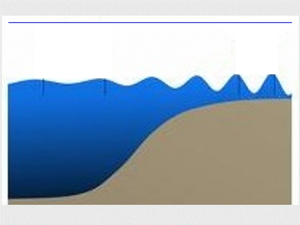
Transformation of small-amplitude internal waves passing over a bottom step in a two-layer fluid
-
- Journal:
- Journal of Fluid Mechanics / Volume 1002 / 10 January 2025
- Published online by Cambridge University Press:
- 09 January 2025, A49
-
- Article
-
- You have access
- Open access
- HTML
- Export citation

Regimes of near-inertial wave dynamics
-
- Journal:
- Journal of Fluid Mechanics / Volume 1002 / 10 January 2025
- Published online by Cambridge University Press:
- 09 January 2025, A22
-
- Article
-
- You have access
- Open access
- HTML
- Export citation
-
When atmospheric storms pass over the ocean, they resonantly force near-inertial waves (NIWs), internal waves with a frequency close to the local Coriolis frequency $f$. It has long been recognised that the evolution of NIWs is modulated by the ocean's mesoscale eddy field. This can result in NIWs being concentrated into anticyclones which provide an efficient pathway for NIW propagation to depth. Here we analyse the eigenmodes of NIWs in the presence of mesoscale eddies and heavily draw on parallels with quantum mechanics. Whether the eddies are effective at modulating the behaviour of NIWs depends on the wave dispersiveness $\varepsilon ^2 = f\lambda ^2/\varPsi$, where $\lambda$ is the deformation radius and $\varPsi$ is a scaling for the eddy streamfunction. If $\varepsilon \gg 1$, NIWs are strongly dispersive, and the waves are only weakly affected by the eddies. We calculate the perturbations away from a uniform wave field and the frequency shift away from $f$. If $\varepsilon \ll 1$, NIWs are weakly dispersive, and the wave evolution is strongly modulated by the eddy field. In this weakly dispersive limit, the Wentzel–Kramers–Brillouin approximation, from which ray tracing emerges, is a valid description of the NIW evolution even if the large-scale atmospheric forcing apparently violates the requisite assumption of a scale separation between the waves and the eddies. The large-scale forcing excites many wave modes, each of which varies on a short spatial scale and is amenable to asymptotic analysis analogous to the semi-classical analysis of quantum systems. The strong modulation of weakly dispersive NIWs by eddies has the potential to modulate the energy input into NIWs from the wind, but we find that this effect should be small under oceanic conditions.


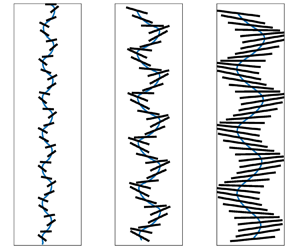
Fluttering motion of a confined cylinder falling freely in fluid at rest
-
- Journal:
- Journal of Fluid Mechanics / Volume 1002 / 10 January 2025
- Published online by Cambridge University Press:
- 09 January 2025, A46
-
- Article
-
- You have access
- Open access
- HTML
- Export citation
-
We investigate experimentally the planar paths displayed by cylinders falling freely in a thin-gap cell containing liquid at rest, by varying the elongation ratio and the Archimedes number of the cylinders, and the solid-to-fluid density ratio. In the investigated conditions, the oscillatory falling motion features two main characteristics: the mean fall velocity $\overline {u_v}$ does not scale with the gravitational velocity, which overestimates $\overline {u_v}$ and is unable to capture the influence of the density ratio on it; and high-amplitude oscillations of the order of $\overline {u_v}$ are observed for both translational and rotational velocities. To model the body behaviour, we propose a force balance, including proper and added inertia terms, the buoyancy force and vortical contributions accounting for the production of vorticity at the body surface and its interaction with the cell walls. Averaging the equations over a temporal period provides a mean force balance that governs the mean fall velocity of the cylinder, revealing that the coupling between the translational and rotational velocity components induces a mean upward inertial force responsible for the decrease of $\overline {u_v}$. This mean force balance also provides a normalization for the frequency of oscillation of the cylinder in agreement with experimental measurements. We then consider the instantaneous force balance experienced by the body, and propose three contributions for the modelling of the vortical force. These can be interpreted as drag, lift and history forces, and their dependence on the control parameters is adjusted on the basis of the experimental measurements.


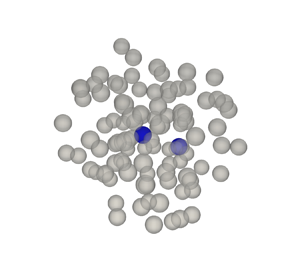
Accurate models of the added mass force of a uniform random distribution of spherical particles or bubbles
-
- Journal:
- Journal of Fluid Mechanics / Volume 1002 / 10 January 2025
- Published online by Cambridge University Press:
- 09 January 2025, A21
-
- Article
-
- You have access
- Open access
- HTML
- Export citation
Measurement of the properties of the dust acoustic wave in a magnetic field
- Part of
-
- Journal:
- Journal of Plasma Physics / Volume 91 / Issue 1 / February 2025
- Published online by Cambridge University Press:
- 09 January 2025, E15
-
- Article
-
- You have access
- Open access
- HTML
- Export citation
-
We present the first experimental observations of the dust acoustic wave where the wave was observed to propagate in the directions of gravity and magnetic field when these directions were not aligned. The experiments were conducted in the Magnetized Dusty Plasma eXperiment facility using a novel electrode system that allows for the angle between gravity and the magnetic field to be varied in a controlled way. This letter reports on measurements in an rf glow discharge argon plasma environment where the angle between direction of gravity and the magnetic field is 45$^{\circ }$
 . When there was no applied magnetic field, the wave was observed to propagate in the direction of gravity. However, as the magnetic field increased and the ions transitioned from flowing in the direction of gravity to the direction of the magnetic field, a second wave emerged and two distinct waves were observed to simultaneously propagate, one in the direction of gravity and one in the direction of the magnetic field. As the magnetic field was further increased, the wave that propagated in the direction of gravity was suppressed and the wave was only observed to propagate in the direction of the applied magnetic field. We also observe that the speed and the kinetic temperature of the dust for the mode that propagated in the direction of gravity decreased with increasing magnetic field while the speed and the kinetic temperature of the dust for the mode that propagated in the direction of the magnetic field increased with increasing magnetic field. These measurements suggest that an ion-dust streaming instability is at least partially responsible for the high temperatures that have previously been observed in dusty plasmas when the dust acoustic wave is present.

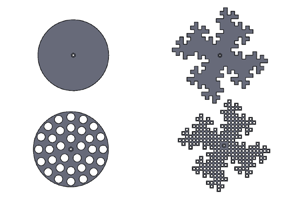
Turbulent shear flow without vortex shedding, Reynolds shear stress and small-scale intermittency
-
- Journal:
- Journal of Fluid Mechanics / Volume 1002 / 10 January 2025
- Published online by Cambridge University Press:
- 09 January 2025, A51
-
- Article
-
- You have access
- Open access
- HTML
- Export citation
Modelling dispersion in stratified turbulent flows as a resetting process
-
- Journal:
- Journal of Fluid Mechanics / Volume 1002 / 10 January 2025
- Published online by Cambridge University Press:
- 09 January 2025, A48
-
- Article
-
- You have access
- Open access
- HTML
- Export citation
-
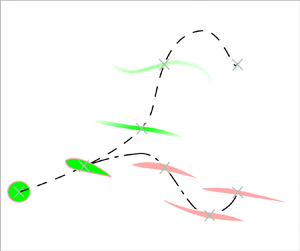
In freely decaying stably stratified turbulent flows, numerical evidence shows that the horizontal displacement of Lagrangian tracers is diffusive while the vertical displacement converges towards a stationary distribution, as shown numerically by Kimura & Herring (J. Fluid Mech., vol. 328, 1996, pp. 253–269). Here, we develop a stochastic model for the vertical dispersion of Lagrangian tracers in stably stratified turbulent flows that aims to replicate and explain the emergence of a stationary probability distribution for the vertical displacement of such tracers. More precisely, our model is based on the assumption that the dynamical evolution of the tracers results from the competing effects of buoyancy forces that tend to bring a vertically perturbed fluid parcel (carrying tracers) to its equilibrium position and turbulent fluctuations that tend to disperse tracers. When the density of a fluid parcel is allowed to change due to molecular diffusion, a third effect needs to be taken into account: irreversible mixing. Indeed, ‘mixing’ dynamically and irreversibly changes the equilibrium position of the parcel and affects the buoyancy force that ‘stirs’ it on larger scales. These intricate couplings are modelled using a stochastic resetting process (Evans & Majumdar, Phys. Rev. Lett., vol. 106, issue 16, 2011, 160601) with memory. More precisely, Lagrangian tracers in stratified turbulent flows are assumed to follow random trajectories that obey a Brownian process. In addition, their stochastic paths can be reset to a given position (corresponding to the dynamically changing equilibrium position of a density structure containing the tracers) at a given rate. Scalings for the model parameters as functions of the molecular properties of the fluid and the turbulent characteristics of the flow are obtained by analysing the dynamics of an idealised density structure. Even though highly idealised, the model has the advantage of being analytically solvable. In particular, we show the emergence of a stationary distribution for the vertical displacement of Lagrangian tracers. We compare the predictions of this model with direct numerical simulation data at various Prandtl numbers $Pr$, the ratio of kinematic viscosity to molecular diffusion.

A quasi-linear model of electromagnetic turbulent transport and its application to flux-driven transport predictions for STEP
-
- Journal:
- Journal of Plasma Physics / Volume 91 / Issue 1 / February 2025
- Published online by Cambridge University Press:
- 09 January 2025, E16
-
- Article
-
- You have access
- Open access
- HTML
- Export citation
-
A quasi-linear reduced transport model is developed from a database of high-$\beta$
 electromagnetic nonlinear gyrokinetic simulations performed with spherical tokamak for energy production (STEP) relevant parameters. The quasi-linear model is fully electromagnetic and accounts for the effect of equilibrium flow shear using a novel approach. Its flux predictions are shown to agree quantitatively with predictions from local nonlinear gyrokinetic simulations across a broad range of STEP-relevant local equilibria. This reduced transport model is implemented in the T3D transport solver that is used to perform the first flux-driven simulations for STEP to account for transport from hybrid kinetic ballooning mode turbulence, which dominates over a wide region of the core plasma. Nonlinear gyrokinetic simulations of the final transport steady state from T3D return turbulent fluxes that are consistent with the reduced model, indicating that the quasi-linear model may also be appropriate for describing the transport steady state. Within the assumption considered here, our simulations support the existence of a transport steady state in STEP with a fusion power comparable to that in the burning flat top of the conceptual design, but do not demonstrate how this state can be accessed.

High-density positron beam generation via Breit–Wheeler and trident processes using ultra-intense lasers
-
- Journal:
- Journal of Plasma Physics / Volume 91 / Issue 1 / February 2025
- Published online by Cambridge University Press:
- 09 January 2025, E14
-
- Article
-
- You have access
- Open access
- HTML
- Export citation
-
Using two counter-propagating ultra-intense laser interactions with a solid target, we conducted a study on the generation of electron-positron pairs via the multi-photon Breit–Wheeler (BW) process and trident process. These processes were simulated using the particle-in-cell (PIC) code EPOCH. Our proposed scheme involves irradiating two targets with two counter-propagating lasers. High-energy photons are produced when hot electrons collide with the reflected laser pulse at the target's front, leading to electron and positron pair production. In the single-target scenario, electron bunches are extracted from the target by the p-polarized laser electromagnetic field and accelerated by the laser ponderomotive force before colliding with the counter-propagating laser. However, using two targets enhances pair creation compared with the single-target set-up. We observed that in two-target configurations, the increased number of high-energy gamma-rays contributes to higher-energy electron–positron generation. Additionally, the generation of hot electrons is also more pronounced in this scheme. Consequently, the laser demonstrates higher efficiency in generating gamma photons and positrons in the dual-target set-up, which is beneficial for investigating high-energy pair production and gamma-ray emission. The generated positrons exhibit a density of the order of $10^{27}\,\text {m}^{-3}$
 and can be accelerated to energies of 1.5 GeV. The involvement of hot electrons in the target is crucial for generating high-energy photons and positrons. The maximum pair yield reaches $8 \times 10^9$
 for the BW process and $10^8$
 for the trident process. Notably, the total laser energy conversion efficiencies to electrons, $\gamma$
 -rays and positrons show improvement in the dual-target configuration. Specifically, the laser energy absorbed by positrons increases from 11.62 % in Case A to 13.12 % in Case B. These enhancements in conversion efficiency and electron/positron density have significant practical implications in experimental set-ups. In both the BW and trident processes, the two-target set-up dominates, highlighting its effectiveness. We also compared the strengths of both approaches, suggesting that these simple models of implementing two targets can be used in experiments as well.


Multi-scale physics of magnetic reconnection in hot magnetized plasmas
- Part of
-
- Journal:
- Journal of Plasma Physics / Volume 91 / Issue 1 / February 2025
- Published online by Cambridge University Press:
- 09 January 2025, E19
-
- Article
-
- You have access
- Open access
- HTML
- Export citation
