Refine search
Actions for selected content:
238141 results in Physics and Astronomy
Drosophila melanogaster: a promising system for space biology research
-
- Journal:
- International Journal of Astrobiology / Volume 23 / 2024
- Published online by Cambridge University Press:
- 18 December 2024, e26
-
- Article
-
- You have access
- Open access
- HTML
- Export citation
Frictional effects on shear-induced diffusion in suspensions of non-Brownian particles
-
- Journal:
- Journal of Fluid Mechanics / Volume 1001 / 25 December 2024
- Published online by Cambridge University Press:
- 16 December 2024, A42
-
- Article
-
- You have access
- Open access
- HTML
- Export citation
A fast radio burst monitor with a compact all-sky phased array (CASPA)
-
- Journal:
- Publications of the Astronomical Society of Australia / Volume 41 / 2024
- Published online by Cambridge University Press:
- 16 December 2024, e109
-
- Article
-
- You have access
- Open access
- HTML
- Export citation
-
Fast radio bursts (FRBs) are short-duration radio transients that occur at random times in host galaxies distributed all over the sky. Large field of view instruments can play a critical role in the blind search for rare FRBs. We present a concept for an all-sky FRB monitor using a compact all-sky phased array (CASPA), which can efficiently achieve an extremely large field of view of $\sim10^4$ square degrees. Such a system would allow us to conduct a continuous, blind FRB search covering the entire southern sky. Using the measured FRB luminosity function, we investigate the detection rate for this all-sky phased array and compare the result to a number of other proposed large field-of-view instruments. We predict a rate of a few FRB detections per week and determine the dispersion measure and redshift distributions of these detectable FRBs. This instrument is optimal for detecting FRBs in the nearby Universe and for extending the high-end of the FRB luminosity function through finding ultraluminous events. Additionally, this instrument can be used to shadow the new gravitational-wave observing runs, detect high-energy events triggered from Galactic magnetars and search for other bright, but currently unknown transient signals.

Vibration-induced morphological evolution of a melting solid under microgravity
-
- Journal:
- Journal of Fluid Mechanics / Volume 1001 / 25 December 2024
- Published online by Cambridge University Press:
- 16 December 2024, A43
-
- Article
- Export citation
-
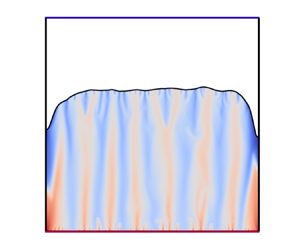
We study the melting process of a solid under microgravity, driven solely by lateral vibrations that are perpendicular to the applied temperature gradient due to the absence of gravity-induced convection. Using direct numerical simulations with the phase-field method, we examine two-dimensional vibration-induced melting in a square cavity over four orders of magnitude of vibrational Rayleigh numbers, $10^5\le Ra_{{vib}}\le 10^9$. Our results show that as melting progresses, the flow structure transitions from a periodic-circulation regime with diffusion-dominated heat transfer to a columnar regime with vibroconvection. The mean height of the liquid–solid interface follows a power-law dependency with time, $\bar {\xi } \sim \tilde t^{1/(2-2\alpha )}$, where $\alpha = 0$ in the periodic-circulation regime and $\alpha = 1/2$ in the columnar regime. We further observe that within the columnar regime, the morphological evolution of the liquid–solid interface is influenced by the interaction of columnar thermal plumes in the central regions and the peripheral flow near the sidewalls. Specifically, we offer a comprehensive analysis of the plume merging behaviour, which is governed by the aspect ratio ( $\bar {\xi }$) of the liquid layer and the intensity of vibration, quantified by the effective vibrational Rayleigh number $Ra_{vib}^{eff}$. We identify the relationship between the number of columnar plumes $K_m$ and $Ra_{vib}^{eff}$, finding that $K_m \sim \bar {\xi }^{-1} (Ra_{vib}^{eff})^{\gamma }$ with the fitting scaling exponent $\gamma = 0.150 \pm 0.025$. We subsequently quantify the characteristics of the interface roughness amplitude evolution in microgravity vibroconvection. Our results indicate that the roughness amplitude exhibits a power-law dependence on the mean height of the liquid layer. Drawing from the Stefan boundary condition, we theoretically deduce this dependence under the assumption of a non-uniform heat flux distribution at the interface, where the theory is corroborated by our numerical simulations.


Constructing nested coordinates inside strongly shaped toroids using an action principle
-
- Journal:
- Journal of Plasma Physics / Volume 90 / Issue 6 / December 2024
- Published online by Cambridge University Press:
- 16 December 2024, 905900614
-
- Article
-
- You have access
- Open access
- HTML
- Export citation
-
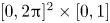
A new approach for constructing polar-like boundary-conforming coordinates inside a toroid with strongly shaped cross-sections is presented. A coordinate mapping is obtained through a variational approach, which involves identifying extremal points of a proposed action in the mapping space from $[0, 2{\rm \pi} ]^2 \times [0, 1]$
 to a toroidal domain in $\mathbb {R}^3$
 . This approach employs an action built on the squared Jacobian and radial length. Extensive testing is conducted on general toroidal boundaries using a global Fourier–Zernike basis via action minimisation. The results demonstrate successful coordinate construction capable of accurately describing strongly shaped toroidal domains. The coordinate construction is successfully applied to the computation of three-dimensional magnetohydrodynamic equilibria in the GVEC code where the use of traditional coordinate construction by interpolation from the boundary failed.

The conformational landscape of TRiC ring-opening and its underlying stepwise mechanism revealed by cryo-EM
-
- Journal:
- QRB Discovery / Volume 6 / 2025
- Published online by Cambridge University Press:
- 16 December 2024, e7
- Print publication:
- 2025
-
- Article
-
- You have access
- Open access
- HTML
- Export citation
Kilowatt-level spectrum-programmable multi-wavelength fiber laser
-
- Journal:
- High Power Laser Science and Engineering / Volume 12 / 2024
- Published online by Cambridge University Press:
- 16 December 2024, e74
-
- Article
-
- You have access
- Open access
- HTML
- Export citation
Improved method to optimize the phase jump of multiple exposure-tiled gratings
-
- Journal:
- High Power Laser Science and Engineering / Volume 12 / 2024
- Published online by Cambridge University Press:
- 16 December 2024, e77
-
- Article
-
- You have access
- Open access
- HTML
- Export citation
Selecting variable sources with median colours using a self-organising map
-
- Journal:
- Publications of the Astronomical Society of Australia / Volume 41 / 2024
- Published online by Cambridge University Press:
- 16 December 2024, e110
-
- Article
-
- You have access
- Open access
- HTML
- Export citation
-
A key objective for upcoming surveys, and when re-analysing archival data, is the identification of variable stellar sources. However, the selection of these sources is often complicated by the unavailability of light curve data. Utilising a self-organising map (SOM), we demonstrate the selection of diverse variable source types from a catalogue of variable and non-variable SDSS Stripe 82 sources whilst employing only the median $u-g$, $g-r$, $r-i$, and $i-z$ photometric colours for each source as input, without using source magnitudes. This includes the separation of main sequence variable stars that are otherwise degenerate with non-variable sources ( $u-g$, $g-r$) and ( $r-i$, $i-z$) colour-spaces. We separate variable sources on the main sequence from all other variable and non-variable sources with a purity of $80.0\%$ and completeness of $25.1\%$, figures which can be modified depending on the application. We also explore the varying ability of the same method to simultaneously select other types of variable sources from the heterogeneous sample, including variable quasars and RR-Lyrae stars. The demonstrated ability of this method to select variable main sequence stars in colour-space holds promise for application in future survey reduction pipelines and for the analysis of archival data, where light curves may not be available or may be prohibitively expensive to obtain.


Electrostatic surface waves in a magnetized plasma propagating in channels
-
- Journal:
- Journal of Plasma Physics / Volume 90 / Issue 6 / December 2024
- Published online by Cambridge University Press:
- 16 December 2024, 905900613
-
- Article
-
- You have access
- Open access
- HTML
- Export citation
High-energy, high-peak-power, sub-nanosecond, spatial super-Gaussian 177 nm vacuum ultraviolet laser
-
- Journal:
- High Power Laser Science and Engineering / Volume 12 / 2024
- Published online by Cambridge University Press:
- 16 December 2024, e75
-
- Article
-
- You have access
- Open access
- HTML
- Export citation
Dynamics of a thin film of fluid spreading over a lubricated substrate
-
- Journal:
- Journal of Fluid Mechanics / Volume 1001 / 25 December 2024
- Published online by Cambridge University Press:
- 16 December 2024, A47
-
- Article
-
- You have access
- Open access
- HTML
- Export citation
FLM volume 1000 Cover and Front matter
-
- Journal:
- Journal of Fluid Mechanics / Volume 1000 / 10 December 2024
- Published online by Cambridge University Press:
- 16 December 2024, p. f1
-
- Article
-
- You have access
- Export citation
Structure and energy transfer in homogeneous turbulence below a free surface
-
- Journal:
- Journal of Fluid Mechanics / Volume 1001 / 25 December 2024
- Published online by Cambridge University Press:
- 16 December 2024, A46
-
- Article
-
- You have access
- Open access
- HTML
- Export citation
Linear stability analysis of turbulent mean flows based on a data-consistent Reynolds-averaged Navier–Stokes model: prediction of three-dimensional stall cells around an airfoil
-
- Journal:
- Journal of Fluid Mechanics / Volume 1001 / 25 December 2024
- Published online by Cambridge University Press:
- 16 December 2024, A41
-
- Article
-
- You have access
- Open access
- HTML
- Export citation
-
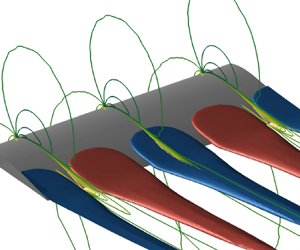
Stall cells are transverse cellular patterns that often appear on the suction side of airfoils near stalling conditions. Wind-tunnel experiments on a NACA4412 airfoil at Reynolds number ${Re}=3.5 \times 10^5$ show that they appear for angles of attack larger than $\alpha = 11.5^{\circ }\ (\pm 0.5^{\circ })$. Their onset is further investigated based on global stability analyses of turbulent mean flows computed with the Reynolds-averaged Navier–Stokes (RANS) equations. Using the classical Spalart–Allmaras turbulence model and following Plante et al. (J. Fluid Mech., vol. 908, 2021, A16), we first show that a three-dimensional stationary mode becomes unstable for a critical angle of attack $\alpha = 15.5^{\circ }$ which is much larger than in the experiments. A data-consistent RANS model is then proposed to reinvestigate the onset of these stall cells. Through an adjoint-based data-assimilation approach, several corrections in the turbulence model equation are identified to minimize the differences between assimilated and reference mean-velocity fields, the latter reference field being extracted from direct numerical simulations. Linear stability analysis around the assimilated mean flow obtained with the best correction is performed first using a perturbed eddy-viscosity approach which requires the linearization of both RANS and turbulence model equations. The three-dimensional stationary mode becomes unstable for angle $\alpha = 11^{\circ }$ which is in significantly better agreement with the experimental results. The interest of this perturbed eddy-viscosity approach is demonstrated by comparing with results of two frozen eddy-viscosity approaches that neglect the perturbation of the eddy viscosity. Both approaches predict the primary destabilization of a higher-wavenumber mode which is not experimentally observed. Uncertainties in the stability results are quantified through a sensitivity analysis of the stall cell mode's eigenvalue with respect to residual mean-flow velocity errors. The impact of the correction field on the results of stability analysis is finally assessed.


A 1.8 kW high power all-fiber Raman oscillator
-
- Journal:
- High Power Laser Science and Engineering / Volume 12 / 2024
- Published online by Cambridge University Press:
- 16 December 2024, e76
-
- Article
-
- You have access
- Open access
- HTML
- Export citation
Intranight optical monitoring of the rare quasar J0950+5128, the brightest known candidate for transition from radio-quiet to radio-loud state
-
- Journal:
- Publications of the Astronomical Society of Australia / Volume 41 / 2024
- Published online by Cambridge University Press:
- 16 December 2024, e106
-
- Article
- Export citation
-
We report a novel pilot project to characterise intra-night optical variability (INOV) of an extremely rare type of quasar, which has recently been caught in the act of transiting from a radio-quiet to radio-loud state, on a decadal time scale. Such rare transitions may signify a recurrence, or conceivably the first switch-on of jet activity in optically luminous quasars. The newly formed jet could well be jittery and unsteady, both in power and direction. The optically brightest among such radio-state transition candidates, the quasar J0950+5128 ( $z = 0.2142$), was monitored by us with dense sampling in the R-band, during 2020-21 in 6 sessions, each lasting $ \gt $ 4 hours. This is the first attempt to characterise the INOV properties associated with this recently discovered, extremely rarely observed phenomenon of quasar radio-state transition. The non-detection of INOV in any of the 6 sessions, down to the 1-2% level, amounts to a lack of evidence for a blazar-like optical activity, $\sim$ 2 years after its transition to radio-loud state was found. The only INOV feature detected in J0950+5128 during our observational campaign was a $\sim$ 0.15-mag spike lasting < 6 minutes, seen at 13.97 UT on 18-March-2021. We also report the available optical light curves of this quasar from the Zwicky Transient Facility survey, which indicate that it had experienced a phase of INOV activity around the time its transition to the radio-loud state was detected, however that phase did not sustain until the launch of our INOV campaign $\sim$ 2 years later.


Data-driven active control of a thin elliptical cylinder undergoing transverse flow-induced vibrations
-
- Journal:
- Journal of Fluid Mechanics / Volume 1001 / 25 December 2024
- Published online by Cambridge University Press:
- 13 December 2024, A35
-
- Article
-
- You have access
- Open access
- HTML
- Export citation
-
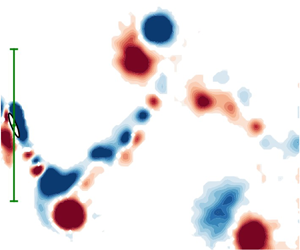
This experimental study employs Bayesian optimisation to maximise the cross-flow (transverse) flow-induced vibration (FIV) of an elastically mounted thin elliptical cylinder by implementing axial (or angular) flapping motions. The flapping amplitude was in proportion to the vibration amplitude, with a relative phase angle imposed between the angular and transverse displacements of the cylinder. The control parameter space spanned over the ranges of proportional gain and phase difference of $0 \leq K_p^* \leq 5$ and $0 \leq \phi _d \leq 360^\circ$, respectively, over a reduced velocity range of $3.0 \leqslant {U^*} = U/({{f_{nw}}} b) \leqslant 8.5$. The corresponding Reynolds number range was $1250 \leqslant {{Re}} =(U b)/\nu \leqslant 3580$. Here, $U$ is the free stream velocity, $b$ is the major cross-sectional diameter of the cylinder, ${{f_{nw}}}$ is the natural frequency of the system in quiescent fluid (water) and $\nu$ is the kinematic viscosity of the fluid. It was found that the controlled body rotation extended the wake-body synchronisation across the entire ${U^*}$ range tested, with a larger amplitude response than the non-rotating case for all flow speeds. Interestingly, two new wake-body synchronisation regimes were identified, which have not been reported in previous studies. As this geometry acts as a ‘hard-oscillator’ for ${U^*} \geqslant 6.3$, an adaptive gain (i.e. one that varies as a function of oscillation amplitude) was also implemented, allowing the body vibration, achieved for a non-rotating cylinder using increasing ${U^*}$ increments, to be excited from rest. The findings of the present study hold potential implications for the use of FIV as a means to efficiently extract energy from free-flowing water sources, a topic of increasing interest over the last decade.


Phase space eigenfunctions with applications to continuum kinetic simulations
-
- Journal:
- Journal of Plasma Physics / Volume 90 / Issue 6 / December 2024
- Published online by Cambridge University Press:
- 13 December 2024, 905900610
-
- Article
-
- You have access
- Open access
- HTML
- Export citation
Velocity fluctuations for bubbly flows at small Re
-
- Journal:
- Journal of Fluid Mechanics / Volume 1001 / 25 December 2024
- Published online by Cambridge University Press:
- 13 December 2024, A34
-
- Article
-
- You have access
- Open access
- HTML
- Export citation
-
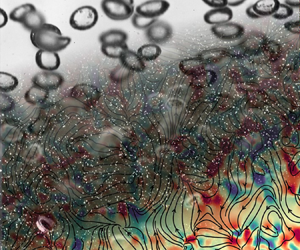
We experimentally investigate the effect of Reynolds number ( $Re$) on the turbulence induced by the motion of bubbles in a quiescent Newtonian fluid at small $Re$. The energy spectra, $E(k)$, are determined from the decaying turbulence behind the bubble swarm obtained using particle image velocimetry. We show that when $Re \sim O(100)$, the slope of the normalized energy spectra is no longer independent of the gas volume fraction and the $k^{-3}$ subrange is significantly narrower, where $k$ is the wavenumber. This is further corroborated using second-order longitudinal velocity structure function and spatial correlation of the velocity behind the bubble swarm. On further decreasing the bubble Reynolds number ( $O(1) < Re < O(10)$), the signature $k^{-3}$ of the energy spectra for the bubble-induced turbulence is replaced by $k^{-5/3}$ scaling. Thus, we provide experimental evidence to the claim by Mazzitelli et al. (Phys. Fluids, vol. 15, 2003, pp. L5–L8) that at low Reynolds numbers the normalized energy spectra of the bubble-induced turbulence will no longer show the $k^{-3}$ scaling because of the absence of bubble wake and that the energy spectra will depend on the number of bubbles, thus being non-universal.


