Refine search
Actions for selected content:
238152 results in Physics and Astronomy
References
-
- Book:
- Fundamentals of Particle Physics
- Published online:
- 31 August 2023
- Print publication:
- 14 September 2023, pp 524-528
-
- Chapter
- Export citation
2 - Quantum Tools and a First Protocol
-
- Book:
- Introduction to Quantum Cryptography
- Published online:
- 10 October 2023
- Print publication:
- 14 September 2023, pp 40-77
-
- Chapter
- Export citation
Frontmatter
-
- Book:
- Mid-Infrared and Terahertz Quantum Cascade Lasers
- Published online:
- 25 August 2023
- Print publication:
- 14 September 2023, pp i-iv
-
- Chapter
- Export citation
10 - Metasurface-based THz Quantum Cascade Lasers
- from Part II - Active Research Topics
-
- Book:
- Mid-Infrared and Terahertz Quantum Cascade Lasers
- Published online:
- 25 August 2023
- Print publication:
- 14 September 2023, pp 310-342
-
- Chapter
- Export citation
2 - State-of-the-Art Mid-Infrared QCLs: Elastic Scattering, High CW Power, and Coherent-Power Scaling
- from Part I - Bandstructure Engineering, Modeling and State-of-the-Art QCLs
-
- Book:
- Mid-Infrared and Terahertz Quantum Cascade Lasers
- Published online:
- 25 August 2023
- Print publication:
- 14 September 2023, pp 41-101
-
- Chapter
- Export citation
4 - Conservation Rules and Symmetries
-
- Book:
- Fundamentals of Particle Physics
- Published online:
- 31 August 2023
- Print publication:
- 14 September 2023, pp 101-116
-
- Chapter
- Export citation
14 - Multiheterodyne Spectroscopic Sensing and Applications of Mid-Infrared and Terahertz Quantum Cascade Laser Combs
- from Part III - Applications
-
- Book:
- Mid-Infrared and Terahertz Quantum Cascade Lasers
- Published online:
- 25 August 2023
- Print publication:
- 14 September 2023, pp 443-476
-
- Chapter
- Export citation
3 - Long-Wavelength Mid-Infrared Quantum Cascade Lasers
- from Part I - Bandstructure Engineering, Modeling and State-of-the-Art QCLs
-
- Book:
- Mid-Infrared and Terahertz Quantum Cascade Lasers
- Published online:
- 25 August 2023
- Print publication:
- 14 September 2023, pp 102-137
-
- Chapter
- Export citation
5 - Quantifying Information
-
- Book:
- Introduction to Quantum Cryptography
- Published online:
- 10 October 2023
- Print publication:
- 14 September 2023, pp 125-152
-
- Chapter
- Export citation
Index
-
- Book:
- Mid-Infrared and Terahertz Quantum Cascade Lasers
- Published online:
- 25 August 2023
- Print publication:
- 14 September 2023, pp 524-530
-
- Chapter
- Export citation
8 - Topological Field Theory
- from II - Part II
-
- Book:
- Condensed Matter Field Theory
- Published online:
- 24 August 2023
- Print publication:
- 14 September 2023, pp 421-521
-
- Chapter
- Export citation
12 - The Standard Model and Beyond
-
- Book:
- Fundamentals of Particle Physics
- Published online:
- 31 August 2023
- Print publication:
- 14 September 2023, pp 432-459
-
- Chapter
- Export citation
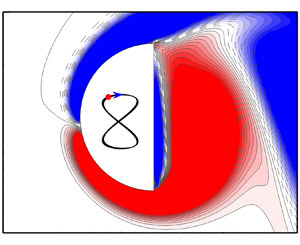
Two-degree-of-freedom flow-induced vibrations of a D-section prism
-
- Journal:
- Journal of Fluid Mechanics / Volume 971 / 25 September 2023
- Published online by Cambridge University Press:
- 13 September 2023, A5
-
- Article
-
- You have access
- Open access
- HTML
- Export citation
-
This paper presents a comprehensive study of flow-induced vibrations of a D-section prism with various angles of attack $\alpha$ ( $= 0^{\circ }\unicode{x2013}180^{\circ }$) and reduced velocity $U^*$ (= 2–20) via direct numerical simulations at a Reynolds number ${Re} = 100$. The prism is allowed to vibrate in both streamwise and transverse directions. Based on the characteristics of vibration amplitudes and frequencies, the responses are classified into nine different regimes: typical VIV regime ( $\alpha = 0^{\circ }\unicode{x2013}30^{\circ }$), hysteretic VIV regime ( $\alpha = 35^{\circ }\unicode{x2013}45^{\circ }$), extended VIV regime ( $\alpha = 50^{\circ }\unicode{x2013}55^{\circ }$), first transition response regime ( $\alpha = 60^{\circ }\unicode{x2013}65^{\circ }$), dual galloping regime ( $\alpha = 70^{\circ }$), combined VIV and galloping regime ( $\alpha = 75^{\circ }\unicode{x2013}80^{\circ }$), narrowed VIV regime ( $\alpha = 85^{\circ }\unicode{x2013}145^{\circ }$), second transition response regime ( $\alpha = 150^{\circ }\unicode{x2013}160^{\circ }$) and transverse-only galloping regime ( ${\alpha = 165^{\circ }\unicode{x2013}180^{\circ }}$). In the typical and narrowed VIV regimes, the vibration frequencies linearly increase with increasing $U^*$. In the hysteretic and extended VIV regimes, the vibration amplitudes are large in a wider range of $U^*$ as a result of the closeness of the vortex shedding frequency to the natural frequency of the prism because of the shear layer reattachment and separation point movement. In the two galloping regimes, the transverse amplitude keeps increasing with $U^*$ while the streamwise amplitude stays small or monotonically increases with increasing $U^*$. In the combined VIV and galloping regime, the vibration amplitude is relatively small in the VIV region while drastically increasing with increasing $U^*$ in the galloping region. In the transition response regimes, the vibration frequencies are galloping-like but the divergent amplitude cannot persist at high $U^*$. Furthermore, a wake mode map in the examined parametric space is offered. Particular attention is paid to physical mechanisms for hysteresis, dual galloping and flow intermittency. Finally, we probe the dependence of the responses on Reynolds numbers, mass ratios and degrees of freedom, and analyse the roles of the shear layer reattachment and separation point movement in the appearance of multiple responses.


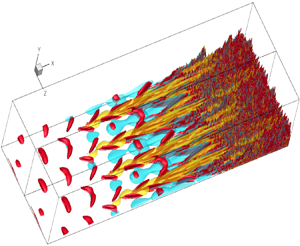
High-subsonic boundary-layer flows of an organic vapour
-
- Journal:
- Journal of Fluid Mechanics / Volume 971 / 25 September 2023
- Published online by Cambridge University Press:
- 13 September 2023, A8
-
- Article
-
- You have access
- Open access
- HTML
- Export citation
-
Boundary layers of Novec649, a low-global-warming potential fluid of interest for low-grade heat recovery, are investigated numerically by means of linear stability theory, direct numerical simulation (DNS) and large-eddy simulations (LES). This organic vapour is of interest in organic Rankine cycle (ORC) turbines and realistic thermodynamic conditions are selected. Under these conditions, the vapour behaves as a dense gas and, due to its high molecular complexity, real-gas effects occur. In addition, the fluid exhibits large and highly variable heat capacities and density- as well as temperature-dependent transport properties. More specifically we report the first direct and LES of transitional and turbulent boundary layers of Novec649 at high-subsonic conditions $M=0.9$. A controlled transition is performed by using oblique modes determined by linear stability theory extended to dense gases. An oblique-type transition is obtained as in low-speed air flows, where sinuous streaks develop by the lift-up mechanism and break down into turbulence. In the turbulent state, the profiles of dynamic flow properties (velocities, turbulent intensities, turbulent kinetic energy budgets) are little affected by the gas properties and remain very close to incompressible DNS, despite the high-subsonic flow speed. The fluctuations levels for thermodynamic properties have been quantified with respect to air flows. Notwithstanding a drastic reduction, genuine compressibility effects are present. For example, the fluctuating Mach number and the acoustic mode are characteristic of high-speed flows. The influence of forcing frequency and amplitude on the established turbulent state has been investigated using LES. An analysis of integral quantities shows a slow relaxation towards a canonical equilibrium turbulent state for all cases due to the high Reynolds numbers typical of dense gas flows. Overall the present DNS constitutes a valuable reference not only for forthcoming experiments but also for future studies of free-stream transition and loss mechanisms in ORC turbines.

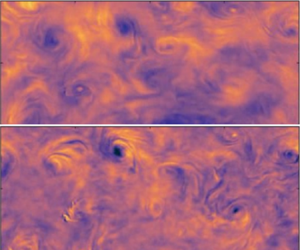
Supply mechanisms of the geostrophic mode in rotating turbulence: interactions with self, waves and eddies
-
- Journal:
- Journal of Fluid Mechanics / Volume 971 / 25 September 2023
- Published online by Cambridge University Press:
- 13 September 2023, A10
-
- Article
- Export citation
-
Direct numerical simulations are performed in rotating turbulence for different regimes at various Rossby and inertial Reynolds numbers ( $\textit {Re}_I$). A new algorithm, adapted from stratified turbulence (Lam et al., J. Fluid Mech., vol. 923, 2021, A31) to rotating turbulence, permits to separate the three-dimensional velocity field into three parts: inertial waves (IWs), eddies and a geostrophic mode (GM). It uses the space–time properties of waves and their advection by the GM to filter the IWs from the rest of the motion. We obtain balance equations for the separate energies of waves, eddies and the GM. Their mutual interactions are evaluated and analysed via Sankey diagrams that provide a global picture of energy exchanges. When the flow is forced at large scale, it mainly feeds the wave part and the multiple interactions lead to energy dissipation in eddy and GM motion. We also show that, in addition to the wave/wave interaction that feeds the GM, corresponding to different mechanisms described in the literature, other non-documented interactions feed it, as the eddy/wave interaction or the eddy/eddy interaction at moderate $\textit {Re}_I$. We propose a scale-by-scale analysis of the transfer to the GM: we show that transfers from wave or eddy occur at large scale, that they either inject or remove energy, and that this occurs with or without direct cascade depending on the kind of interaction, wave/wave, eddy/wave or eddy/eddy. The self-interaction of the GM is an inverse cascade for its horizontal component, shaping it into a very large-scale flow.


Suspensions of viscoelastic capsules: effect of membrane viscosity on transient dynamics
-
- Journal:
- Journal of Fluid Mechanics / Volume 971 / 25 September 2023
- Published online by Cambridge University Press:
- 13 September 2023, A13
-
- Article
- Export citation
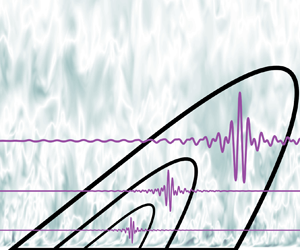
Self-similar, spatially localized structures in turbulent pipe flow from a data-driven wavelet decomposition
-
- Journal:
- Journal of Fluid Mechanics / Volume 971 / 25 September 2023
- Published online by Cambridge University Press:
- 13 September 2023, A9
-
- Article
- Export citation
-
This study aims to extract and characterize structures in fully developed pipe flow at a friction Reynolds number of $\textit {Re}_\tau = 12\,400$. To do so, we employ data-driven wavelet decomposition (DDWD) (Floryan & Graham, Proc. Natl Acad. Sci. USA, vol. 118, 2021, e2021299118), a method that combines features of proper orthogonal decomposition and wavelet analysis in order to extract energetic and spatially localized structures from data. We apply DDWD to streamwise velocity signals measured separately via a thermal anemometer at 40 wall-normal positions. The resulting localized velocity structures, which we interpret as being reflective of underlying eddies, are self-similar across streamwise extents of 40 wall units to one pipe radius, and across wall-normal positions from $y^+=350$ to $y/R=1$. Notably, the structures are similar in shape to Meyer wavelets. Projections of the data onto the DDWD wavelet subspaces are found to be self-similar as well, but in Fourier space; the bounds of self-similarity are the same as before, except streamwise self-similarity starts at a larger length scale of $450$ wall units. The evidence of self-similarity provided in this study lends further support to Townsend's attached eddy hypothesis, although we note that the self-similar structures are detected beyond the log layer and extend to large length scales.


The influence of bandwidth on the energetics of intermediate to deep water laboratory breaking waves
-
- Journal:
- Journal of Fluid Mechanics / Volume 971 / 25 September 2023
- Published online by Cambridge University Press:
- 13 September 2023, A11
-
- Article
-
- You have access
- Open access
- HTML
- Export citation
-
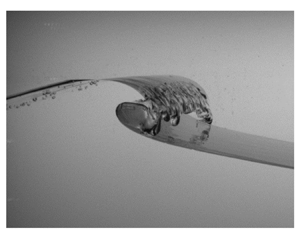
An experimental investigation of two-dimensional dispersively focused laboratory breaking waves is presented. We describe the bandwidth effect on breaking wave energetics, including spectral energy evolution, characteristic group velocity, energy dissipation and its rate, and breaking strength parameter, $b$. To evaluate the role of bandwidth, three definitions of wave group steepness are adopted where $S_s$ and $S_n$ are bandwidth-dependent and $S_p$ remains constant when bandwidth is changed. Our data show two regimes of spectral energy evolution in breaking wave groups, with both regimes bandwidth-dependent: energy dissipation and gain occur at $f > 0.95f_p$ ( $f_p$ is the peak frequency) and $f < 0.95f_p$, respectively. The characteristic group velocity, which is used in energy dissipation calculations, increases by up to 7 % after wave breaking, being larger for higher bandwidth breaking waves. An unambiguous bandwidth dependence is found between $S_p$ and both the fractional and absolute wave energy dissipation. Wave groups of larger bandwidth break at a lower value of $S_p$ and consequently lose relatively more energy. The energy dissipation rate depends on the breaking duration which itself is bandwidth dependent. Consequently, no clear bandwidth effect is observed in energy dissipation rate when compared with either $S_p$ or $S_s$. However, there is a systematic bandwidth dependence in the variation of $b$ when parameterised in terms of $S_p$, with their relationship becoming increasingly nonlinear as bandwidth increases. When parameterised with $S_s$, $b$ shows a markedly reduced bandwidth dependence. Finally, the numerical breaking onset and relationship between $b$ and $S_s$ in the numerical study of Derakhti & Kirby (J. Fluid Mech., vol. 790, 2016, pp. 553–581) is validated experimentally.


On the flow past ellipses in a Hele-Shaw cell
-
- Journal:
- Journal of Fluid Mechanics / Volume 971 / 25 September 2023
- Published online by Cambridge University Press:
- 13 September 2023, A12
-
- Article
-
- You have access
- Open access
- HTML
- Export citation
-
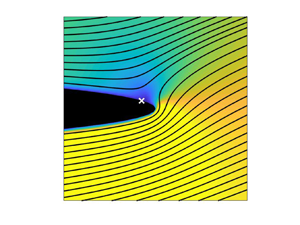
In this work we investigate the effect of vertical confinement and inertia on the flow past thin ellipses in a Hele-Shaw cell (with centre line velocity $U_c$ and height 2 $h$) with different aspect ratios for symmetrical flows and at an angle of attack, using asymptotic methods and numerical simulations. A Stokes region is identified at the ellipse vertices which results in flow different to flow past bluff bodies. Comparison with asymptotic analysis indicates close agreement over the ‘flat’ portion of the ellipse, for $\delta =(b/a)=0.05$, where $a$ and $b$ are the semi-major and -minor ellipse axes, respectively. Two flow conditions are investigated for ellipses at an angle of attack of 10 $^\circ$ for a fixed $\delta =0.05$. Firstly, for $\varLambda =(U_ca/\nu )(h/a)^2 \ll 1$, the effect of increasing the vertical confinement of the Hele-Shaw cell results in the rear stagnation point (RSP) moving from close to the potential-flow prediction when $\epsilon =h/a$ is very small to the two-dimensional Stokes-flow prediction when $\epsilon$ is large. Secondly, for a fixed $\epsilon \ll 1$, when inertia is increased past $\varLambda ={O}(\epsilon )$ the RSP moves towards the trailing edge and is located there for $\varLambda ={O}(1)$. Under these conditions an attached exponentially decaying shear layer or ‘viscous tail’ is formed. A modified Bernoulli equation of the depth-averaged flow, together with the Kutta–Joukowski theorem is used to predict the drag and lift coefficients on the ellipse, which include a linear and a nonlinear contribution, corresponding to a Hele-Shaw and circulation component, respectively. Close agreement is found up to $\varLambda ={O}(1)$.


Inviscid evolution of a uniform vortex dipole in a strain field
-
- Journal:
- Journal of Fluid Mechanics / Volume 971 / 25 September 2023
- Published online by Cambridge University Press:
- 12 September 2023, A6
-
- Article
-
- You have access
- Open access
- HTML
- Export citation
-
Competing models employing anti-parallel vortex collision in search of a finite-time singularity of Euler's equation have arisen recently. Both the vortex sheet model proposed by Brenner et al. (Phys. Rev. Fluids, vol. 1, 2016, 084503) and the ‘tent’ model proposed by Moffatt & Kimura (J. Fluid Mech., vol. 861, 2019, pp. 930–967) consider a vortex monopole exposed to a strain flow to model the evolution of interacting anti-parallel vortices, a fundamental element in the turbulent cascade. Herein we employ contour dynamics to explore the inviscid evolution of a vortex dipole subjected to an external strain flow with and without axial stretching. We find that for any strain-to-vorticity ratio $\mathcal {E}$, the constituent vortices compress indefinitely, with weaker strain flows causing flattening to occur more slowly. At low $\mathcal {E}$, the vortex dipole forms the well-documented head–tail structure, whereas increasing $\mathcal {E}$ results in the dipole compressing into a pair of vortex sheets with no appreciable head structure. Axial stretching effectively lowers $\mathcal {E}$ dynamically throughout the evolution, thus delaying the transition from the head–tail regime to the vortex sheet regime to higher strain-to-vorticity ratios. Findings from this study offer a bridge between the two cascade models, with the particular mechanism arising depending on $\mathcal {E}$. It also suggests limits for the ‘tent’ model for a finite-time singularity, wherein the curvature-induced strain flow must be very weak in comparison with the vorticity density-driven mutual attraction such that the convective time scale of the evolution exceeds the core flattening time scale.


