Refine search
Actions for selected content:
238152 results in Physics and Astronomy
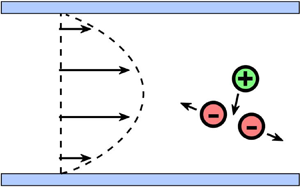
Shear dispersion of multispecies electrolyte solutions in the channel domain
-
- Journal:
- Journal of Fluid Mechanics / Volume 970 / 10 September 2023
- Published online by Cambridge University Press:
- 06 September 2023, A27
-
- Article
- Export citation
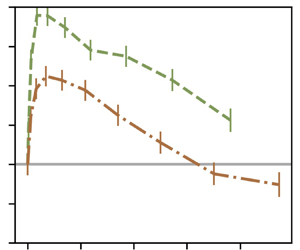
An experimental study on the settling velocity of inertial particles in different homogeneous isotropic turbulent flows
-
- Journal:
- Journal of Fluid Mechanics / Volume 970 / 10 September 2023
- Published online by Cambridge University Press:
- 04 September 2023, A23
-
- Article
-
- You have access
- Open access
- HTML
- Export citation
-
We propose an experimental study on the gravitational settling velocity of dense, sub-Kolmogorov inertial particles under different background turbulent flows. We report phase Doppler particle analyser measurements in a low-speed wind tunnel uniformly seeded with micrometre scale water droplets. Turbulence is generated with three different grids (two consisting of different active-grid protocols while the third is a regular static grid), allowing us to cover a very wide range of turbulence conditions in terms of Taylor-scale-based Reynolds numbers ( $Re_\lambda \in [30\unicode{x2013}520]$), Rouse numbers ( $Ro \in [0\unicode{x2013}5]$) and volume fractions ( $\phi _v \in [0.5\times 10^{-5}\unicode{x2013}2.0\times 10^{-5}]$). We find, in agreement with previous works, that enhancement of the settling velocity occurs at low Rouse number, while hindering of the settling occurs at higher Rouse number for decreasing turbulence energy levels. The wide range of flow parameters explored allowed us to observe that enhancement decreases significantly with the Taylor–Reynolds number and is significantly affected by the volume fraction $\phi _v$. We also studied the effect of large-scale forcing on settling velocity modification. The possibility of changing the inflow conditions by using different grids allowed us to test cases with fixed $Re_\lambda$ and turbulent intensity but with different integral length scale. Finally, we assess the existence of secondary flows in the wind tunnel and their role on particle settling. This is achieved by characterising the settling velocity at two different positions, the centreline and close to the wall, with the same streamwise coordinate.


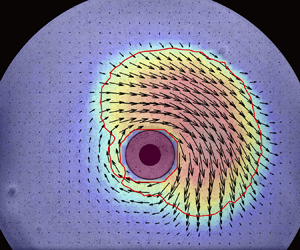
Drag of a shear-thickening suspension on a rotating cylinder
-
- Journal:
- Journal of Fluid Mechanics / Volume 970 / 10 September 2023
- Published online by Cambridge University Press:
- 04 September 2023, A35
-
- Article
- Export citation
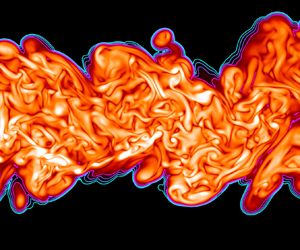
Length scales and the turbulent/non-turbulent interface of a temporally developing turbulent jet
-
- Journal:
- Journal of Fluid Mechanics / Volume 970 / 10 September 2023
- Published online by Cambridge University Press:
- 04 September 2023, A33
-
- Article
- Export citation
-
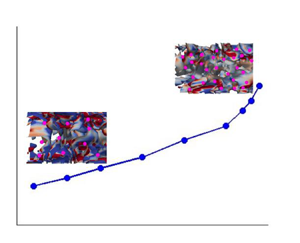
The temporally developing self-similar turbulent jet is fundamentally different from its spatially developing namesake because the former conserves volume flux and has zero cross-stream mean flow velocity whereas the latter conserves momentum flux and does not have zero cross-stream mean flow velocity. It follows that, irrespective of the turbulent dissipation's power-law scalings, the time-local Reynolds number remains constant, and the jet half-width $\delta$, the Kolmogorov length $\eta$ and the Taylor length $\lambda$ grow identically as the square root of time during the temporally developing self-similar planar jet's evolution. We predict theoretically and confirm numerically by direct numerical simulations that the mean centreline velocity, the Kolmogorov velocity and the mean propagation speed of the turbulent/non-turbulent interface (TNTI) of this planar jet decay identically as the inverse square root of time. The TNTI has an inner structure over a wide range of closely spatially packed iso-enstrophy surfaces with fractal dimensions that are well defined over a range of scales between $\lambda$ and $\delta$, and that decrease with decreasing iso-enstrophy towards values close to $2$ at the viscous superlayer. The smallest scale on these isosurfaces is approximately $\eta$, and the length scales between $\eta$ and $\lambda$ contribute significantly to the surface area of the iso-enstrophy surfaces without being characterised by a well-defined fractal dimension. A simple model is sketched for the mean propagation speeds of the iso-enstrophy surfaces within the TNTI of temporally developing self-similar turbulent planar jets. This model is based on a generalised Corrsin length, on the multiscale geometrical properties of the TNTI, and on a proportionality between the turbulent jet volume's growth rate and the growth rate of $\delta$. A prediction of this model is that the mean propagation speed at the outer edge of the viscous superlayer is proportional to the Kolmogorov velocity multiplied by the $1/4$th power of the global Reynolds number.


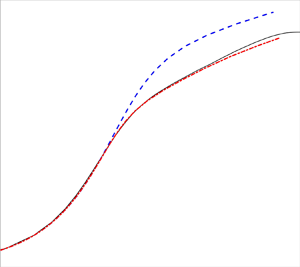
Near-wall model for compressible turbulent boundary layers based on an inverse velocity transformation
-
- Journal:
- Journal of Fluid Mechanics / Volume 970 / 10 September 2023
- Published online by Cambridge University Press:
- 04 September 2023, A36
-
- Article
-
- You have access
- Open access
- HTML
- Export citation
Stellarator–mirror fusion–fission hybrid – a fast route to clean and safe nuclear energy
-
- Journal:
- Journal of Plasma Physics / Volume 89 / Issue 4 / August 2023
- Published online by Cambridge University Press:
- 04 September 2023, 955890401
-
- Article
-
- You have access
- Open access
- HTML
- Export citation
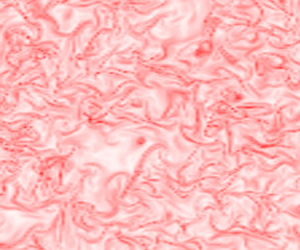
Investigation of Lagrangian Areas of Minimal Stretching (LAMS) in a turbulent boundary layer
-
- Journal:
- Journal of Fluid Mechanics / Volume 970 / 10 September 2023
- Published online by Cambridge University Press:
- 04 September 2023, A31
-
- Article
-
- You have access
- Open access
- HTML
- Export citation
-
In this paper the three-dimensional finite-time Lyapunov exponent (FTLE) field of a direct numerical simulation of a flat-plate turbulent boundary layer is analysed in several wall-parallel sections. The data consider a case at a low subsonic Mach number with a moderate positive pressure gradient in the streamwise direction. In contrast to other studies mainly focusing on the maxima of the FTLE field, particular emphasis is placed on the regions of minimal stretching between the vortices and shear layers of the three-dimensional turbulent flow field. These visually appear as contiguous islands or ‘valleys’ between the ‘ridges’ of the FTLE maxima, both at forward and backward integration of the flow field in time. To clearly distinguish the structures investigated from their more common counterparts (e.g. Lagrangian coherent structures, LCS), the acronym LAMS (Lagrangian areas of minimal stretching) is proposed to denote the associated cohesive fluid regions. Consistent with intuition, the largest LAMS occur near the boundary-layer edge, where large regions of homogeneous laminar external flow coexist with upwelling turbulent structures. Compensating for turbulent regions pushing upward, they sink from there down toward the wall, becoming smaller and longer. This process is associated with an increased relative velocity of the LAMS compared with the mean flow, which is observed over the whole boundary layer in the range $y^+ \gtrsim 10$. Furthermore, it is observed that the Q4 (sweep) events contained in the LAMS clearly dominate over Q2 (ejection) events above $y^+ \approx 10$. Thereby, local maxima occur at $y^+ \approx 20$ and near the boundary-layer edge. Below $y^+ \approx 10$, the relationship reverses. Sweeping LAMS from above $y^+ \approx 10$ and ejecting LAMS from below meet in the layer where the maximal vortical activity occurs. The latter is caused by mostly streamwise oriented vortices with maximal vortex stretching in the streamwise direction. Overall, LAMS are associated with cohesive fluid regions between the surrounding vortices and shear layers that both drop down from the boundary-layer edge toward the wall in the outer region of the boundary layer and lift from the wall in the near-wall region.


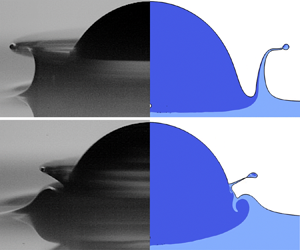
Droplet impact dynamics on shallow pools
-
- Journal:
- Journal of Fluid Mechanics / Volume 970 / 10 September 2023
- Published online by Cambridge University Press:
- 04 September 2023, A34
-
- Article
-
- You have access
- Open access
- HTML
- Export citation
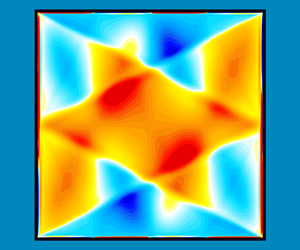
Superharmonic and triadic resonances in a horizontally oscillated stably stratified square cavity
-
- Journal:
- Journal of Fluid Mechanics / Volume 970 / 10 September 2023
- Published online by Cambridge University Press:
- 04 September 2023, A25
-
- Article
-
- You have access
- Open access
- HTML
- Export citation
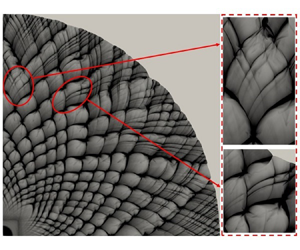
Direct detonation initiation in hydrogen/air mixture: effects of compositional gradient and hotspot condition
-
- Journal:
- Journal of Fluid Mechanics / Volume 970 / 10 September 2023
- Published online by Cambridge University Press:
- 04 September 2023, A22
-
- Article
- Export citation
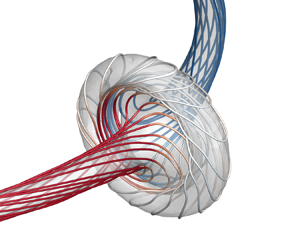
Role of internal structures within a vortex in helicity dynamics
-
- Journal:
- Journal of Fluid Mechanics / Volume 970 / 10 September 2023
- Published online by Cambridge University Press:
- 04 September 2023, A26
-
- Article
- Export citation
Energetic electron transport in magnetic fields with island chains and stochastic regions
-
- Journal:
- Journal of Plasma Physics / Volume 89 / Issue 4 / August 2023
- Published online by Cambridge University Press:
- 04 September 2023, 905890420
-
- Article
-
- You have access
- Open access
- HTML
- Export citation
-
This paper investigates energetic electron transport in magnetized toroidal plasmas with magnetic fields characterized by island chains and regions of stochastic field lines produced by coil perturbations. We report on experiments performed in the DIII-D tokamak, which utilize electron cyclotron heating and current drive pulses to ‘tag’ electron populations within different locations across the discharge. The cross-field transport of these populations is then inferred from electron cyclotron emission measurements and gamma emission signals from scintillator detectors. Two types of energetic particles are distinguished and discussed: non-relativistic suprathermal electrons and relativistic runaway electrons. The magnetic field topology in each discharge is reconstructed with field-line tracing codes, which are also used to determine the location and scale of magnetic islands and stochastic regions. Comparison of simulations and experiments suggests that suprathermal transport is suppressed when the tagging is performed at a smaller radial location than the location of the $q = 1$
 island chain and enhanced otherwise. Here q is the safety factor. We further demonstrate that increasing the width of the stochastic region within the edge plasma yields enhancement of the suprathermal electron transport.


Wind turbine wakes: experimental investigation of two-point correlations and the effect of stable thermal stability
-
- Journal:
- Journal of Fluid Mechanics / Volume 970 / 10 September 2023
- Published online by Cambridge University Press:
- 04 September 2023, A30
-
- Article
-
- You have access
- Open access
- HTML
- Export citation
-
Wind tunnel experiments are performed in both neutral and stable boundary layers to study the effect of thermal stability on the wake of a single turbine and on the wakes of two axially aligned turbines, thereby also showing the influence of the second turbine on the impinging wake. In the undisturbed stable boundary layers, the turbulence length scales are significantly smaller in the vertical and longitudinal directions (up to 50 % and $\approx$40 %, respectively), compared with the neutral flow, while the lateral length scale is unaffected. The reductions are larger with the imposed inversion of a second stable case, except in the near-wall region. In the neutral case, the length scales in the wake flow of the single turbine are reduced both vertically and laterally (up to 50 % and nearly 40 %, respectively). While there is significant upstream influence of a second turbine (on mean and turbulence quantities), there is virtually no upstream effect on vertical length scales. However, curiously, the presence of the second turbine aids length-scale recovery in both directions. Longitudinally, each turbine contributes to successive reduction in coherence. The effect of stability on the turbulence length scales in the wake flows is non-trivial: at the top of the boundary layer, the reduction in the wall-normal length scale is dominated by the thermal effect, while closer to the wall, the wake processes strongly modulate this reduction. Laterally, the turbines’ rotation promotes asymmetry, while stability opposes this tendency. The longitudinal coherence, significantly reduced by the wake flows, is less affected by the boundary layer's thermal stability.

Thermal equilibrium of collisional non-neutral plasma in a magnetic dipole trap – CORRIGENDUM
-
- Journal:
- Journal of Plasma Physics / Volume 89 / Issue 4 / August 2023
- Published online by Cambridge University Press:
- 04 September 2023, 945890403
-
- Article
-
- You have access
- Open access
- HTML
- Export citation
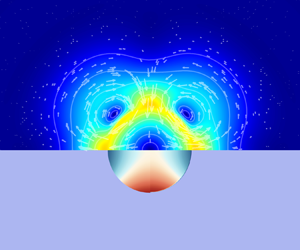
Numerical investigation of the sharp-interface limit of the Navier–Stokes–Cahn–Hilliard equations
-
- Journal:
- Journal of Fluid Mechanics / Volume 970 / 10 September 2023
- Published online by Cambridge University Press:
- 04 September 2023, A24
-
- Article
-
- You have access
- Open access
- HTML
- Export citation
-
In this article, we study the behaviour of the Abels–Garcke–Grün Navier–Stokes–Cahn– Hilliard diffuse-interface model for binary-fluid flows, as the diffuse-interface thickness passes to zero. For the diffuse-interface model to approach a classical sharp-interface model in the limit $\varepsilon \to +0$, the so-called mobility parameter $m$ in the diffuse-interface model must scale appropriately with the interface-thickness parameter $\varepsilon$. In the literature various scaling relations in the range $o(1)$ to $O(\varepsilon ^3)$ have been proposed, but the optimal order to pass to the limit has not been explored previously. Our primary objective is to elucidate this optimal order of the $m$–
$m$– $\varepsilon$ scaling relation in terms of the rate of convergence of the diffuse-interface solution to the sharp-interface solution. Additionally, we examine how the convergence rate is affected by a sub-optimal parameter scaling. We centre our investigation around the case of an oscillating droplet. To provide reference limit solutions, we derive new analytical expressions for small-amplitude oscillations of a viscous droplet in a viscous ambient fluid in two dimensions. For two distinct modes of oscillation, we probe the sharp-interface limit of the Navier–Stokes–Cahn–Hilliard equations by means of an adaptive finite-element method. The adaptive-refinement procedure enables us to consider diffuse-interface thicknesses that are significantly smaller than other relevant length scales in the droplet-oscillation problem, allowing an exploration of the asymptotic regime.


A mathematical model for the interaction of anisotropic turbulence with a rigid leading edge
-
- Journal:
- Journal of Fluid Mechanics / Volume 970 / 10 September 2023
- Published online by Cambridge University Press:
- 04 September 2023, A29
-
- Article
-
- You have access
- Open access
- HTML
- Export citation
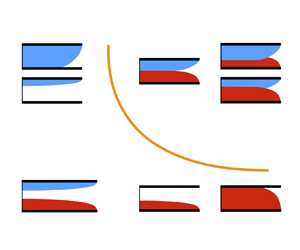
The interaction of gravity currents in a porous layer with a finite edge
-
- Journal:
- Journal of Fluid Mechanics / Volume 970 / 10 September 2023
- Published online by Cambridge University Press:
- 04 September 2023, A37
-
- Article
- Export citation
Assessment of local isotropy, energetics, and modified eddy-viscosity based modelling for particle-laden turbulent channel flows
-
- Journal:
- Journal of Fluid Mechanics / Volume 970 / 10 September 2023
- Published online by Cambridge University Press:
- 04 September 2023, A32
-
- Article
-
- You have access
- Open access
- HTML
- Export citation
Acoustic and gravity waves in the ocean: a new derivation of a linear model from the compressible Euler equation
-
- Journal:
- Journal of Fluid Mechanics / Volume 970 / 10 September 2023
- Published online by Cambridge University Press:
- 04 September 2023, A28
-
- Article
-
- You have access
- Open access
- HTML
- Export citation

Theory of Liquids
- From Excitations to Thermodynamics
-
- Published online:
- 01 September 2023
- Print publication:
- 17 August 2023
