Refine search
Actions for selected content:
238152 results in Physics and Astronomy
2 - Wave Propagation
-
- Book:
- Physics and Engineering of Graded-Index Media
- Published online:
- 27 July 2023
- Print publication:
- 10 August 2023, pp 19-54
-
- Chapter
- Export citation
F - Quantum Electromagnetic Field
-
- Book:
- Quantum Processes and Measurement
- Published online:
- 27 July 2023
- Print publication:
- 10 August 2023, pp 231-239
-
- Chapter
- Export citation
List of Acronyms
-
- Book:
- Physics and Engineering of Graded-Index Media
- Published online:
- 27 July 2023
- Print publication:
- 10 August 2023, pp xv-xvi
-
- Chapter
- Export citation
D - Qubits
-
- Book:
- Quantum Processes and Measurement
- Published online:
- 27 July 2023
- Print publication:
- 10 August 2023, pp 222-226
-
- Chapter
- Export citation
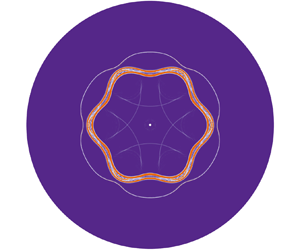
Instability evolution of a shock-accelerated thin heavy fluid layer in cylindrical geometry
-
- Journal:
- Journal of Fluid Mechanics / Volume 969 / 25 August 2023
- Published online by Cambridge University Press:
- 10 August 2023, A6
-
- Article
- Export citation
-
Instability evolutions of shock-accelerated thin cylindrical SF $_6$ layers surrounded by air with initial perturbations imposed only at the outer interface (i.e. the ‘Outer’ case) or at the inner interface (i.e. the ‘Inner’ case) are numerically and theoretically investigated. It is found that the instability evolution of a thin cylindrical heavy fluid layer not only involves the effects of Richtmyer–Meshkov instability, Rayleigh–Taylor stability/instability and compressibility coupled with the Bell–Plesset effect, which determine the instability evolution of the single cylindrical interface, but also strongly depends on the waves reverberated inside the layer, thin-shell correction and interface coupling effect. Specifically, the rarefaction wave inside the thin fluid layer accelerates the outer interface inward and induces the decompression effect for both the Outer and Inner cases, and the compression wave inside the fluid layer accelerates the inner interface inward and causes the decompression effect for the Outer case and compression effect for the Inner case. It is noted that the compressible Bell model excluding the compression/decompression effect of waves, thin-shell correction and interface coupling effect deviates significantly from the perturbation growth. To this end, an improved compressible Bell model is proposed, including three new terms to quantify the compression/decompression effect of waves, thin-shell correction and interface coupling effect, respectively. This improved model is verified by numerical results and successfully characterizes various effects that contribute to the perturbation growth of a shock-accelerated thin heavy fluid layer.

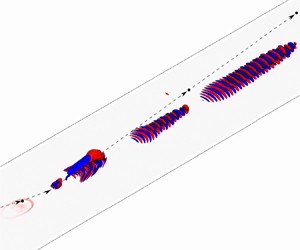
Biorthogonal decomposition of the disturbance flow field generated by particle impingement on a hypersonic boundary layer
-
- Journal:
- Journal of Fluid Mechanics / Volume 969 / 25 August 2023
- Published online by Cambridge University Press:
- 10 August 2023, A1
-
- Article
-
- You have access
- Open access
- HTML
- Export citation
-
The disturbance flow field in a hypersonic boundary layer excited by particle impingement was investigated with a focus on the first stage of the laminar-to-turbulent transition process, namely the receptivity process. A previously validated direct numerical simulation approach adopting disturbance flow tracking is used to simulate the particle-induced transition process. Particle impingement generates a highly complex disturbance flow field that can be characterised by a wide range of frequencies and wavenumbers. After providing some insight about the spectral characteristics of the disturbance flow field in the frequency and wavenumber domains, biorthogonal decomposition is employed to reveal the composition of the disturbance flow field consisting of different continuous and discrete eigenmodes that are triggered through particle impingement. The disturbance flow characteristics for different frequency and wavenumber pairs are discussed where large contributions in the disturbance flow spectrum are observed in the vicinity of the impingement location. A significant amount of the disturbance energy is diverted into the free stream leading to large coefficients of projection for the slow and fast acoustic branches while contributions to the entropy and vorticity branches are negligible. In addition to the continuous acoustic spectra, the first-, second- and other higher-order Mack modes are activated and provide large contributions to the disturbance flow field inside the boundary layer. Finally, it is demonstrated that the disturbance flow field in the vicinity of the impingement location can be reconstructed with a maximum relative error of $2.3\,\%$ by employing a theoretical biorthogonal eigenfunction system expansion and by considering contributions from fast and slow acoustic waves and at most four discrete modes only.

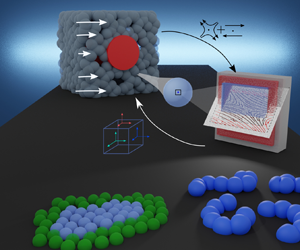
Generalized Lagrangian heterogeneous multiscale modelling of complex fluids
-
- Journal:
- Journal of Fluid Mechanics / Volume 969 / 25 August 2023
- Published online by Cambridge University Press:
- 10 August 2023, A2
-
- Article
- Export citation
7 - Nonuniform GRIN Media
-
- Book:
- Physics and Engineering of Graded-Index Media
- Published online:
- 27 July 2023
- Print publication:
- 10 August 2023, pp 214-240
-
- Chapter
- Export citation
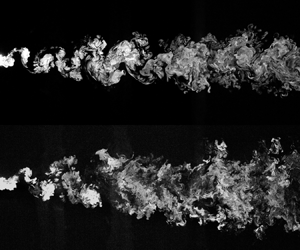
Spatial evolution of the turbulent/turbulent interface geometry in a cylinder wake
-
- Journal:
- Journal of Fluid Mechanics / Volume 969 / 25 August 2023
- Published online by Cambridge University Press:
- 10 August 2023, A4
-
- Article
- Export citation
-
This study aims to examine the spatial evolution of the geometrical features of the turbulent/turbulent interface (TTI) in a cylinder wake. The wake is exposed to various turbulent backgrounds in which the turbulence intensity and the integral length scale are varied independently, and comparisons to a turbulent/non-turbulent interface (TNTI) are drawn. The turbulent wake was marked with a high Schmidt number ( $Sc$) scalar, and a planar laser induced fluorescence experiment was carried out to capture the interface between the wake and the ambient flow from $x/d = 5$ to 40, where $x$ is the streamwise coordinate from the centre of the cylinder, and $d$ is the cylinder's diameter. It is found that the TTI generally spreads faster towards the ambient flow than the TNTI. A transition region of the interfaces’ spreading is found at $x/d \approx 15$, after which the interfaces propagate at a slower rate than previously (upstream), and the mean interface positions of both the TNTI and TTI scale with the local wake half-width. The locations of both the TNTI and TTI have non-Gaussian probability density functions (PDFs) in the near wake because of the influence of the large-scale coherent motions present within the flow. Further downstream, after the large-scale coherent motions have dissipated, the TNTI position PDF does become Gaussian. For the first time, we explore the spatial variation of the ‘roughness’ of the TTI, quantified via the fractal dimension, from near field to far field. The length scale in the background flow has a profound effect on the TTI fractal dimension in the near wake, whilst the turbulence intensity becomes important only for the fractal dimension farther downstream.


3 - Experiment: Quantum Processes
-
- Book:
- Quantum Processes and Measurement
- Published online:
- 27 July 2023
- Print publication:
- 10 August 2023, pp 33-43
-
- Chapter
- Export citation
C - Description of Composite Systems
-
- Book:
- Quantum Processes and Measurement
- Published online:
- 27 July 2023
- Print publication:
- 10 August 2023, pp 218-221
-
- Chapter
- Export citation
Moment-based approach to the flux-tube linear gyrokinetic model
-
- Journal:
- Journal of Plasma Physics / Volume 89 / Issue 4 / August 2023
- Published online by Cambridge University Press:
- 10 August 2023, 905890414
-
- Article
-
- You have access
- Open access
- HTML
- Export citation
8 - Experiment: Continuous Quantum Fluctuations
-
- Book:
- Quantum Processes and Measurement
- Published online:
- 27 July 2023
- Print publication:
- 10 August 2023, pp 135-141
-
- Chapter
- Export citation
3 - Focusing and Self-Imaging
-
- Book:
- Physics and Engineering of Graded-Index Media
- Published online:
- 27 July 2023
- Print publication:
- 10 August 2023, pp 55-83
-
- Chapter
- Export citation
Frontmatter
-
- Book:
- Quantum Processes and Measurement
- Published online:
- 27 July 2023
- Print publication:
- 10 August 2023, pp i-iv
-
- Chapter
- Export citation
Influence of ion and variable dust charge on electron-dust bremsstrahlung emission spectrum in complex plasmas
-
- Journal:
- Journal of Plasma Physics / Volume 89 / Issue 4 / August 2023
- Published online by Cambridge University Press:
- 10 August 2023, 455890401
-
- Article
- Export citation
Index
-
- Book:
- Quantum Processes and Measurement
- Published online:
- 27 July 2023
- Print publication:
- 10 August 2023, pp 301-304
-
- Chapter
- Export citation
Contents
-
- Book:
- Quantum Processes and Measurement
- Published online:
- 27 July 2023
- Print publication:
- 10 August 2023, pp v-x
-
- Chapter
- Export citation
Index
-
- Book:
- Physics and Engineering of Graded-Index Media
- Published online:
- 27 July 2023
- Print publication:
- 10 August 2023, pp 342-348
-
- Chapter
- Export citation
10 - Photonic Crystals and Metamaterials
-
- Book:
- Physics and Engineering of Graded-Index Media
- Published online:
- 27 July 2023
- Print publication:
- 10 August 2023, pp 292-314
-
- Chapter
- Export citation
